AI Fundamentals
What are Neural Networks?

 Add Unite.AI to your preferred sources on Google

An artificial neural network is a parameterized mathematical model made from layers of connected operations. During training, the network adjusts its parameters so that inputs are mapped to useful outputs. Neural networks can approximate complex nonlinear relationships and learn representations directly from text, images, audio, time series, and other data.
The name is historically inspired by biological neurons, but modern networks are engineering systems rather than realistic simulations of the brain. Terms such as “neuron” and “learning” are helpful shorthand and should not be mistaken for evidence of human-like cognition.
Key takeaways
- A neuron computes a weighted sum, adds a trainable bias, and applies an activation function.
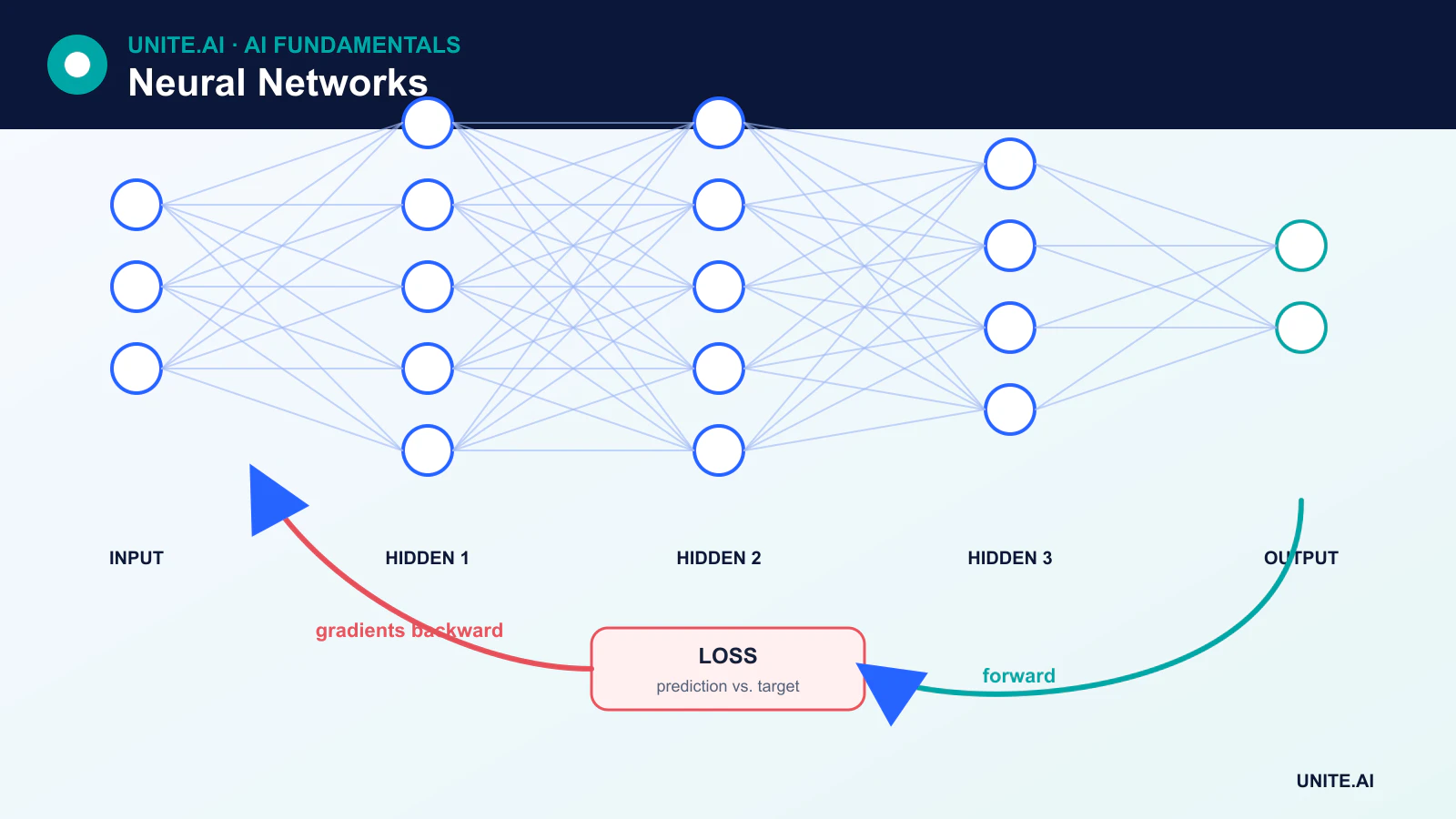
- A forward pass creates predictions; a loss measures error; backpropagation computes gradients; an optimizer updates parameters.
- MLPs, CNNs, RNNs, and transformers organize connections differently.
- More layers or parameters do not automatically produce a better or more trustworthy model.
From a single artificial neuron to a network
For an input vector x, a basic unit computes:
z = Wx + boutput = activation(z)
W contains trainable weights and b is a trainable bias. The activation function introduces nonlinearity. The weights do not “pass through” the activation on their own; the activation is applied to the weighted sum and bias.
A multilayer perceptron (MLP) stacks dense layers. The input layer represents the features, hidden layers transform them, and the output layer is designed for the task—for example, class logits or a regression value.
How neural networks learn
- The model initializes trainable parameters.
- A forward pass processes a batch and produces predictions.
- A loss function compares predictions with the training objective.
- Backpropagation uses the chain rule to compute gradients.
- An optimizer such as stochastic gradient descent or AdamW updates weights and biases.
Backpropagation became central to neural-network training through work developed and popularized across several decades; it was not first created in the recent deep-learning era. Modern frameworks implement reverse-mode automatic differentiation so practitioners do not manually derive every gradient.
Why activation functions matter
Without nonlinear activations, multiple ordinary linear layers collapse into one linear transformation. ReLU is widely used because it is simple and efficient. GELU and SiLU are common in modern architectures. Sigmoid and softmax remain useful for particular output interpretations, but sigmoid can saturate in hidden layers and contribute to vanishing gradients.
Major neural-network architectures
Convolutional neural networks
CNNs apply learned filters across local neighborhoods and share parameters across positions. These properties make them efficient for images and other grid-like signals.
Recurrent networks
RNNs, LSTMs, and GRUs update a hidden state over a sequence. They remain useful for streaming and time-series tasks, although recurrence limits parallel processing and can struggle with long dependencies.
Transformers
Transformers use attention to create context-dependent representations. Residual connections, normalization, position information, and feed-forward blocks are core parts of the architecture. Transformers now underpin many large language and multimodal models.
Autoencoders and generative networks
Autoencoders learn representations through reconstruction. GANs, diffusion models, and autoregressive networks generate new samples using different objectives and training procedures.
Components that make deep networks trainable
Modern systems use more than layers and activations. Residual connections let information and gradients bypass blocks. Normalization stabilizes activations. Regularization, data augmentation, dropout, and weight decay can reduce overfitting. Embedding layers map discrete items such as tokens to vectors. Attention lets a representation depend dynamically on other elements.
Strengths and limitations
Neural networks can learn features from high-dimensional raw data and scale with data and compute. They can also require large datasets, specialized hardware, and careful tuning. Their predictions may be poorly calibrated, brittle under distribution shift, vulnerable to adversarial manipulation, or difficult to explain.
Architecture should follow the task and deployment constraints. For many tabular problems, a tree ensemble or linear model can be faster and easier to validate. For high-stakes applications, model performance must be evaluated by subgroup and failure mode, not only by an aggregate benchmark.
Layers, activations, and information flow
A neural network composes parameterized functions. Each unit forms a weighted combination of inputs, adds a bias, and passes the result through an activation such as ReLU, sigmoid, tanh, or GELU. Stacking layers allows hierarchical features and nonlinear decision boundaries. Width controls units per layer; depth controls successive transformations; connectivity and weight sharing encode architecture. The network’s output depends on preprocessing, parameters, normalization, and inference mode together. A neuron is a mathematical operation, not a literal biological neuron or an independently meaningful concept.
Forward propagation computes predictions; a loss quantifies error; backpropagation applies the chain rule to gradients; an optimizer updates parameters. Initialization, learning rate, batch statistics, residual paths, and normalization affect whether gradients vanish, explode, or remain useful. Regularization includes weight decay, dropout, augmentation, early stopping, and architectural constraints. Plot training and validation behavior, inspect gradient and activation statistics, and compare repeated runs. A large network can memorize training data, while a small one can underfit or miss necessary structure.
Architecture selection, evaluation, and deployment
Multilayer perceptrons process fixed vectors; convolutional networks exploit local structure; recurrent and state-space models process sequences; transformers use attention; graph networks exchange information along edges. Hybrids are common. Choose based on inductive bias, data, sequence or image size, latency, memory, interpretability, and available hardware. Evaluate against a linear or tree baseline and perform ablations to learn which complexity matters. Parameter count alone does not predict quality, inference cost, or data requirement.
Serving requires frozen preprocessing, an exported or compiled graph, numeric validation, and resource tests at realistic load. Quantization and pruning can reduce size but may alter rare-class behavior. Monitor inputs, outputs, calibration, latency, and confirmed outcomes; test adversarial and shifted data. Protect models, dependencies, and data through signed artifacts, access control, and supply-chain review. Explanations from individual activations or saliency require causal and behavioral verification. Neural networks are flexible function approximators, not guarantees of understanding, truth, or robustness.
Worked example: a neural demand forecaster
A retailer predicts weekly item demand from sales, promotions, price, holidays, availability, and weather. The network is compared with seasonal-naive, linear, and tree baselines using rolling time splits. Future promotions are included only when genuinely known at forecast time, while stockouts are modeled because observed sales can understate demand. Evaluation uses weighted absolute error, bias, interval coverage, and results by item velocity and store.
The serving pipeline versions feature availability, model, and horizon and refuses a forecast when required inputs are stale. Planners see intervals and can override with recorded reasons. Monitoring detects missing feeds, changing error, bias, and unusual forecasts; business outcomes are separated from forecast accuracy because ordering policy also affects inventory. A model update is shadowed across several cycles, and the prior forecaster remains available for rollback during seasonal or supplier disruption.
Implementation evidence and operational readiness
A production decision needs more than a successful demonstration. Define the intended users, operating environment, inputs, outputs, dependencies, owner, and the consequence of each important failure. Establish a reproducible baseline and a versioned evaluation set before tuning. Test ordinary cases, boundary conditions, malformed or missing input, distribution shift, dependency outage, misuse, and the groups or environments most likely to be underserved. Measure task quality together with calibration or uncertainty, latency, throughput, resource cost, accessibility, privacy, and security. Record every transformation and threshold so an independent reviewer can reproduce the result and distinguish evidence from an attractive prototype.
Before launch, assign authority for release, exceptions, changes, rollback, and retirement. Use a staged rollout, preserve a safe fallback, and verify monitoring with deliberately injected failures. Operational telemetry should reveal input quality, output behavior, model or rule version, dependency health, human overrides, and confirmed outcomes without collecting unnecessary sensitive data. Define alert thresholds and a response owner, then review real-world evidence after deployment rather than assuming offline performance will persist. Reevaluate whenever data sources, users, models, vendors, policies, hardware, or objectives change. A maintained system also needs documented recovery, incident learning, deletion and retention procedures, and a clear point at which it should be disabled or replaced.
Frequently asked questions
Is every neural network deep learning?
No. A small network with one hidden layer is a neural network, while deep learning generally refers to architectures with multiple learned processing stages. The boundary is conventional rather than a strict scientific threshold.
Do neural networks store their training data?
They store learned parameters, not an ordinary searchable copy of the dataset. Nevertheless, large models can memorize and reproduce individual training examples, which creates privacy and copyright risks that must be tested.
Primary references