AI Fundamentals
What is Deep Learning?

 Add Unite.AI to your preferred sources on Google
Deep learning is a family of machine-learning methods that uses neural networks with multiple processing layers to learn useful representations of data. These models power many modern systems for language, images, audio, recommendations, scientific prediction, and generative AI.
The word deep refers to the number of transformations between input and output, not to a machine possessing deeper understanding. A deep model learns numerical relationships that are useful for its training objective, and its performance must still be tested on new data.
Key takeaways
- Deep learning is a subset of machine learning.
- Layers transform tensors using learned parameters, nonlinear activations, normalization, and other operations.
- Backpropagation computes gradients; an optimizer uses those gradients to update trainable parameters, including weights and biases.
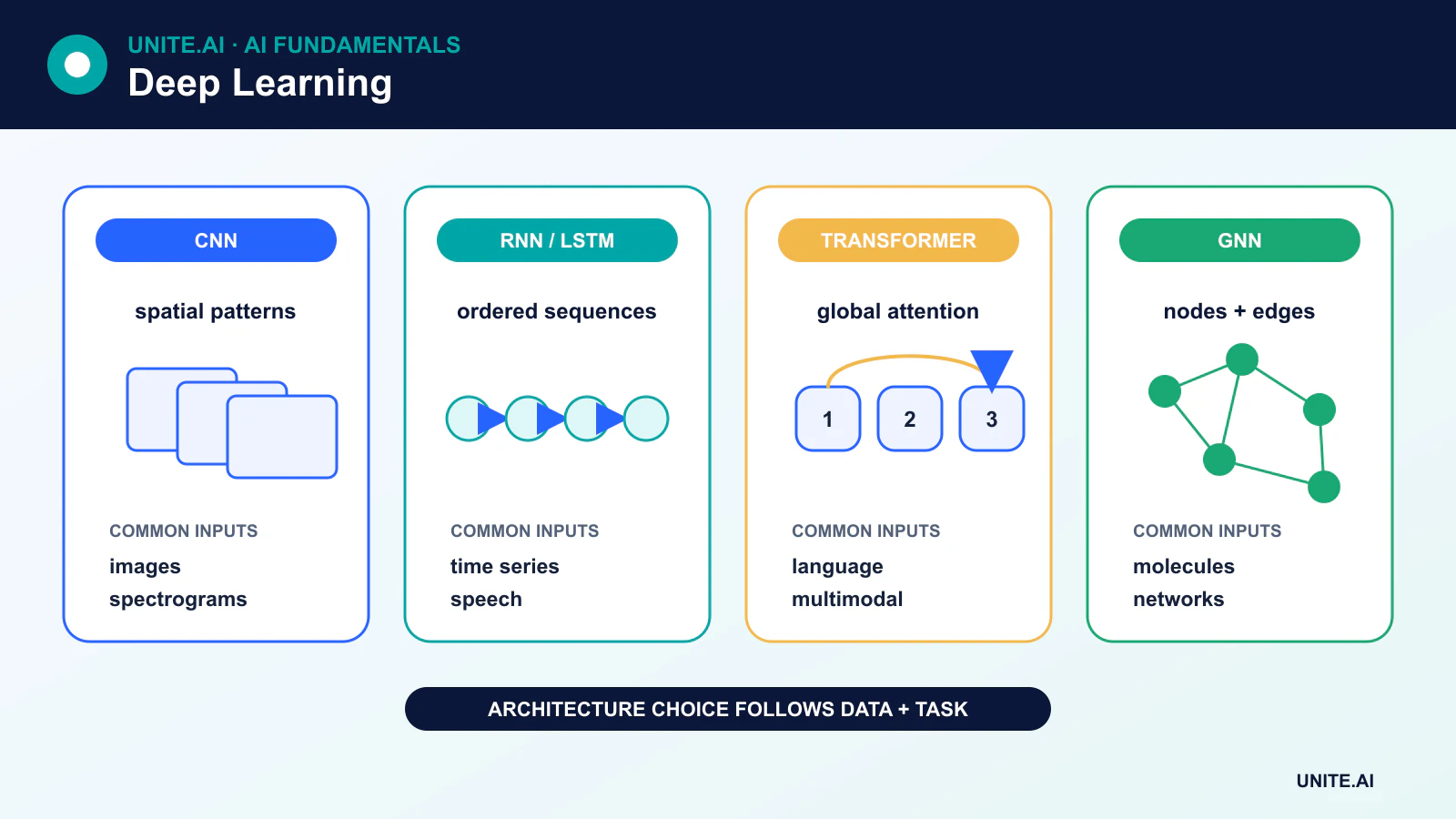
- CNNs, recurrent networks, transformers, autoencoders, and diffusion models have different structures and strengths.
How a deep neural network learns
A neural network receives data as tensors, or multidimensional arrays of numbers. An image tensor may encode pixel channels, while a language model uses vectors representing tokens. Each layer performs a differentiable transformation and passes the result to the next layer.
In a basic dense layer, the model calculates a weighted sum of its inputs, adds a trainable bias, and then applies an activation function:
output = activation(Wx + b)
The activation function introduces nonlinearity. Without it, stacking ordinary linear layers would still represent only a linear transformation. ReLU and its variants are common in hidden layers, while output activations depend on the task.
Training typically follows four steps:
- A forward pass produces predictions.
- A loss function measures how the predictions differ from the objective.
- Backpropagation applies the chain rule to compute the gradient of the loss with respect to each trainable parameter.
- An optimizer such as stochastic gradient descent or AdamW updates the parameters.
Repeating these steps over many batches can improve the model, but lower training loss does not guarantee reliable real-world behavior. Validation, regularization, representative data, and monitoring remain essential.
Major deep-learning architectures
Multilayer perceptrons
A multilayer perceptron (MLP) uses fully connected layers in which each output unit depends on all inputs from the preceding layer. MLPs are useful for tabular features and as components inside larger systems, but they do not build in assumptions about image locality or sequence order.
Convolutional neural networks
Convolutional neural networks (CNNs) apply learned filters across local regions. Weight sharing makes them efficient for grids such as images and spectrograms. CNNs remain important for vision and edge deployment, although vision transformers and hybrid models are also widely used.
Recurrent networks, LSTMs, and GRUs
Recurrent neural networks (RNNs) update a hidden state as a sequence is processed. LSTMs and gated recurrent units help preserve information and reduce the vanishing-gradient problem that makes basic RNNs struggle with long dependencies. They do not eliminate every long-context limitation, but they remain useful for streaming signals, time-series data, and compact sequential models.
Transformers
Transformers use attention to model relationships among elements of a sequence or set. Their ability to process many positions in parallel helped them replace recurrence in most large-scale language systems, and transformer variants now process images, audio, video, proteins, and multimodal data.
Autoencoders and generative models
An autoencoder compresses an input into a representation and reconstructs the input from it. This creates a self-supervised reconstruction objective; it does not automatically convert unlabeled data into labeled examples.
Generative adversarial networks train a generator and discriminator in competition. Diffusion models learn to reverse a gradual noising process. Autoregressive transformers generate one token or unit at a time. These approaches have different training dynamics, controllability, and compute requirements.
Why depth helps—and why architecture matters
Multiple layers let a model compose simpler transformations into more complex ones. In vision, some learned features may progress from local textures toward task-specific patterns. In language, attention layers build context-dependent token representations. These descriptions are useful intuitions, not fixed rules for what every layer must learn.
Modern networks also rely on residual connections, normalization, careful initialization, regularization, and optimized hardware. Simply adding layers or parameters can make a model harder to train, slower, or more prone to overfitting. Model scale helps only when the data, objective, optimization, and deployment setting support it.
Training versus inference
Training adjusts parameters and is usually the compute-intensive stage. Inference runs the trained model to produce an output. Inference can still be expensive for large models, which is why teams use quantization, distillation, batching, caching, sparsity, and specialized hardware such as neural processing units.
Limitations and responsible use
Deep models can inherit bias, memorize sensitive information, fail under distribution shift, and produce convincing but incorrect outputs. They can also be difficult to interpret and costly to train. Evaluation should cover more than a benchmark average: teams need class- or subgroup-level performance, robustness, calibration, security, latency, energy use, and the consequences of failure.
Representations, optimization, and architecture choices
Deep networks learn successive representations through parameterized layers. Linear transformations mix inputs; nonlinear activations allow the network to approximate complex functions; normalization and residual connections help optimization; attention, convolution, recurrence, or state-space operations encode different structural assumptions. Depth increases the number of transformations, not guaranteed intelligence. Architecture should reflect the modality, data volume, latency, memory, and invariances of the task. A smaller convolutional model may outperform a transformer when data is limited and local spatial structure dominates.
Training computes a loss, differentiates it with backpropagation, and updates parameters with an optimizer such as stochastic gradient descent or Adam. Batch size, learning rate, schedule, initialization, regularization, and numeric precision interact. Curves for training and validation loss help distinguish underfitting, overfitting, instability, and leakage, but they do not establish real-world usefulness. Use independent evaluation data, repeated runs where variance matters, ablations, and comparison with simpler baselines. Large parameter counts also increase the need for data governance, compute planning, and reproducible configuration.
Serving deep models safely and efficiently
Deployment can use a hosted endpoint, dedicated accelerator, browser, phone, or embedded device. Export and compilation may fuse operators, quantize weights and activations, or change numeric behavior, so validate the deployed artifact rather than only the training checkpoint. Measure cold start, steady latency, throughput, memory, power, and quality at realistic batch and sequence sizes. Compression methods—pruning, distillation, quantization, and low-rank adaptation—trade size or speed against accuracy and engineering complexity and must be assessed on sensitive classes and edge cases.
Deep models can fail confidently under distribution shift, adversarial input, spurious correlation, and poorly represented groups. Monitor input and output distributions, task outcomes, calibration, resource use, and dependency versions. Use access control, signed artifacts, protected training data, red teaming, and rate limits appropriate to the threat model. Explanations such as saliency maps or attention views are diagnostic evidence, not proof of causation. Combine them with behavioral tests, counterfactuals, human review, incident response, and explicit limits on automated decisions.
Worked example: training an image defect detector
A factory gathers product images across cameras, shifts, materials, and known defect classes, then splits by production batch so near-duplicate items cannot cross partitions. A small convolutional baseline is compared with a pretrained deep network. Augmentation reproduces validated lighting and viewpoint variation without erasing defects. Evaluation reports per-defect recall, false-reject rate, calibration, inference latency, and robustness to blur, glare, camera replacement, and rare material colors.
The exported model and exact resize, color, and normalization code are tested on the line hardware for sustained throughput and thermal behavior. Low-confidence cases go to inspectors; an independent rule stops the line for safety-critical sensor failure. Images are retained only as permitted and model artifacts are signed. Monitoring connects predictions to later inspection outcomes and production lots. A new camera or material triggers a controlled reevaluation rather than silent online learning from unreviewed labels.
Implementation evidence and operational readiness
A production decision needs more than a successful demonstration. Define the intended users, operating environment, inputs, outputs, dependencies, owner, and the consequence of each important failure. Establish a reproducible baseline and a versioned evaluation set before tuning. Test ordinary cases, boundary conditions, malformed or missing input, distribution shift, dependency outage, misuse, and the groups or environments most likely to be underserved. Measure task quality together with calibration or uncertainty, latency, throughput, resource cost, accessibility, privacy, and security. Record every transformation and threshold so an independent reviewer can reproduce the result and distinguish evidence from an attractive prototype.
Before launch, assign authority for release, exceptions, changes, rollback, and retirement. Use a staged rollout, preserve a safe fallback, and verify monitoring with deliberately injected failures. Operational telemetry should reveal input quality, output behavior, model or rule version, dependency health, human overrides, and confirmed outcomes without collecting unnecessary sensitive data. Define alert thresholds and a response owner, then review real-world evidence after deployment rather than assuming offline performance will persist. Reevaluate whenever data sources, users, models, vendors, policies, hardware, or objectives change. A maintained system also needs documented recovery, incident learning, deletion and retention procedures, and a clear point at which it should be disabled or replaced.
Primary references