
Robotics & Physical AI
Siemens, NVIDIA, and Humanoid Bring Physical AI to the Factory Floor

 Add Unite.AI to your preferred sources on Google
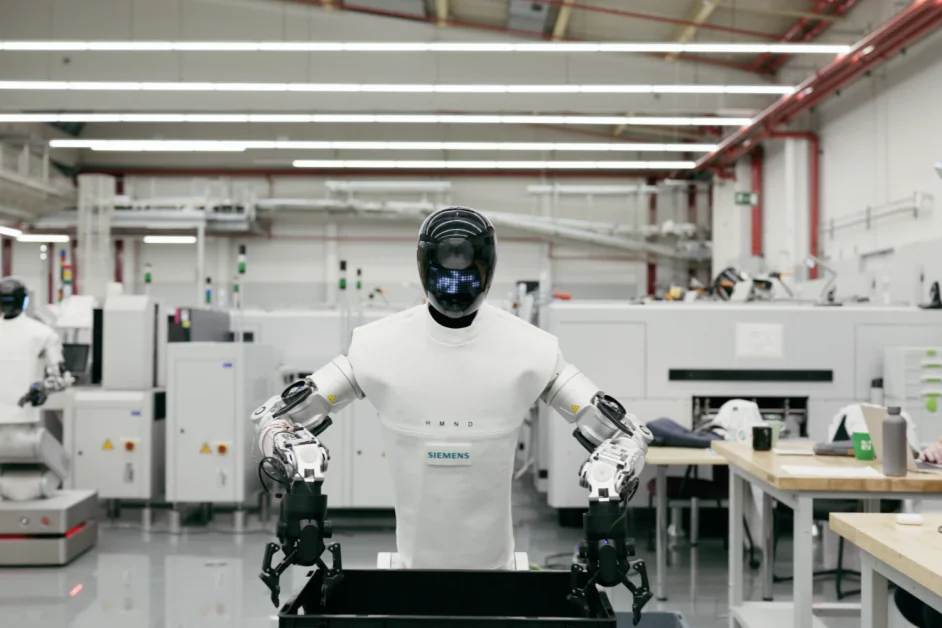
A new milestone in industrial AI is unfolding on the factory floor. Siemens, working alongside NVIDIA (NVDA ) and UK-based robotics firm Humanoid, has successfully deployed a humanoid robot inside a live production environment. The test took place at Siemens’ electronics facility in Erlangen, Germany, where the HMND 01 Alpha robot performed real operational tasks within an active workflow rather than a controlled demonstration.
The Shift Toward Physical AI
The significance of this deployment lies in what it represents. Physical AI refers to systems that move beyond digital environments and operate directly in the real world, where conditions are constantly changing and far less predictable. Manufacturing has long exposed the limits of traditional automation, which thrives in structured settings but struggles when variability and human interaction are introduced. This new generation of AI-driven machines is designed to adapt in those environments, closing the gap between intelligence and execution.
What makes this moment particularly notable is that it brings together three previously separate domains. High-performance AI infrastructure, advanced robotics hardware, and industrial automation systems have historically evolved in parallel. This collaboration demonstrates what happens when those layers are tightly integrated, creating systems that can both think and act in complex environments.
Real-World Performance on the Factory Floor
The HMND 01 Alpha was integrated into Siemens’ logistics operations, where it handled tote movement tasks essential to maintaining production flow. It autonomously picked, transported, and placed containers for human operators while maintaining performance levels that align with real industrial expectations. The robot achieved a throughput of roughly 60 tote movements per hour, maintained uptime exceeding a full shift, and delivered high success rates in pick-and-place operations.
These metrics matter because they reflect real production constraints. Factories are not forgiving environments, and even small inefficiencies can ripple across entire supply chains. The fact that a humanoid system can operate within those constraints suggests that the technology is beginning to meet the reliability threshold required for broader adoption.
A Closer Look at the HMND 01 Alpha
The HMND 01 Alpha represents a different approach to humanoid robotics than what is often seen in research labs. Rather than focusing on bipedal walking or human-like motion for its own sake, the system is designed with industrial practicality in mind. Its omnidirectional wheeled base allows for stable and efficient movement across factory floors, while its upper body is optimized for manipulation tasks such as grasping, lifting, and placing objects.
This hybrid design reflects a growing realization in robotics that functionality often outweighs form. In industrial settings, stability, endurance, and precision are more valuable than perfectly mimicking human movement. The robot’s manipulation capabilities are powered by a proprietary AI framework developed by Humanoid, enabling it to adapt to different tasks and environments without requiring constant reprogramming.
The system is also designed to operate in human-centric spaces. Instead of replacing workers outright, it is intended to function alongside them, taking over repetitive or physically demanding tasks while integrating into existing workflows. This collaborative model is increasingly seen as the most viable path for deploying robotics at scale in industries where full automation remains impractical.
The Evolution of Humanoid Robotics
Humanoid robotics has a long and often uneven history. Early systems were primarily experimental, built to explore mobility and balance rather than deliver commercial value. Over time, companies and research institutions introduced more advanced prototypes, but most remained confined to controlled environments due to limitations in perception, control, and adaptability.
In recent years, that trajectory has begun to shift. Advances in AI, particularly in areas such as computer vision and reinforcement learning, have enabled robots to better understand and interact with their surroundings. At the same time, improvements in simulation have allowed developers to train and refine systems virtually before deploying them in the real world.
The HMND 01 Alpha sits at the intersection of these trends. It reflects a move away from purely experimental humanoids toward systems designed for specific, high-value applications. Rather than trying to solve every problem at once, the focus is on delivering reliable performance in targeted use cases, with logistics and material handling emerging as early entry points.
Integration as the Critical Layer
The robot itself is only part of the story. Its value comes from being embedded into a broader industrial ecosystem. Siemens provides this layer through its Xcelerator platform, which connects machines, systems, and workflows across the factory. This allows the robot to exchange data in real time, coordinate with other equipment, and adapt its behavior based on shifting conditions.
This level of integration is essential for scaling humanoid robotics beyond isolated deployments. Without it, even advanced systems remain standalone tools. With it, they become part of a coordinated production environment where decisions and actions are continuously aligned across the entire operation.
Accelerating Development with NVIDIA
NVIDIA’s contribution centers on how quickly these systems can be built and deployed. By using a simulation-first approach powered by its physical AI stack, including tools for virtual testing and reinforcement learning, the HMND 01 platform was optimized before entering the physical world. This dramatically reduces development timelines and allows for more refined systems from the outset.
The ability to design and test robots in simulation also enables more rapid iteration. Engineers can experiment with different configurations, optimize performance, and identify potential issues long before hardware is manufactured. This approach is becoming increasingly important as robotics systems grow more complex and costly to build.
The Path to Adaptive Manufacturing
This deployment is part of a broader effort to create fully AI-driven, adaptive manufacturing environments. The long-term vision is a factory where machines adjust dynamically to demand, robots collaborate seamlessly with human workers, and systems continuously learn from operations.
In that context, humanoid robots are not the end goal, but a key component of a much larger transformation. They represent a flexible interface between digital intelligence and physical execution, capable of performing tasks that would otherwise require human intervention.
What This Means for the Industry
For years, humanoid robotics has been framed as a future concept. This development suggests that the timeline is accelerating. The key shift is not just that these robots exist, but that they are now meeting production-level expectations and integrating into real industrial systems.
As deployments expand, the focus will move from experimentation to scale. Factories will increasingly serve as testing grounds for systems that combine AI, robotics, and industrial automation into unified platforms. The transition from theory to practice is already underway, and the factory floor is where that transformation is becoming visible.



