Robotics & Physical AI
Humanoid Secures Major Manufacturing Deal With Schaeffler to Deploy Thousands of Robots

 Add Unite.AI to your preferred sources on Google
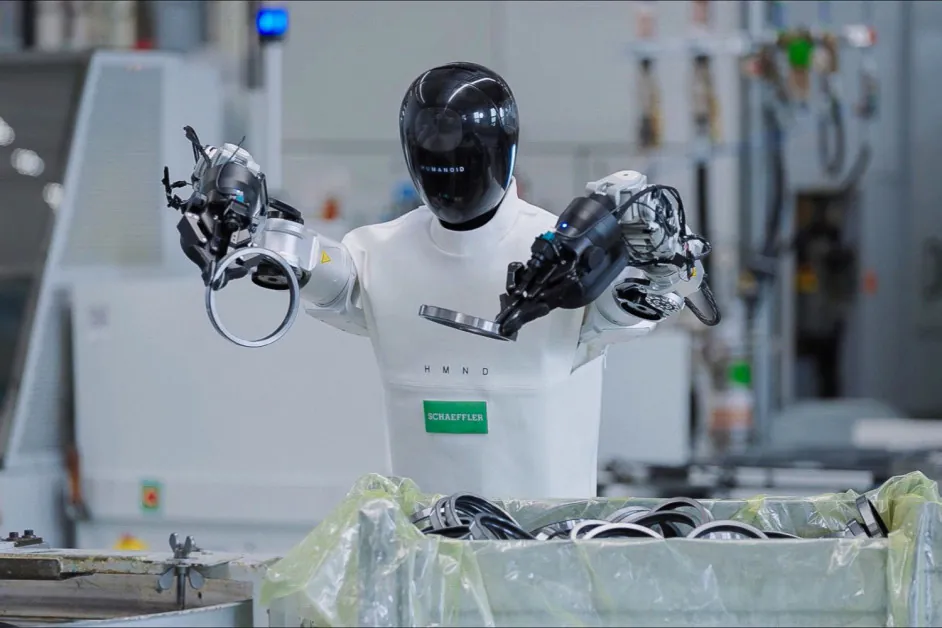
The race to bring humanoid robots into real industrial environments took a major step forward this week as Humanoid announced a large-scale deployment agreement with Schaeffler that will place humanoid robots directly onto live factory floors in Germany beginning in late 2026.
The deal is notable not only for its scale, but also because it moves beyond pilot demonstrations into long-term industrial deployment. Under the agreement, Humanoid plans to deploy a four-digit number of wheeled humanoid robots across Schaeffler facilities by 2032, while Schaeffler will simultaneously become a preferred supplier of actuators powering the robots’ joints and movement systems.
Humanoid Robots Move Into Real Production Environments
The first deployment phase will begin between December 2026 and June 2027 at two Schaeffler sites in Germany.
At Schaeffler’s Herzogenaurach facility, the robots will initially focus on box handling tasks inside active production operations. Meanwhile, a second deployment in Schweinfurt will begin with integration testing and operational validation before transitioning toward near full-scale production use.
Unlike many humanoid robotics announcements that remain confined to labs or tightly controlled demos, this partnership centers on deployment inside existing industrial infrastructure. The companies said the systems must integrate with Schaeffler’s factory architecture, IT requirements, safety standards, and cybersecurity protocols from day one.
Humanoid’s systems are being offered under a Robot-as-a-Service (RaaS) model, meaning customers pay for ongoing robotic operations rather than purchasing robots outright. The service package includes fleet management software, maintenance, updates, technical support, and continuous performance optimization.
Why Actuators Matter in Humanoid Robotics
One of the most important aspects of the agreement may actually be the actuator partnership.
Actuators function as the muscles of humanoid robots, controlling movement in joints such as shoulders, elbows, hips, and knees. In advanced humanoid systems, actuators are among the most technically demanding and expensive components.
Schaeffler has spent the last year aggressively expanding into the humanoid robotics market, positioning itself as a core infrastructure supplier rather than a robot manufacturer itself. The company says actuators can account for roughly 50% of a humanoid robot’s bill of materials.
The German engineering giant recently unveiled compact planetary gear actuators specifically designed for humanoid robots. These systems integrate gearboxes, electric motors, controllers, and encoders into highly compact units designed for continuous industrial operation.
Under the new agreement, Schaeffler will supply more than half of Humanoid’s joint actuator demand for wheeled platforms through 2031. The partnership is expected to involve a seven-digit number of actuator units over time.
A Broader Push Into Industrial Humanoids
The partnership also reflects a larger industry shift as manufacturers increasingly look toward humanoid robotics to address labor shortages, repetitive tasks, and factory flexibility.
While fully autonomous humanoid workers remain an emerging technology, industrial environments are becoming one of the first serious commercial markets for deployment because factories already operate with structured workflows and predictable environments.
Schaeffler has been rapidly building partnerships across the humanoid robotics ecosystem, including collaborations involving other robotics and automation companies focused on humanoid deployment and actuator development.
The company has publicly stated that it expects humanoid robotics orders to become a significant business segment by the end of the decade as global production scales.
Humanoid’s Focus on Wheeled Platforms
Unlike some competitors pursuing fully bipedal robots immediately, Humanoid’s current systems use wheeled bases. That design choice can significantly simplify deployment inside factories by improving stability, extending operating time, and reducing the complexity of locomotion while still allowing upper-body manipulation tasks.
The company says future deployments may expand into more dexterous operations including packaging and assembly work.
Humanoid was founded in 2024 by Artem Sokolov, making the Schaeffler agreement one of the largest disclosed industrial humanoid deployment deals secured by a startup of its age.
Humanoid Robotics Is Entering a New Phase
For years, humanoid robotics has largely been driven by demonstrations showcasing walking, balancing, or choreographed movements. The next phase of the industry appears increasingly focused on proving long-term operational reliability inside factories and logistics environments.
That transition places growing importance on industrial-grade components, uptime, integration, and maintainability rather than simply robotics demonstrations.
The Humanoid-Schaeffler agreement suggests the sector may now be moving from experimental pilots toward measurable industrial deployment at scale.