
AI Models & Platforms
Orbital AI: The Next Frontier for Hyperscale Infrastructure

 Add Unite.AI to your preferred sources on Google
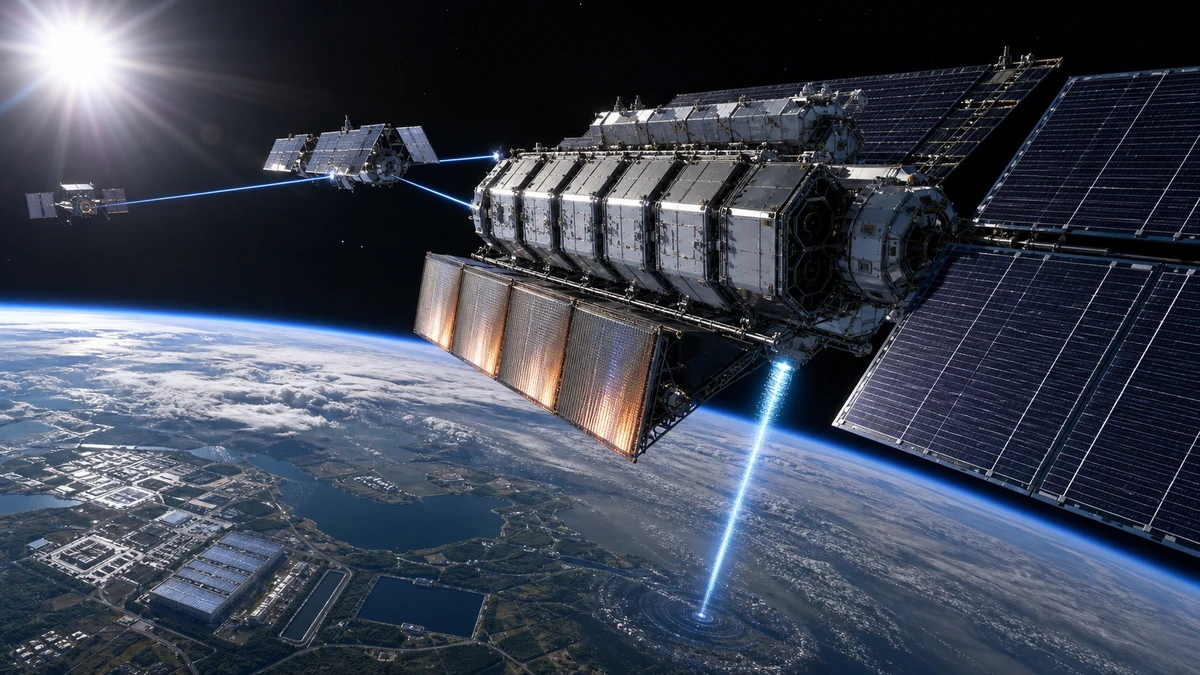
The limits of terrestrial physics are beginning to stall the global pursuit of Artificial Intelligence supremacy. As Large Language Models (LLMs) expand in complexity, the environmental and energetic toll of ground-based training has reached an inflection point. Projections suggest that by 2030, the energy appetite of generative AI could triple, consuming nearly 20% of the United States’ total power supply. To bypass the regulatory friction and climate impacts of massive Earth-bound facilities, a new strategic frontier is emerging in low Earth orbit. What was once dismissed as science fiction—Orbital Data Centres (ODCs)—is now becoming a mechanical necessity for the next generation of AI scaling.
This transition into “Extra terra nullius” represents more than a simple change in geography. The move toward space-resident compute signals a paradigm shift in the execution of agentic workflows, the speed of geospatial intelligence, and the ultimate sustainability of the global intelligence cloud.
Energy Sovereignty and the Orbital Advantage
The fundamental catalyst for off-worlding AI workloads is the staggering power requirement of frontier models. A single high-density training cluster now rivals the energy consumption of a mid-sized US city, contributing to a forecast where data center electricity usage hits 606 terawatt-hours by 2030. In the orbital environment, the economics of power are entirely redefined. Free from the interference of clouds or atmospheric filtration, satellites can harness solar energy with an efficiency up to eight times higher than terrestrial arrays, providing the 24/7 high-density power required for massive neural network training.
The orbital harvesting advantage is driven by the transition from intermittent terrestrial solar to 24/7 space-based illumination. By operating in constant sunlight without atmospheric scattering or weather interference, orbital arrays achieve a near-100% capacity factor—effectively quadrupling the energy yield compared to the roughly 25% average for ground-based farms. When combined with the higher raw intensity of unfiltered solar radiation, a single orbital panel can generate roughly eight times the total annual energy of an identical installation on Earth.
Revisiting the Thermal Management Equation
Cooling currently accounts for approximately 40% of a traditional data center’s energy overhead. On Earth, training environments push hardware to its thermal limits, necessitating millions of gallons of water for evaporative cooling. Space, while lacking air for traditional convection, serves as a high-capacity heat sink for thermal radiation. By utilizing modular radiators and anhydrous ammonia as a working fluid, ODCs can effectively jettison waste heat into the vacuum. This transition enables a passively cooled architecture, ensuring that every watt harvested from the sun is dedicated to computational throughput rather than mechanical cooling.
The Economic Feasibility of Space-Based Compute
The commercial viability of space-based AI is supported by a “trifactor” of market forces: the exponential demand for LLM processing, the rising volatility of ground-based energy costs, and the collapse of launch expenses. Reusable heavy-lift vehicles have slashed the price of orbital entry by over 95%. Industry analysts suggest that by the 2030s, launch costs could drop below $200 per kilogram, making orbital clusters more cost-effective than terrestrial facilities when calculated against a decade-long operational lifespan.
Hardware Innovation for the Final Frontier
The architecture of AI is already being redesigned for the vacuum. Leading chipmakers are responding to the NewSpace demand by engineering dedicated platforms, such as the Space-1 Vera Rubin Module and specialized Server Edition GPUs. These components are optimized for high-performance computing within the rigid constraints of size, weight, and power (SWaP) found in orbital environments.
The Divergence of Training and Inference
While training frontier models requires concentrated, high-wattage power, the real-time deployment of those models—inference—is poised for a massive orbital expansion. By 2030, global inference capacity is expected to soar to 54 gigawatts. Orbital facilities are uniquely positioned to serve as “edge” nodes. By processing data directly on radar or imaging satellites, AI can conduct high-speed analysis at the source. This localized processing eliminates the need to downlink massive raw datasets, significantly reducing latency for critical applications like autonomous disaster response or maritime network management.
Project Suncatcher and the Distributed Mesh
Google’s (GOOGL ) “Project Suncatcher” serves as a primary example of this shift, testing solar-centric data constellations in orbit. These systems utilize proprietary Tensor Processing Units (TPUs)—chips specifically engineered for the high-volume tensor operations that define modern AI. By linking these constellations via laser-based optical interconnects, developers can create a distributed, orbital mesh capable of terabit-per-second communication. Preliminary research indicates that modern TPU hardware can endure the radiation stressors of low Earth orbit for five-year durations while maintaining operational integrity.
| AI Workload Category | Resource Requirement | Orbital Benefit |
|---|---|---|
| Frontier Model Training | Gigawatt-scale, high-density continuous load | Constant, high-intensity solar harvesting |
| Real-time Model Inference | High-volume, latency-critical requests | Proximity to data sources; minimal downlink lag |
| Geospatial Intelligence | Heavy SAR and multi-spectral data streams | Local source-side processing and filtering |
| Autonomous Agentic Workflows | Multistep reasoning and memory retrieval | Decentralized, resilient cloud fabric |
Navigating the Technical Constraints
Scaling intelligence off-world introduces a unique set of engineering hurdles. Radiation remains the primary threat, specifically within the Van Allen belts where charged particles can induce “bit flipping” in standard semiconductor logic. This has catalyzed the development of radiation-hardened synaptic transistors and photonic compute modules. Unlike electronic chips, photonic processors use light to move and process data, offering natural immunity to electromagnetic interference while providing the bandwidth required for hyperscale AI missions.
- Logic Integrity: Advanced semiconductor materials like indium gallium zinc oxide are currently being validated for their ability to maintain stable gate logic under intense proton bombardment.
- Ablation and Atmosphere: The current “de-orbit” strategy for redundant hardware results in atmospheric burning, which may have long-term consequences for ozone stability and thermal regulation.
- Orbital Congestion: The proliferation of ODC constellations increases the statistical probability of collisions, risking a Kessler Syndrome event that could render orbital planes inaccessible.
Beyond the technical, the expansion of spaceport infrastructure on Earth is creating social friction, often impacting indigenous territories and local ecologies. For the NewSpace sector to remain viable, ethical equity in ground-based operations must be prioritized alongside orbital innovation.
The Emergence of Hybrid Intelligence
The logical evolution of AI infrastructure is a hybrid ecosystem where Earth-based hyperscalers are seamlessly integrated with orbital edge nodes. Platforms like Sophia Space are already developing modular “TILE” architectures—units that consolidate power, compute, and thermal management into a single, resilient edge compute fabric. As space becomes a native extension of the global cloud, the synergy between chip designers and launch providers will become the defining engine of industrial growth.
The Convergence of Silicon and Space
The long-term value of orbital data centers lies in the democratization of massive-scale compute. By moving past the limitations of national energy grids and terrestrial land use, space-based AI can offer a “sovereignty-blind” global infrastructure. This shift will be the primary accelerator for agentic AI—autonomous systems capable of deep reasoning—by ensuring the uninterrupted processing power they require to function.
-
Source-Side Training: On-orbit models can be refined using real-time geospatial data without the bottleneck of ground transmission.
-
Neuromorphic Resilience: Radiation-tolerant synaptic processors allow for brain-inspired computing efficiency in high-stress environments.
-
Global Resilience: Laser-linked satellite networks establish a compute fabric that remains operational even during large-scale terrestrial disruptions.
A Phased Reality: While the orbital logic is sound, the transition remains a long-range play. Current initiatives like Project Suncatcher and Sophia Space are in the early validation phase, focusing on hardware resilience and thermal stability. Industry consensus suggests a phased rollout: high-latency “cold storage” and source-side inference by 2030, with full-scale frontier model training clusters unlikely to reach orbit before the mid-2030s.
While the roadmap from science fiction to orbital reality is still being drafted, the mechanical and economic foundations for a space-based AI economy are already in place. By migrating our most resource-heavy digital workloads into the vacuum, we are securing a path toward a sustainable and computationally infinite future.



