AI Fundamentals
Generative vs. Discriminative Machine Learning Models

 Add Unite.AI to your preferred sources on Google

Generative and discriminative describe what a model learns about data and targets. In classical supervised classification, a generative model learns a joint distribution such as P(x, y) or class-conditional P(x|y), while a discriminative model learns P(y|x) or a direct decision boundary.
The distinction is useful, but modern systems often combine objectives. A model can learn generative representations and later be fine-tuned for discriminative prediction, or share one backbone between generation and classification.
Key takeaways
- Generative classifiers model how inputs and labels arise; discriminative classifiers model the label given the input or a boundary.
- Generative assumptions can help with limited labeled data but can also be wrong.
- Discriminative methods often focus capacity on the prediction task and may achieve better asymptotic classification error.
- GANs, VAEs and language models are generative systems, but “generative” does not mean every component is a generative classifier.
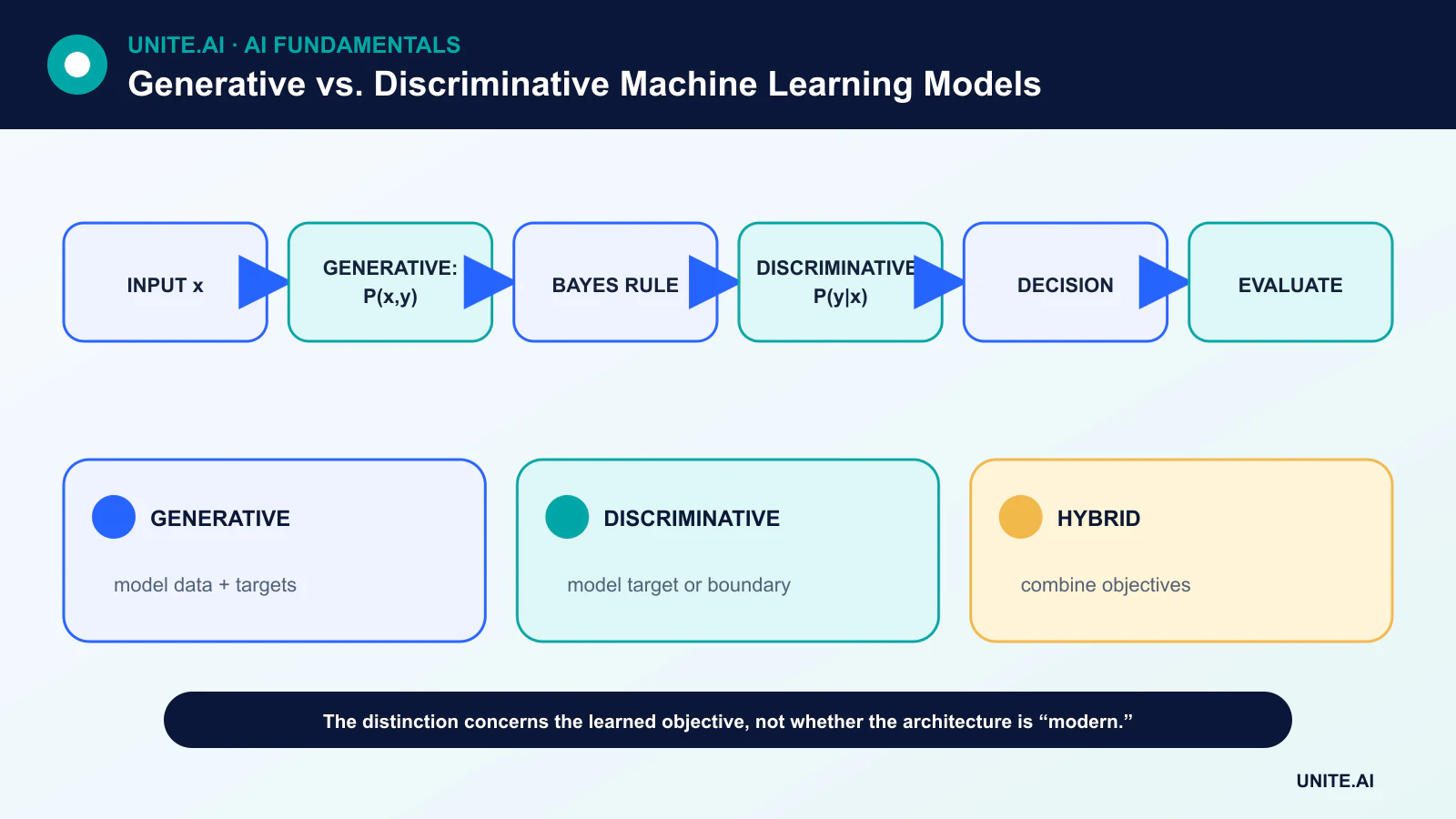
The probability factorization
A generative classifier can estimate P(x|y) and P(y), then use Bayes’ theorem to derive P(y|x). Naive Bayes is a classic example. A discriminative classifier such as logistic regression estimates P(y|x) directly; an SVM learns a separating boundary.
Modeling P(x,y) is a broader task than predicting y from x. That extra structure can support sampling or missing-data reasoning, but it also requires assumptions about the input distribution.
Data efficiency and asymptotic behavior
Ng and Jordan’s comparison of naive Bayes and logistic regression showed a useful tradeoff: under their assumptions, the generative model can approach its limiting performance with fewer examples, while the discriminative model can reach a lower asymptotic error.
This is not a universal ranking. Results depend on whether the model family fits the data, the dimension, regularization, optimization and label quality. Empirical comparison on a representative validation design remains essential.
Representative model families
Generative models include class-conditional distributions, hidden Markov models, mixture models, variational autoencoders, autoregressive language models, diffusion models and GANs.
Discriminative models include logistic regression, decision trees, conditional random fields, support vector machines and neural classifiers. The same neural backbone can participate in either category depending on its training objective and output.
Hybrid and self-supervised systems
A pretrained language or vision model can learn from unlabeled data with a generative or self-supervised objective, then receive a discriminative head for a target task. Semi-supervised methods may optimize labeled classification and an unlabeled-data objective together.
Hybridization makes architecture labels less informative than the full training pipeline. Documentation should state the objective, data, outputs and intended inference—not simply call a model generative.
Choosing between approaches
Use the task to decide. If the goal is a calibrated boundary with abundant labels, a discriminative model is a natural baseline. If sampling, density estimation, missing-data structure or unlabeled data are central, a generative component may help.
Compare robustness, sample efficiency, compute, likelihood or calibration as appropriate. A good generated sample does not prove a good classifier, and a high-accuracy classifier does not imply a realistic model of the input distribution.
Probability directions and modeling objectives
A discriminative model learns a boundary or conditional distribution P(y|x): given features x, predict label y. Logistic regression, support vector machines, conditional random fields, and many classifiers are discriminative. A generative model learns a joint distribution P(x,y), a class-conditional distribution P(x|y), or an unconditional data distribution, enabling sampling or likelihood-related tasks. Naive Bayes and linear discriminant analysis are generative classifiers; GANs, variational autoencoders, diffusion models, and autoregressive models generate data through different objectives.
The distinction concerns what distribution or decision rule is modeled, not whether a neural network is used. A generative language model can be prompted to classify, while a discriminative reranker can guide generation. Generative assumptions may improve data efficiency or handle missing variables but create model misspecification risk. Discriminative methods often excel with abundant labeled data because they focus directly on the prediction boundary. Compare families under equal features, data, tuning, and compute rather than treating one category as universally superior.
Training and evaluation by use case
Classification evaluation uses precision, recall, calibration, robustness, and error cost. Generative evaluation must address fidelity, diversity, coverage, likelihood or task utility, memorization, and safety. A model can produce attractive samples while dropping modes, or achieve good likelihood with poor perceptual output. Synthetic-data utility should be tested by training and evaluating downstream models on independent real data, including rare groups. Keep test data out of generation prompts and selection.
In semi-supervised learning, a generative model may exploit unlabeled structure; in anomaly detection, likelihood can fail when out-of-distribution data receives high density for irrelevant reasons. In retrieval-augmented generation, a generative answer model and discriminative retriever or reranker form a hybrid. Diagnose stages separately so fluent output does not hide retrieval failure. Choose the decomposition that makes evidence and control observable.
Deployment and governance
Generative systems add content provenance, intellectual-property, impersonation, prompt injection, and output-moderation risks; discriminative systems add threshold, denial, and unequal-error risks. Both require data rights, secure artifacts, versioning, representative tests, monitoring, and human authority proportional to consequence. Track the precise objective and output semantics in documentation. Generative versus discriminative is a useful statistical distinction, but real systems commonly combine them, and reliability depends on the whole data and decision pipeline.
Worked example: classifying and generating support replies
A support platform uses a discriminative classifier to identify issue type and urgency and a generative model to draft a response from approved policies. The classifier is evaluated with class-specific recall and calibration; the retriever with evidence recall; the generator with groundedness, correctness, and refusal. Each stage has an unknown outcome, and the generative model cannot alter classification or customer entitlement through persuasive text.
Agents see the predicted route, sources, and draft and approve or correct before sending. Permission filters apply before retrieval, and prompt injection in customer text cannot authorize tools. Monitoring separates routing errors, retrieval gaps, unsupported statements, and agent edits. A policy change updates sources immediately and triggers regression tests; tuning is reserved for stable behavior. The hybrid design uses discriminative and generative strengths while preserving evidence and human authority.
Implementation evidence and operational readiness
A production decision needs more than a successful demonstration. Define the intended users, operating environment, inputs, outputs, dependencies, owner, and the consequence of each important failure. Establish a reproducible baseline and a versioned evaluation set before tuning. Test ordinary cases, boundary conditions, malformed or missing input, distribution shift, dependency outage, misuse, and the groups or environments most likely to be underserved. Measure task quality together with calibration or uncertainty, latency, throughput, resource cost, accessibility, privacy, and security. Record every transformation and threshold so an independent reviewer can reproduce the result and distinguish evidence from an attractive prototype.
Before launch, assign authority for release, exceptions, changes, rollback, and retirement. Use a staged rollout, preserve a safe fallback, and verify monitoring with deliberately injected failures. Operational telemetry should reveal input quality, output behavior, model or rule version, dependency health, human overrides, and confirmed outcomes without collecting unnecessary sensitive data. Define alert thresholds and a response owner, then review real-world evidence after deployment rather than assuming offline performance will persist. Reevaluate whenever data sources, users, models, vendors, policies, hardware, or objectives change. A maintained system also needs documented recovery, incident learning, deletion and retention procedures, and a clear point at which it should be disabled or replaced.
Frequently asked questions
Is a GAN’s discriminator a discriminative model?
It performs discrimination during training, but the overall GAN is a generative framework whose output is produced by the generator.
Is discriminative learning always supervised?
No. The term describes the modeled relationship or boundary, while supervision describes the training signal. Modern objectives can blur the categories.
Primary references