AI Fundamentals
Alberta’s AI Ecosystem: How Amii Connects Research, Talent, and Industry

 Add Unite.AI to your preferred sources on Google

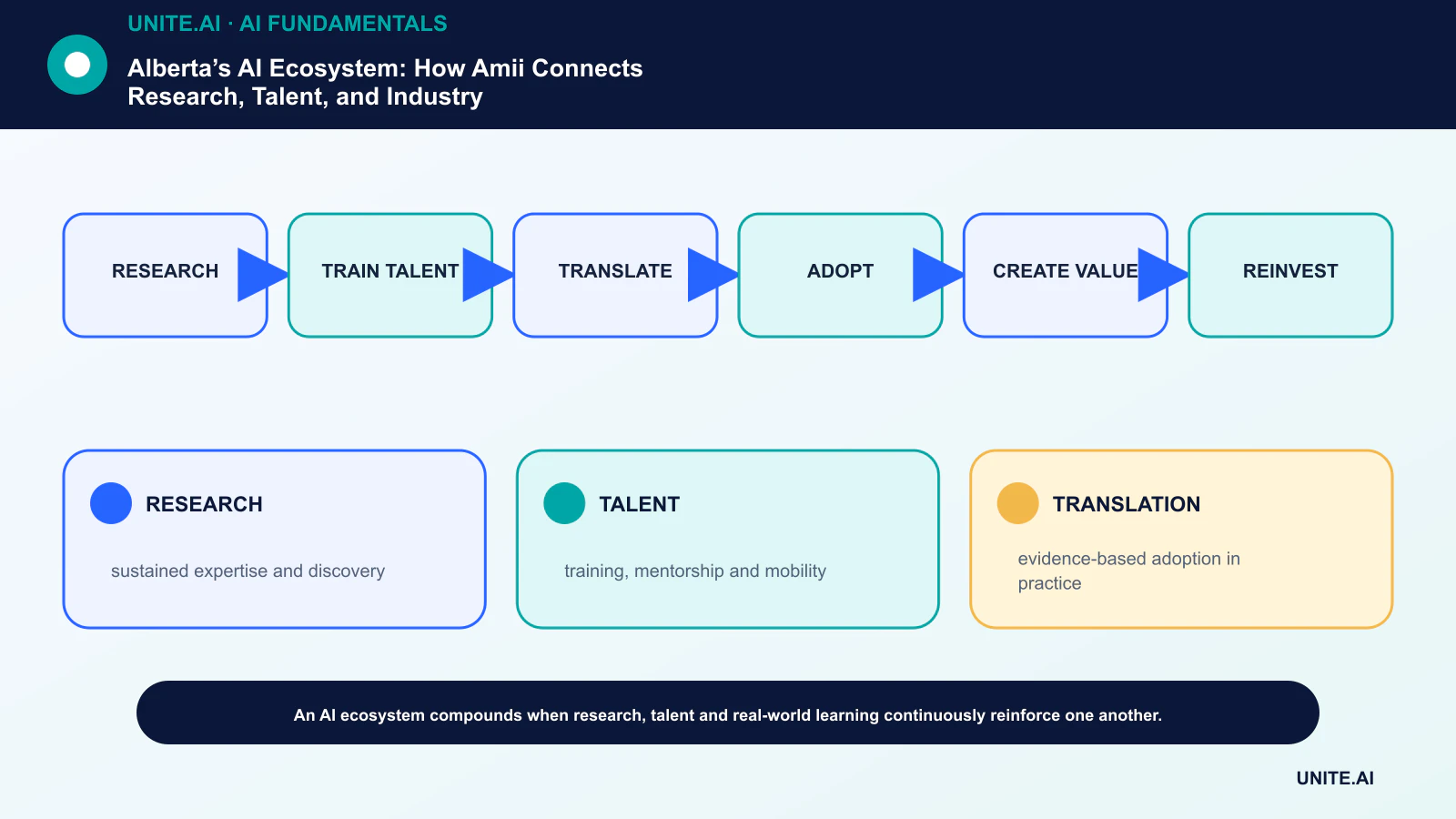
An AI innovation ecosystem is more than a group of companies using machine learning. It connects long-horizon research, experienced mentors, skilled graduates, shared infrastructure, investment, public institutions and organizations able to turn research into responsible products.
Alberta offers a useful case study. The Alberta Machine Intelligence Institute (Amii) traces its roots to the Alberta Ingenuity Centre for Machine Learning, founded in 2002, and later became one of Canada’s national AI institutes under the Pan-Canadian AI Strategy.
Key takeaways
- Research institutes create value by sustaining expertise that individual short-term projects cannot.
- Talent develops through graduate training, mentorship, practitioner education and opportunities to work on real problems.
- Industry translation needs problem selection, data readiness, evaluation and change management—not just model access.
- Events such as the 2022 inaugural AI Week are convening mechanisms; durable impact is measured after the event.
A foundation of long-horizon research
University research groups can pursue foundational questions before a commercial market is obvious. Stable institutions help preserve intellectual continuity, attract faculty and students, and create dense networks in fields such as reinforcement learning and statistical machine learning.
Amii’s history reflects this long view: the organization began as AICML in 2002 and later expanded its role as a not-for-profit national AI institute. The lesson is not that every region should copy one structure, but that durable expertise compounds over time.
Talent is an ecosystem output
A research cluster trains graduate students and postdoctoral researchers, but its wider talent system also includes technical workshops, executive literacy, internships, mentors and pathways into local organizations. Retention depends on meaningful work and a community, not education alone.
Strong programs teach experimental design, software and data practice alongside algorithms. This connects machine learning theory with deployment constraints, professional judgment and responsible use.
From research to operational value
Translation begins with selecting a problem that has usable data, an accountable owner and an outcome worth improving. Researchers and practitioners then need shared definitions, a baseline, a validation design and a plan for integrating the system into work.
An institute can reduce coordination cost by connecting domain organizations with technical experts, but it should not promise that every engagement becomes a product. Negative findings, capability building and improved data practices can also be valuable outcomes.
Convening and public literacy
Amii announced its inaugural AI Week for May 2022 to mark two decades of Alberta AI activity. The program combined research, business and community sessions. Its lasting value lies in relationships, shared knowledge and follow-on work rather than the temporary event itself.
Public programming can make technical work more legible, expose students to career paths and let communities question how AI affects them. Access improves when organizers offer different levels, bursaries, recordings and formats instead of assuming one expert audience.
How to evaluate an AI hub
Useful measures include research quality, student completion, talent retention, company adoption, repeat collaborations, startups, open resources, responsible-AI practices and the distribution of benefits. Attendance or investment announcements are inputs, not final outcomes.
Evaluation should also ask what would have happened without the hub and whether projects remain useful after initial support. A credible ecosystem learns from failed transfers and avoids inflating every data-science collaboration into an economic-impact claim.
How an AI ecosystem creates a talent and research pipeline
An AI ecosystem links universities, research institutes, companies, government, investors, educators, and community organizations. Its value comes from repeated flows of people, knowledge, data, infrastructure, and problems—not a list of institutions. In Alberta, the University of Alberta’s reinforcement-learning history, Amii’s research and industry programs, and regional public support form important anchors. A comprehensive assessment should distinguish basic research, applied collaboration, startup formation, workforce training, and adoption by established organizations.
Research institutes bridge different incentives. Faculty and students need publishable scientific questions; companies need measurable outcomes and protected information; public funders seek economic and social benefit. Effective programs define intellectual-property terms, data access, milestones, publication review, and talent supervision before work begins. Shared compute, technical staff, and evaluation support often determine whether an idea moves beyond a demonstration. Long-term relationships outperform one-off matchmaking events when organizations are learning how to formulate useful AI problems.
Evaluating ecosystem outcomes
Headcounts and announced funding are inputs, not outcomes. Track trained people and career paths, peer-reviewed research, open tools, patents where relevant, startups and survival, industry projects that reach operation, productivity or public benefit, responsible-AI practices, and distribution across communities. Attribution is difficult because graduates and companies interact with several regions. Use longitudinal evidence and comparisons rather than claiming every local success was caused by one program.
Ecosystems can concentrate opportunity or create dependency on short grants. Barriers include compute cost, immigration and retention, housing, procurement, access for small firms, data governance, and commercialization gaps. Include Indigenous and rural communities through partnership and governance rather than extraction. Responsible growth requires privacy, security, environmental planning, and domain oversight. Public reporting should include failed pilots and lessons, not only success stories.
How organizations can engage
A company should arrive with a bounded problem, owner, data inventory, baseline, and commitment to implementation. A learner should combine fundamentals with projects and research exposure. Policymakers should fund durable infrastructure and evaluation, not only short-term announcements. The health of Alberta’s AI ecosystem depends on whether research excellence becomes trustworthy capability, talent can build sustainable careers, and local organizations can adopt AI without giving up accountability or public value.
Worked example: an Alberta industry–research collaboration
A regional energy company works with an institute and university lab on equipment forecasting. Before research begins, partners define the scientific question, operational baseline, data rights, publication review, security, compute, student supervision, and who can deploy results. Data remains in a governed environment, while de-identified artifacts and reproducible methods support research. Milestones include a baseline, independent evaluation, field shadowing, and documented failure modes—not only a paper or demo.
The collaboration tracks student training, reusable tools, research output, adoption, downtime impact, and lessons from unsuccessful approaches. Operations staff and safety engineers review every deployment claim. If the model fails to beat existing maintenance practice, the negative result is retained and shared within permitted boundaries. The project strengthens the ecosystem by transferring capability and evidence to local teams, rather than creating a one-off prototype dependent on an external researcher or short grant.
Implementation evidence and operational readiness
A production decision needs more than a successful demonstration. Define the intended users, operating environment, inputs, outputs, dependencies, owner, and the consequence of each important failure. Establish a reproducible baseline and a versioned evaluation set before tuning. Test ordinary cases, boundary conditions, malformed or missing input, distribution shift, dependency outage, misuse, and the groups or environments most likely to be underserved. Measure task quality together with calibration or uncertainty, latency, throughput, resource cost, accessibility, privacy, and security. Record every transformation and threshold so an independent reviewer can reproduce the result and distinguish evidence from an attractive prototype.
Before launch, assign authority for release, exceptions, changes, rollback, and retirement. Use a staged rollout, preserve a safe fallback, and verify monitoring with deliberately injected failures. Operational telemetry should reveal input quality, output behavior, model or rule version, dependency health, human overrides, and confirmed outcomes without collecting unnecessary sensitive data. Define alert thresholds and a response owner, then review real-world evidence after deployment rather than assuming offline performance will persist. Reevaluate whenever data sources, users, models, vendors, policies, hardware, or objectives change. A maintained system also needs documented recovery, incident learning, deletion and retention procedures, and a clear point at which it should be disabled or replaced.
Frequently asked questions
What does Amii stand for?
Amii is the Alberta Machine Intelligence Institute, a not-for-profit AI institute headquartered in Edmonton.
Was AI Week the beginning of Alberta’s AI research community?
No. The 2022 event celebrated a research history that Amii traces back to AICML’s founding in 2002.
Primary references