AI Fundamentals
Why AI Research Conferences Matter: Collaboration, Knowledge Transfer, and Talent

 Add Unite.AI to your preferred sources on Google
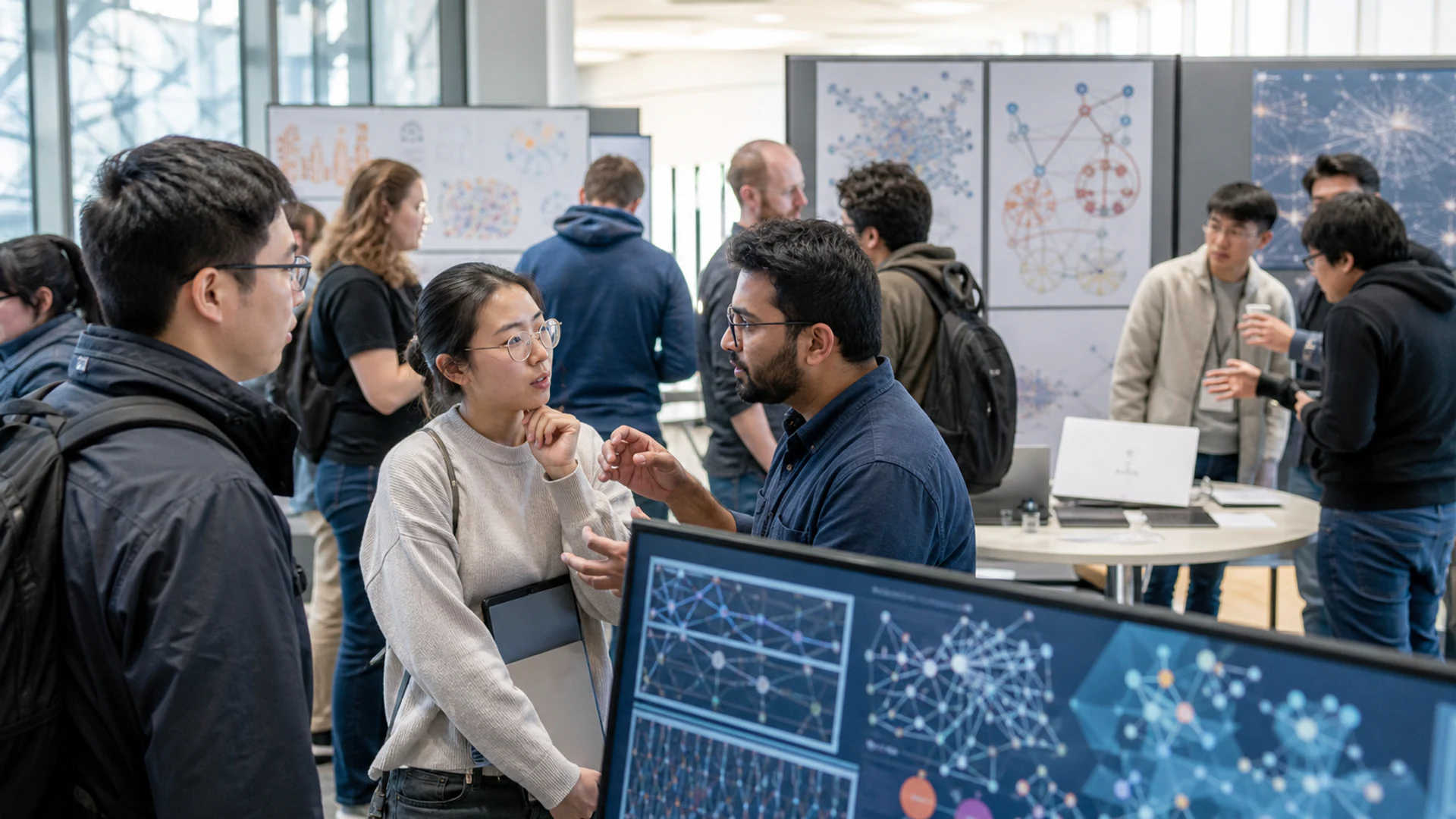
AI conferences, workshops and community programs are part of research infrastructure. They create concentrated opportunities to critique new work, compare methods, meet collaborators, connect students with mentors and translate technical findings for industry and the public.
A successful event is not defined by stage size alone. Its value depends on who can participate, whether claims can be examined, how knowledge is preserved, and what collaborations or learning continue after the program ends.
Key takeaways
- Conferences accelerate feedback and relationship formation, but they do not replace peer review or reproducible evidence.
- Workshops and tutorials connect emerging questions with practical methods and new participants.
- Access requires attention to cost, visas, disability, caregiving, geography and remote participation.
- Measure follow-on research, mentorship, adoption and public learning—not just registrations.
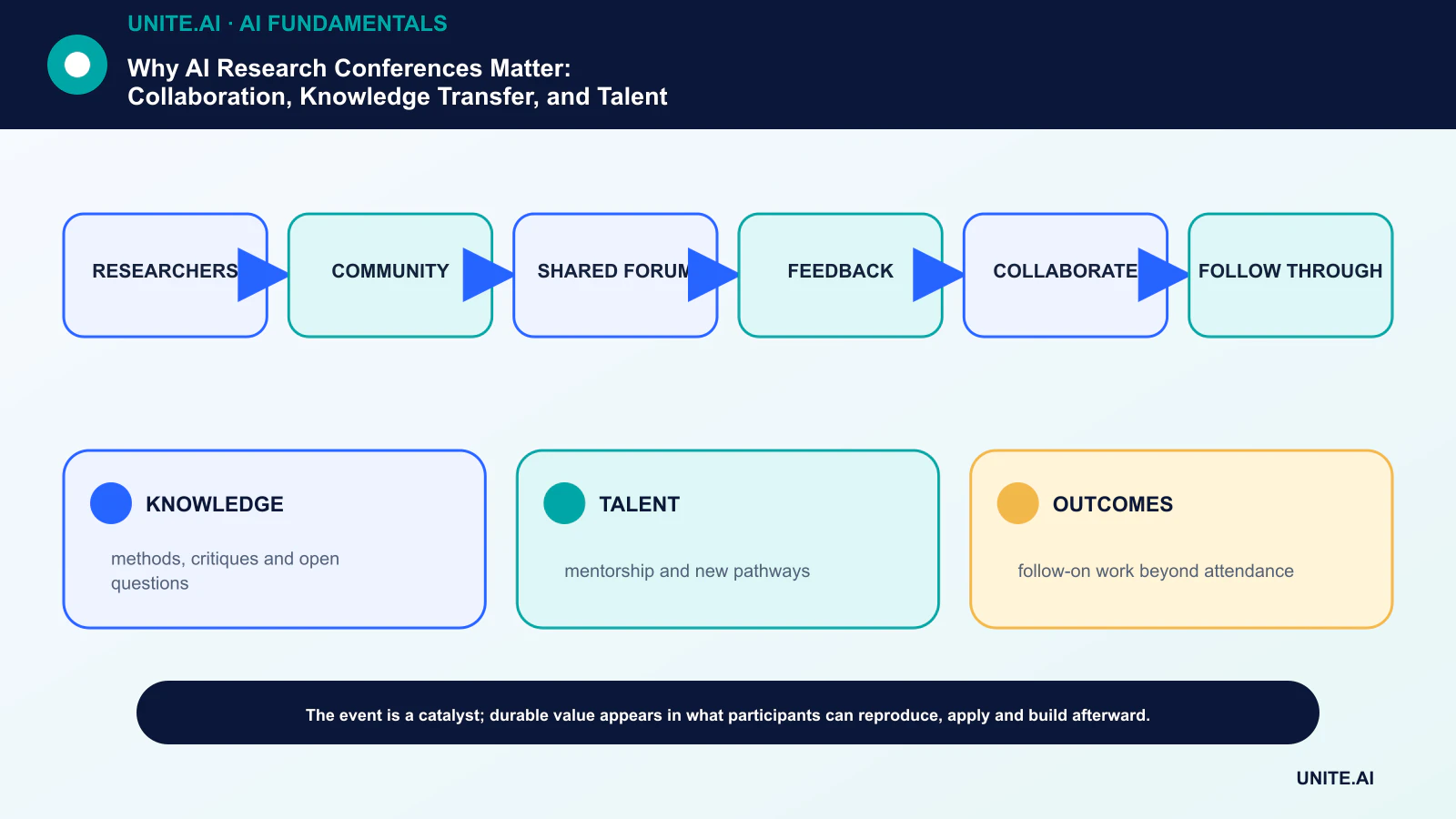
A shared forum for incomplete knowledge
Papers present formal results, while talks, posters and workshops expose assumptions, failed approaches and open questions that may not fit a final manuscript. Conversation can help another team reproduce a result or discover that two fields use different words for the same problem.
This exchange is especially useful in fast-moving areas such as transformers. Speed also creates risk: a polished presentation is not evidence that a claim generalizes. Participants still need methods, code, data documentation and independent evaluation.
Talent, mentorship and career mobility
Students can receive detailed feedback, observe how experts disagree and encounter career paths outside their home institution. Mentors and hiring organizations gain a broader view of emerging talent, while informal networks can support later collaboration.
Organizers should design these opportunities rather than leaving them to chance. Structured mentoring, travel support, newcomer sessions and clear codes of conduct make access more equitable and reduce dependence on existing social connections.
Research-to-industry translation
Industry sessions can surface operational constraints—latency, reliability, safety, data quality and governance—that academic benchmarks omit. Researchers can explain what a method actually demonstrates and where uncertainty remains.
Translation is strongest when sessions compare baselines, failure modes and deployment evidence rather than becoming marketing. A conference should preserve editorial and scientific independence even when sponsors support the venue.
AI Week 2022 as a case study
Amii’s May 2022 AI Week combined an academic symposium with business and community programming. Amii’s post-event release reported 2,142 guests, 82 speakers and 57 events, illustrating how one program can serve multiple levels of technical familiarity.
Those figures describe reach, not long-term impact. A durable assessment would examine new projects, student opportunities, repeat participation, accessible recordings and whether community questions influenced later work.
Designing and measuring a useful event
Good design includes transparent selection, conflict-of-interest policies, accessible venues and media, privacy-aware networking, harassment reporting, artifact review where feasible and clear labeling of peer-reviewed versus invited material.
After the event, survey learning and access, track mentorship and collaborations with consent, publish recordings or summaries, and document unresolved questions. The goal is a reusable knowledge commons—not a temporary impression that every machine-learning problem has been solved.
How conferences support scientific correction and transfer
AI research conferences combine peer review, publication, talks, posters, workshops, tutorials, competitions, and informal discussion. Review filters and improves work but is not certification of truth: reviewers have limited time, methods vary, and accepted papers can contain errors. Posters and question periods let researchers expose assumptions, compare negative results, and find missing baselines. Workshops often develop emerging topics before consensus exists, while tutorials transfer mature methods to new practitioners.
Knowledge transfer requires artifacts beyond a presentation. Papers should specify data, code, compute, evaluation, and limitations; reproducibility checklists and artifact tracks help others validate claims. Benchmarks can coordinate progress but also reward narrow optimization, test-set contamination, and expensive scale. Conference communities should value replication, datasets, systems, theory, negative findings, and impact analysis alongside state-of-the-art scores. Recorded talks widen access but do not replace interactive critique and mentorship.
Talent, networking, and unequal access
Conferences create hiring, mentorship, collaboration, and visibility, especially for students and early-career researchers. Those benefits are uneven when travel, visas, caregiving, disability, cost, language, or harassment exclude participants. Hybrid access, grants, accessible venues, codes of conduct, confidential reporting, and transparent selection improve participation. Networking should not become an informal gate that overrides research quality or concentrates opportunity among already connected institutions.
Sponsors and industry provide resources but can shape agendas and attention. Disclose conflicts, separate editorial decisions from sponsorship, and protect academic independence. Carbon and travel impacts should be measured with meaningful virtual options and regional events. Security matters when unpublished ideas, personal data, or dual-use demonstrations are shared. Organizers need policies for recording, photography, datasets, and responsible disclosure.
How to evaluate conference value
Researchers should set objectives, read papers in advance, document follow-ups, and verify claims after the event. Organizations can track collaborations, replicated methods, recruited talent, training, and projects that produce validated outcomes—not badge scans or social-media impressions. The strongest conference impact is cumulative: communities establish norms, correct one another, and transfer tacit knowledge over years. Conferences matter when they improve the quality, openness, safety, and reach of research, not merely when they generate announcements.
Worked example: evaluating a conference claim
A team sees a conference paper claiming a new retrieval method. It reads the paper and appendix, checks dataset and code, reconstructs the strongest baselines, and reruns the method on a private domain set. Researchers contact the authors about an ambiguous preprocessing step and discuss failure cases at the poster. The internal report separates the peer-reviewed claim, reproduced result, changed implementation, and local outcome.
Adoption waits until latency, cost, licensing, security, and quality are tested in the complete system. The company records whether conference participation led to replication, collaboration, training, or a validated product improvement. Travel and access support are allocated to junior researchers with explicit objectives, and knowledge is shared afterward. Conference acceptance prompts investigation; it is not treated as production certification, and a compelling talk does not override reproducible evidence.
Implementation evidence and operational readiness
A production decision needs more than a successful demonstration. Define the intended users, operating environment, inputs, outputs, dependencies, owner, and the consequence of each important failure. Establish a reproducible baseline and a versioned evaluation set before tuning. Test ordinary cases, boundary conditions, malformed or missing input, distribution shift, dependency outage, misuse, and the groups or environments most likely to be underserved. Measure task quality together with calibration or uncertainty, latency, throughput, resource cost, accessibility, privacy, and security. Record every transformation and threshold so an independent reviewer can reproduce the result and distinguish evidence from an attractive prototype.
Before launch, assign authority for release, exceptions, changes, rollback, and retirement. Use a staged rollout, preserve a safe fallback, and verify monitoring with deliberately injected failures. Operational telemetry should reveal input quality, output behavior, model or rule version, dependency health, human overrides, and confirmed outcomes without collecting unnecessary sensitive data. Define alert thresholds and a response owner, then review real-world evidence after deployment rather than assuming offline performance will persist. Reevaluate whenever data sources, users, models, vendors, policies, hardware, or objectives change. A maintained system also needs documented recovery, incident learning, deletion and retention procedures, and a clear point at which it should be disabled or replaced.
Frequently asked questions
Are conference talks equivalent to peer-reviewed papers?
No. Some sessions summarize reviewed research, while keynotes, panels, workshops and demonstrations may follow different selection processes. The evidence should be checked at its source.
Can virtual participation fully replace an in-person conference?
It improves geographic and cost access, but informal interaction differs. Hybrid design should treat remote participants as a real audience rather than an afterthought.
Primary references