AI Fundamentals
How Does Image Classification Work?

 Add Unite.AI to your preferred sources on Google

Image classification predicts a label for an entire image. It answers questions such as “Which product category is shown?” or “Does this scan contain a target finding?” It does not by itself locate each object or outline its pixels.
Modern systems commonly use convolutional neural networks or vision transformers, often initialized with pretrained weights. Reliable performance still depends on labels, sampling, augmentation, calibration and testing under real deployment conditions.
Key takeaways
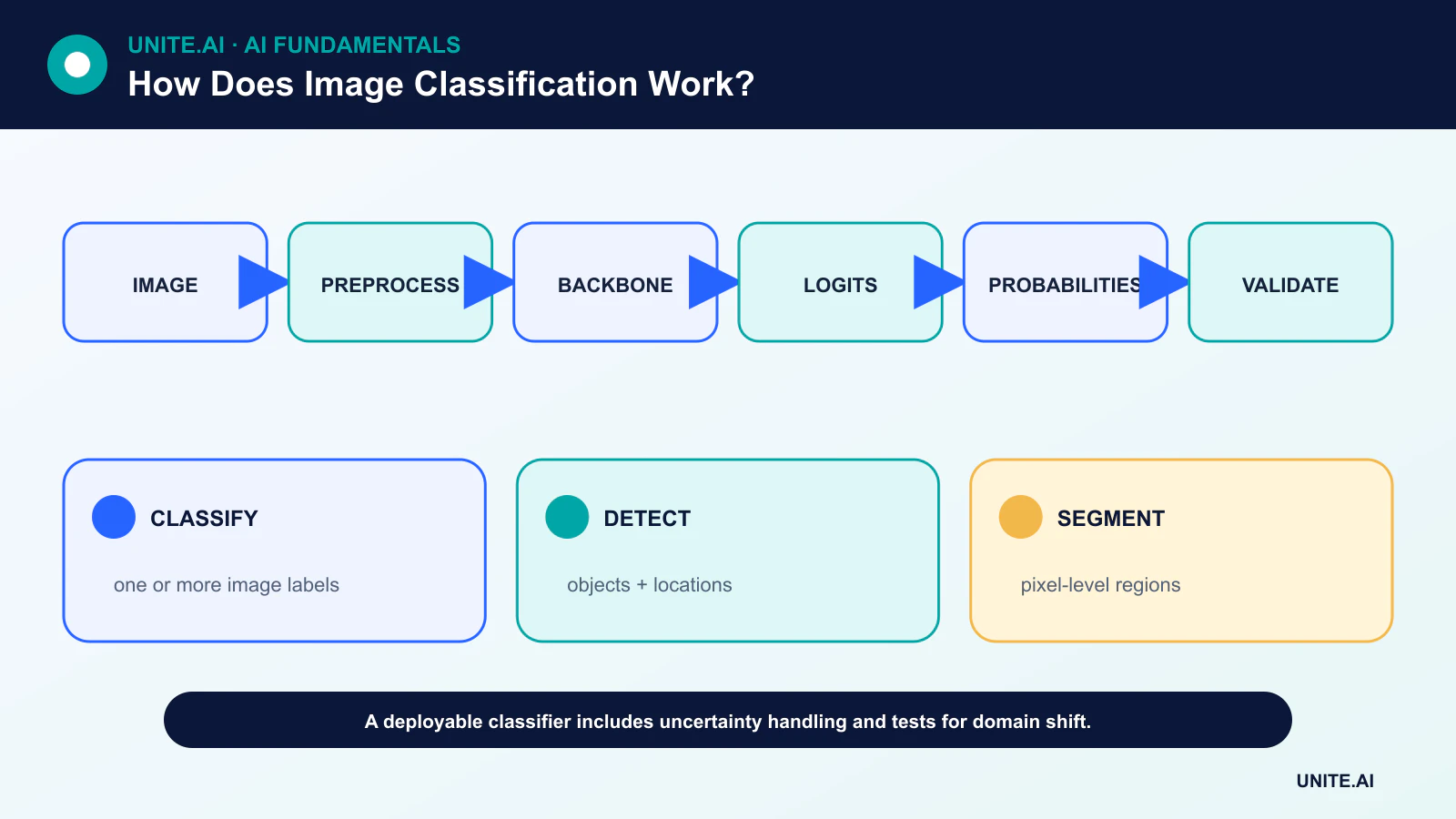
- Classification labels the whole image; detection draws object boxes and segmentation assigns pixel-level regions.
- Pretraining and transfer learning can reduce data requirements, but domain mismatch can erase the benefit.
- Top-line accuracy can hide class imbalance, spurious shortcuts and poor calibration.
- Image quality, capture device, geography and workflow changes can all create distribution shift.
From pixels to scores
Images are resized or cropped, normalized and converted to tensors. Data augmentation may apply label-preserving transformations such as flips, crops or color changes. A backbone maps pixels into features; a classification head produces logits that are converted into relative class scores.
The chosen preprocessing must match deployment. A center crop that removes the relevant object or a normalization mismatch can damage performance even when the trained weights are unchanged.
CNNs and vision transformers
Convolutional neural networks use local filters and shared weights to build spatial features. Residual connections made very deep CNNs easier to optimize. Vision transformers split an image into patches and use attention to model relationships among them.
Architecture comparisons should control for training data, augmentation, compute and resolution. The best model on a public benchmark may not be the best fit for an edge device, small dataset or explainability requirement.
Transfer learning and data design
Transfer learning starts from weights trained on a larger source dataset. A team can freeze the backbone, fine-tune later layers or update the full model. Fine-tuning usually needs a lower learning rate and a leakage-safe validation set.
Labels should describe what is visibly inferable. If a diagnosis depends on patient history unavailable in the image, the classifier cannot learn the full clinical decision. Duplicates, frames from one video and images from the same subject must remain in the same split.
Metrics, uncertainty and shortcuts
Top-1 accuracy requires the highest-scored class to be correct; top-k accuracy accepts the correct class among the k highest scores. Per-class precision, recall and a confusion matrix expose uneven errors.
Models may exploit backgrounds, watermarks, acquisition equipment or framing instead of the intended object. Counterfactual tests, subgroup analysis and saliency tools can help discover shortcuts, but an explanation heatmap is not proof of causal reasoning.
Deployment monitoring
Production checks should cover corrupted files, unexpected dimensions, blur, lighting, camera models and new classes. Confidence should be calibrated on deployment-like data, and out-of-scope inputs should be rejected or reviewed.
Monitoring delayed labels and changes in error cost is essential. A model that appears stable by input statistics can still fail if the relationship between pixels and labels changes.
Building an image-classification dataset
Image classification assigns one or more labels to an entire image. It differs from detection, which localizes objects, and segmentation, which labels pixels. Define class scope, hierarchy, multi-label rules, background or unknown categories, and what evidence must be visible. Collect deployment-representative cameras, locations, lighting, viewpoints, distances, and subjects. Split by subject, scene, session, or source before augmentation; adjacent video frames or duplicated product images across partitions cause severe leakage.
Annotation instructions should cover occlusion, ambiguous objects, multiple classes, low quality, and abstention. Measure agreement and review systematic disagreement. Class balance alone does not ensure coverage: a disease class may include one device or a wildlife class one background. Inspect metadata and near duplicates, and keep a protected test set from independent acquisition. Synthetic data and web scraping can expand variety but introduce licensing, provenance, style, and label problems that must be measured on real images.
Models, training, and evaluation
Classical methods combine engineered descriptors with a classifier; modern systems use convolutional networks or vision transformers, often through transfer learning. Resize and crop choices determine what information survives. Augmentation should reflect valid variation and preserve labels. Optimize a task-appropriate loss, handle imbalance through weighting or sampling carefully, and select checkpoints on validation data. Compare with a simple baseline and ablate augmentation, resolution, and pretrained initialization to learn where gains come from.
Report per-class precision, recall, F1, confusion, top-k accuracy when relevant, calibration, and performance by condition. Test blur, compression, lighting, crop, occlusion, device, and inputs with no supported class. Confidence thresholds can route uncertain cases to review; softmax probability is not guaranteed confidence, especially under shift. Counterfactual backgrounds and occlusion tests reveal shortcut learning. For safety-related use, evaluate worst-case failures and the consequences of false positives and negatives.
Deployment and monitoring
Package decode, color conversion, orientation, normalization, model, and label map together. Validate the exported or quantized artifact on target devices and measure end-to-end latency, memory, power, and throughput. Monitor image quality, input and output distributions, calibration, confirmed labels, and sensor health. Minimize and secure image retention, especially for faces, locations, and bystanders. Provide fallback for corrupted or out-of-scope inputs and roll back model versions. Classification answers the defined image-level question; it should not be stretched into unsupported localization, identity, or intent claims.
Worked example: classifying recyclable materials
A facility photographs items on a conveyor and labels material class, contamination, and unknown. Images are split by collection day and object batch, covering lighting, wet surfaces, crumpling, overlap, and empty belts. A small CNN and pretrained model are compared with color and shape rules. Per-class recall, false sorting, calibration, throughput, and results by camera and material condition drive selection.
The production pipeline verifies camera exposure and belt timing, then sends uncertain items to a general stream rather than forcing a class. Quantized inference is validated on exact hardware. Monitoring tracks input quality, class rates, rejects, and sampled manual audits; new packaging triggers a reviewed data update. The model controls a bounded sorter with physical guards, and sensor or model failure returns the mechanism to a safe state instead of silently misrouting material.
Implementation evidence and operational readiness
A production decision needs more than a successful demonstration. Define the intended users, operating environment, inputs, outputs, dependencies, owner, and the consequence of each important failure. Establish a reproducible baseline and a versioned evaluation set before tuning. Test ordinary cases, boundary conditions, malformed or missing input, distribution shift, dependency outage, misuse, and the groups or environments most likely to be underserved. Measure task quality together with calibration or uncertainty, latency, throughput, resource cost, accessibility, privacy, and security. Record every transformation and threshold so an independent reviewer can reproduce the result and distinguish evidence from an attractive prototype.
Before launch, assign authority for release, exceptions, changes, rollback, and retirement. Use a staged rollout, preserve a safe fallback, and verify monitoring with deliberately injected failures. Operational telemetry should reveal input quality, output behavior, model or rule version, dependency health, human overrides, and confirmed outcomes without collecting unnecessary sensitive data. Define alert thresholds and a response owner, then review real-world evidence after deployment rather than assuming offline performance will persist. Reevaluate whenever data sources, users, models, vendors, policies, hardware, or objectives change. A maintained system also needs documented recovery, incident learning, deletion and retention procedures, and a clear point at which it should be disabled or replaced.
Frequently asked questions
Can an image classifier identify several objects?
A multilabel classifier can say which categories are present, but it does not localize individual instances. Object detection is needed for boxes or counts.
Why can a model fail on photos that look normal to a person?
It may rely on capture artifacts, textures or correlations that changed. Small preprocessing differences and domain shift can also affect learned features.
Primary references