AI Fundamentals
What is an Autoencoder?

 Add Unite.AI to your preferred sources on Google

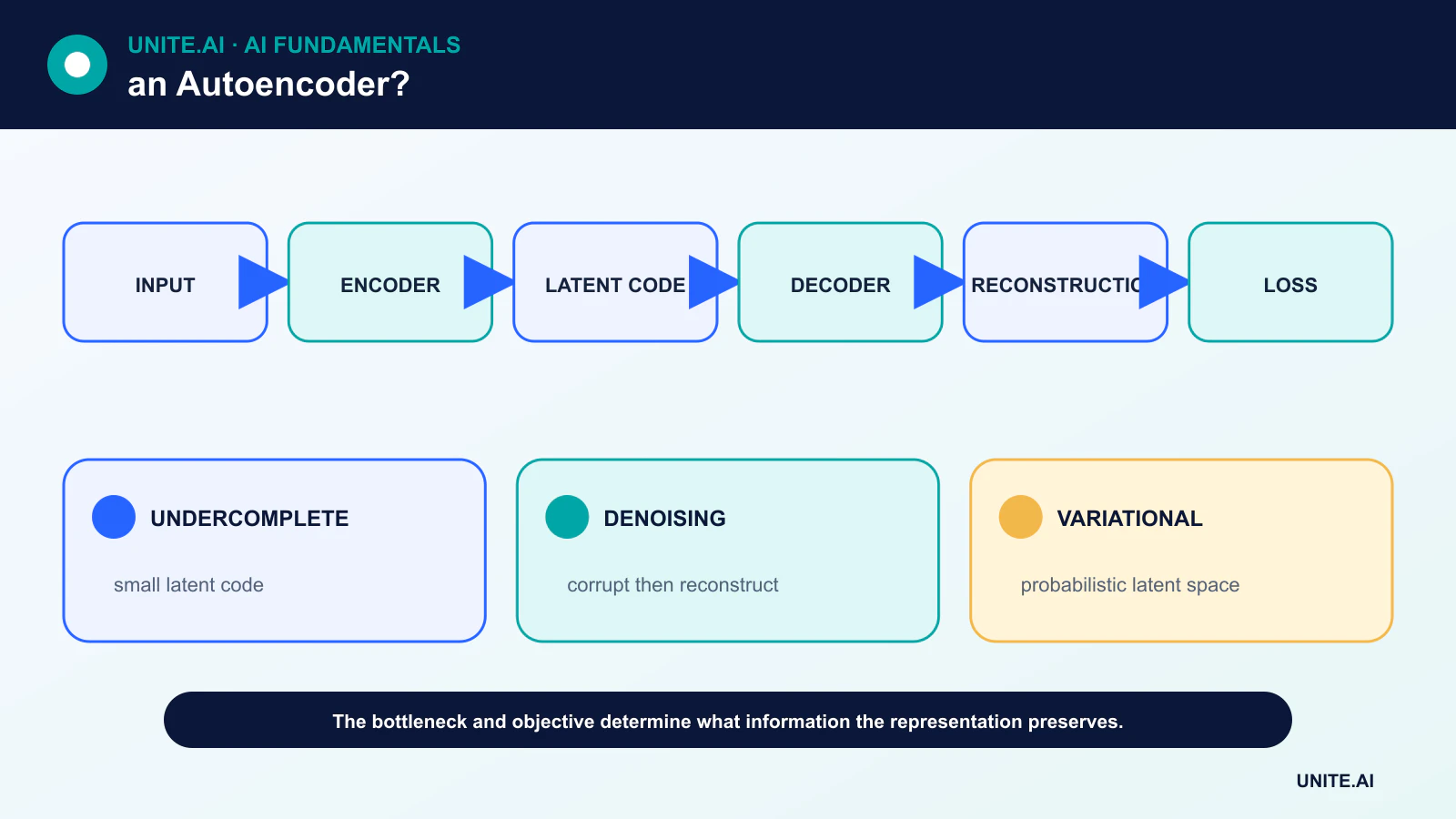
An autoencoder is a neural network trained to reconstruct its input. An encoder maps the input to a latent representation; a decoder maps that representation back to a reconstruction. Training minimizes a reconstruction loss, sometimes with additional constraints.
Copying the input perfectly is not automatically useful. The architecture or objective must create a bottleneck, add noise, impose sparsity or otherwise prevent a trivial identity mapping so the latent code captures useful structure.
Key takeaways
- The encoder compresses or transforms an input; the decoder reconstructs it from a latent code.
- An undercomplete bottleneck, noise or regularization encourages the model to learn structure rather than copy.
- Reconstruction error can support anomaly detection, but anomalies are not guaranteed to have high error.
- Variational autoencoders learn a probabilistic latent model and differ from deterministic autoencoders.
Encoder, latent space and decoder
For input x, the encoder produces latent code z = f(x) and the decoder produces reconstruction x̂ = g(z). The loss compares x and x̂, for example with mean squared error for continuous values or a likelihood suited to the data.
The latent dimension can be smaller than the input, creating an undercomplete autoencoder. A deep network can also learn nonlinear representations, extending the idea behind dimensionality reduction.
Common autoencoder variants
A sparse autoencoder penalizes widespread activation. A denoising autoencoder receives a corrupted input and reconstructs the clean version. A contractive autoencoder penalizes sensitivity of the code to small input changes.
A variational autoencoder (VAE) encodes parameters of a probability distribution, samples a latent value and balances reconstruction with a regularization term that shapes the latent space. This supports sampling but changes the objective and interpretation.
Training and avoiding trivial solutions
Autoencoders use backpropagation like other neural networks. A network with excessive capacity can memorize training examples or learn a near-identity function. Bottleneck size, corruption, penalties and validation on unseen data constrain it.
Loss choice matters. Pixel-wise loss may produce blurry image reconstructions, while perceptual losses inherit assumptions from another network. The best reconstruction metric is not necessarily the best measure of semantic similarity.
Uses and limits
Autoencoders can learn features, denoise signals, compress data, initialize models and produce latent variables for visualization. For anomaly detection, a model trained on normal data may assign higher reconstruction error to unusual inputs.
That approach can fail when the autoencoder also reconstructs anomalies well or when harmless variation is harder to reconstruct than the target anomaly. Thresholds need labeled or carefully reviewed validation data, and error should be monitored by subgroup and operating condition.
Autoencoders versus other generative models
A deterministic autoencoder is not automatically a probabilistic generative model. VAEs define a structured latent distribution; GANs train a generator against a discriminator; diffusion models learn a denoising process.
Choice depends on whether the goal is reconstruction, representation, likelihood, sample fidelity, controllability or anomaly scoring. A smaller task-specific model is often more practical than a large image generator.
Encoder–decoder objectives and latent representations
An autoencoder learns an encoder that maps input x to a latent code z and a decoder that reconstructs x from z. If capacity is unrestricted, it may learn an identity mapping with little useful structure. Bottlenecks, regularization, corruption, sparsity, or architectural constraints force a representation that preserves selected information. The reconstruction loss defines what counts as similar: mean squared error favors average pixel fidelity, while perceptual or modality-specific losses emphasize different features. A low loss does not guarantee semantic meaning.
Undercomplete autoencoders restrict latent dimension. Denoising autoencoders reconstruct clean data from corrupted input. Sparse variants penalize activation; contractive variants penalize sensitivity. Variational autoencoders learn a probabilistic latent distribution by combining reconstruction with a divergence term, enabling sampling but changing the objective. Convolutional, sequence, graph, and transformer autoencoders encode modality structure. Choose latent size and regularization through downstream validation, not attractive two-dimensional plots alone.
Anomaly detection, compression, and evaluation
For anomaly detection, train on representative normal data and score reconstruction error or latent likelihood, but anomalies can sometimes reconstruct well and rare normal cases poorly. Select thresholds on labeled or reviewed validation cases, report event-level recall and false alarms, and test changes in operating state. Compare with simple statistical and one-class baselines. For compression, count the complete codec—including model size, quantization, metadata, and decode compute—and compare quality at matched bitrate with established codecs.
Representation quality can be evaluated through linear probes, clustering stability, retrieval, reconstruction, and downstream tasks, each answering a different question. Avoid leakage when learning the encoder and selecting thresholds. Inspect which features the loss ignores and whether sensitive attributes remain encoded. A compressed latent is not automatically anonymized; inversion and attribute inference may recover private information. Generated reconstructions can also look plausible while altering critical details.
Deployment and monitoring
Version encoder and decoder together, validate numeric changes after export, and preserve input scaling. Monitor reconstruction distribution, latent drift, threshold alerts, and confirmed outcomes. In industrial monitoring, condition the model on operating mode so normal transitions are not treated as faults. For medical or scientific reconstruction, never present a generated detail as measured evidence without validation and provenance. Autoencoders are flexible representation learners, but the constraints and loss—not the architecture name—determine what information is retained, discarded, or fabricated.
Worked example: an autoencoder for pump anomalies
An undercomplete autoencoder learns vibration windows from verified healthy pump operation across load and temperature. It is compared with statistical thresholds and one-class methods, and its reconstruction threshold is selected on reviewed normal transitions and known faults. Evaluation uses event recall, warning lead time, false alerts per operating hour, and results by pump, not random windows that place adjacent samples in train and test.
The production model conditions on operating state and exposes residual patterns to engineers. A high error requests inspection; it does not diagnose the part or stop the pump automatically. Sensor disconnect, clipping, and unseen load produce explicit invalid states. Monitoring tracks reconstruction distribution, alert confirmation, and sensor health. When maintenance or hardware changes the baseline, the old model remains available while a candidate is trained on reviewed data and replayed against historical incidents.
Implementation evidence and operational readiness
A production decision needs more than a successful demonstration. Define the intended users, operating environment, inputs, outputs, dependencies, owner, and the consequence of each important failure. Establish a reproducible baseline and a versioned evaluation set before tuning. Test ordinary cases, boundary conditions, malformed or missing input, distribution shift, dependency outage, misuse, and the groups or environments most likely to be underserved. Measure task quality together with calibration or uncertainty, latency, throughput, resource cost, accessibility, privacy, and security. Record every transformation and threshold so an independent reviewer can reproduce the result and distinguish evidence from an attractive prototype.
Before launch, assign authority for release, exceptions, changes, rollback, and retirement. Use a staged rollout, preserve a safe fallback, and verify monitoring with deliberately injected failures. Operational telemetry should reveal input quality, output behavior, model or rule version, dependency health, human overrides, and confirmed outcomes without collecting unnecessary sensitive data. Define alert thresholds and a response owner, then review real-world evidence after deployment rather than assuming offline performance will persist. Reevaluate whenever data sources, users, models, vendors, policies, hardware, or objectives change. A maintained system also needs documented recovery, incident learning, deletion and retention procedures, and a clear point at which it should be disabled or replaced.
Frequently asked questions
Are autoencoders lossless compression?
Not generally. They usually learn task- and distribution-specific lossy representations and require the trained decoder to reconstruct data.
Is every bottleneck interpretable?
No. A compact code can be useful without each dimension mapping to a human-readable concept.
Primary references