AI Fundamentals
What Is Albumentations? Image Augmentation for Computer Vision

 Add Unite.AI to your preferred sources on Google
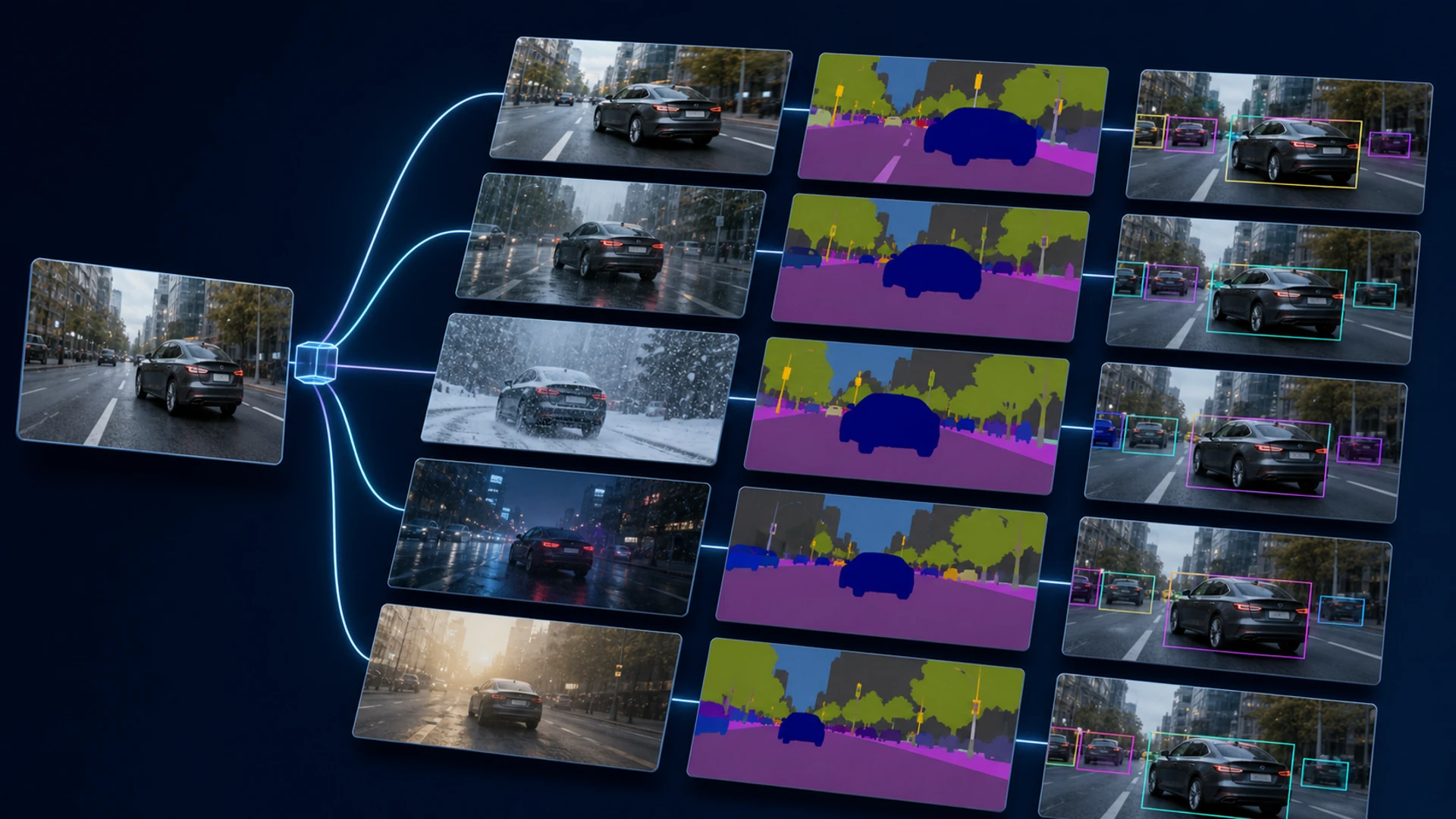
Albumentations is an open-source Python library for image augmentation. It applies randomized geometric and photometric transforms while keeping related targets—such as segmentation masks, bounding boxes, and keypoints—aligned with the image.
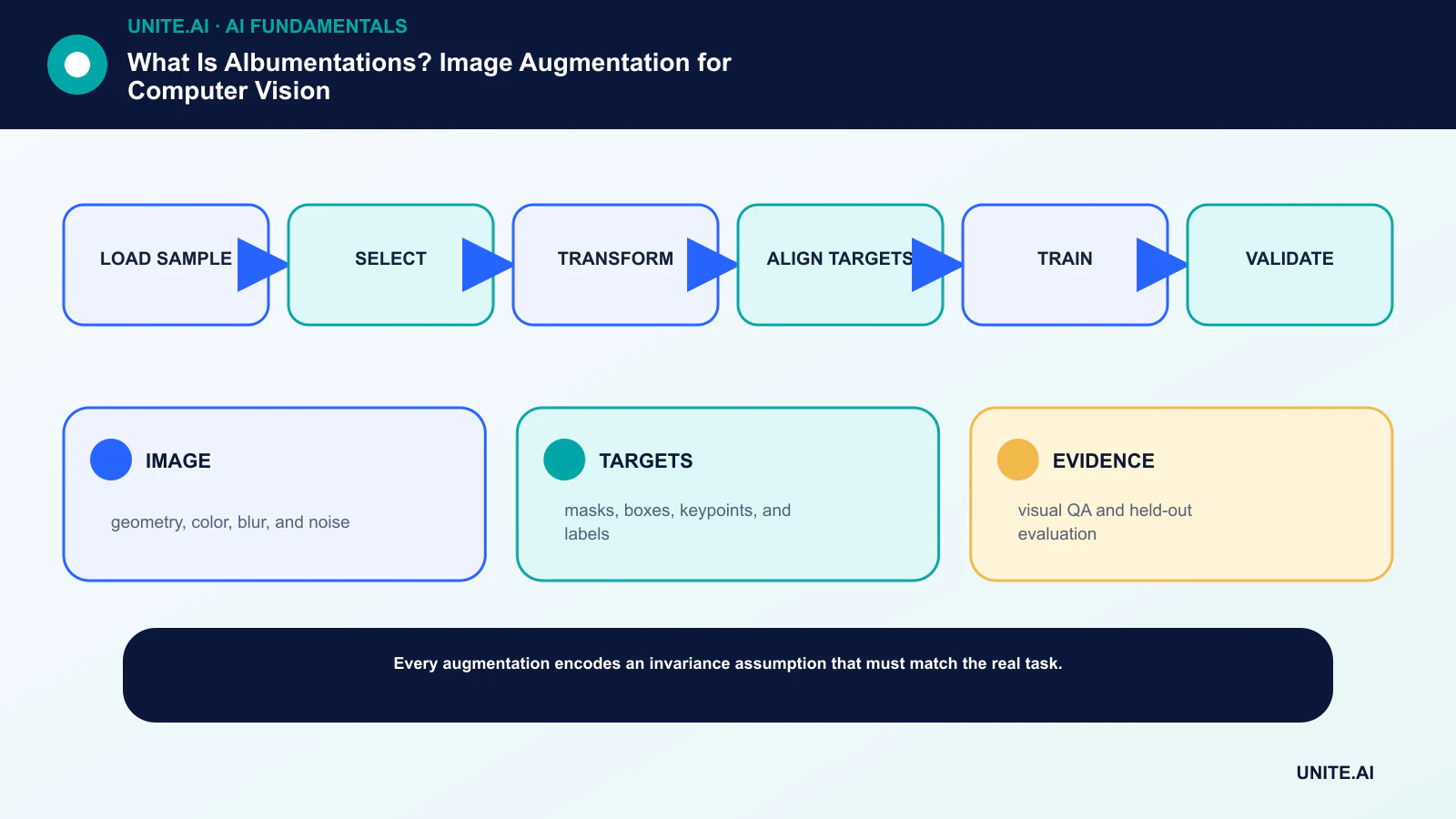
Augmentation is an assumption about invariance: it tells a model that selected changes should not alter the task label. A fast library makes experiments easier, but only domain knowledge and validation can determine whether a transform is legitimate.
Key takeaways
- Compose probabilistic transforms into a reproducible training pipeline.
- Transform images and spatial targets together; validate box and keypoint conventions explicitly.
- Apply random augmentation to training data, not to the untouched validation or test distribution.
- Measure per-class and subgroup effects because stronger augmentation can help one case and harm another.
How an Albumentations pipeline works
A pipeline receives an image and named targets, samples transforms according to their probabilities, and returns a dictionary of updated outputs. Geometric transforms can crop, rotate, flip, or distort; photometric transforms can alter color, contrast, blur, or noise.
The library integrates with training stacks while remaining focused on augmentation. For computer vision, this separation makes it possible to benchmark data policies independently from the model framework.
Keep labels geometrically correct
A crop that changes an image must also crop its mask and update or remove affected boxes and keypoints. Configure the coordinate format, label fields, minimum visibility, clipping, and filtering rules, then visualize batches before training.
Interpolation differs by target: an image may use bilinear interpolation, while a class mask generally needs nearest-neighbor interpolation to avoid inventing category values. Incorrect target handling can silently corrupt the dataset.
Choose transforms from the deployment world
A horizontal flip may be valid for wildlife photos but wrong for text, road signs, medical laterality, or asymmetrical equipment. Color changes may improve lighting robustness yet erase a diagnostic feature when color carries meaning.
Start with plausible nuisance variation, add one family at a time, and inspect hard examples. Link choices to overfitting hypotheses instead of assuming that more synthetic variety is always better.
Reproducibility and evaluation
Record library version, pipeline configuration, probabilities, random-seed strategy, preprocessing order, and normalization. Randomness should vary training samples while experiments remain reproducible at the run level.
Keep validation and test images representative and unaugmented except for deterministic preprocessing. Compare accuracy, calibration, per-class errors, and robustness. Confusion matrices can reveal when an augmentation shifts error rather than reducing it.
Composition, probabilities, and targets
Compose applies a sequence of transforms, each with a probability. OneOf or SomeOf constructs sample among alternatives, and nested probabilities determine the actual distribution. The effective augmentation policy is therefore a stochastic program; record it and inspect sampled frequencies rather than reading each probability in isolation.
Additional targets let several images or masks share geometry, which is useful for stereo pairs, before-and-after imagery, or multiple annotations. Bounding-box support requires a declared format such as Pascal VOC, COCO, YOLO, or Albumentations coordinates. Keypoint formats may include angle or scale, and transforms must preserve those semantics.
Crops can remove every target. Decide whether to resample, keep a background example, or filter it, because each choice changes the class distribution. Detection and segmentation pipelines should log discarded boxes, visible fractions, and empty samples to reveal silent label damage.
Policy design by task
Classification often tolerates crops, color changes, blur, and occlusion when the class remains visible. Detection needs objects and boxes transformed together. Segmentation requires exact mask geometry. Pose estimation must preserve keypoints and may need left-right label swaps after flipping.
Medical imaging may prohibit flips, aggressive color changes, or interpolation that alters quantitative intensity. Remote sensing must consider orientation, season, sensor bands, and geospatial scale. Document analysis must preserve legibility and layout. The domain defines invariance; the library only executes it.
Mixing methods such as MixUp, CutMix, Mosaic, or copy-paste create composite labels and may occur in the data loader or framework rather than Albumentations. Their interaction with basic transforms, normalization, and batching should be tested. Strong policies can slow convergence or change calibration even when final accuracy improves.
Performance, debugging, and experiment design
Augmentation runs on CPU unless a different path is used. Measure data-loader throughput, worker count, decode cost, memory copies, and GPU idle time. Faster transforms are valuable only if they do not alter semantics. Cache immutable decode or preprocessing stages when storage and reproducibility allow.
Visualize grids of original and transformed samples with every target overlay. Add automated tests for coordinate round trips, mask values, shape, dtype, and deterministic replay. Set seeds at the correct scope; identical augmentation across all workers can unintentionally reduce diversity.
Run ablations against a fixed baseline: no augmentation, plausible basic transforms, then stronger policies. Repeat seeds and report variance. Evaluate clean data, relevant corruptions, and subgroups separately. Keep a policy only when its benefit survives held-out testing and the transformed images remain credible to domain experts.
Designing and validating an Albumentations pipeline
Start from the variations expected after deployment: camera angle, crop, scale, illumination, compression, blur, weather, occlusion, and sensor noise. Choose transformations that preserve the label and match those mechanisms. A horizontal flip may be valid for animals but invalid for text, traffic orientation, or asymmetric anatomy. Strong color changes can destroy diagnostically relevant information even if the image still looks plausible.
Albumentations composes transforms and applies spatial changes consistently to images, masks, bounding boxes, and keypoints when configured correctly. Declare coordinate formats, minimum visibility, interpolation, and mask handling explicitly. Visualize hundreds of augmented samples with annotations overlaid, test empty and boundary cases, and save the randomized parameters for debugging. Split data by subject or scene before augmentation so related images do not leak across train and test.
Compare no augmentation, simple augmentation, and the proposed policy on an untouched test set and realistic stress sets. Track class-specific accuracy, localization, calibration, and failure examples, not only training loss. Excessive augmentation can underfit the real distribution, while weak augmentation can encourage shortcut learning. Version the pipeline with the model, seed evaluation runs, and avoid applying random training transforms during validation or inference unless test-time augmentation is deliberately evaluated.
For detection and segmentation, verify coordinate clipping, minimum box area, keypoint visibility, and the interpolation used for categorical masks. Nearest-neighbor interpolation is typically required for class IDs, whereas bilinear interpolation can create invalid labels. Profile the data loader as well: aggressive transforms can make CPU augmentation the training bottleneck. Cache only transformations that are deterministic and preserve the intended randomness across epochs and workers.
Practical implementation checklist
Turn the concept into a bounded, testable workflow: load sample → select → transform → align targets → train → validate. Name an accountable owner, document the data and dependencies, establish a simple baseline, set acceptance and stop criteria, test representative failures, and define monitoring, rollback, and review before expanding scope. Record versions and assumptions so another team can reproduce the result and understand what changed.
Before launch, run a documented readiness review with the people who build, operate, secure, and are affected by the system. Test normal cases, boundary conditions, dependency failures, and misuse; preserve the evidence and unresolved risks. Define who can approve release, change a threshold, override an output, or stop operation. Revisit the decision after real-world data arrives, because a technically successful pilot does not guarantee reliable performance at broader scale.
- IMAGE: geometry, color, blur, and noise.
- TARGETS: masks, boxes, keypoints, and labels.
- EVIDENCE: visual QA and held-out evaluation.
Frequently asked questions
Does image augmentation create new ground truth?
No. It creates transformed training examples under an assumption that labels remain valid. An unrealistic or incorrectly labeled transform introduces noise.
Should validation images be augmented?
Use deterministic resizing and normalization needed by the model, but keep the evaluation distribution fixed. Test-time augmentation is a separate inference method and should be reported explicitly.
Primary references