AI Fundamentals
Electronic Skin for Humanoid Robotics: How It Works

 Add Unite.AI to your preferred sources on Google
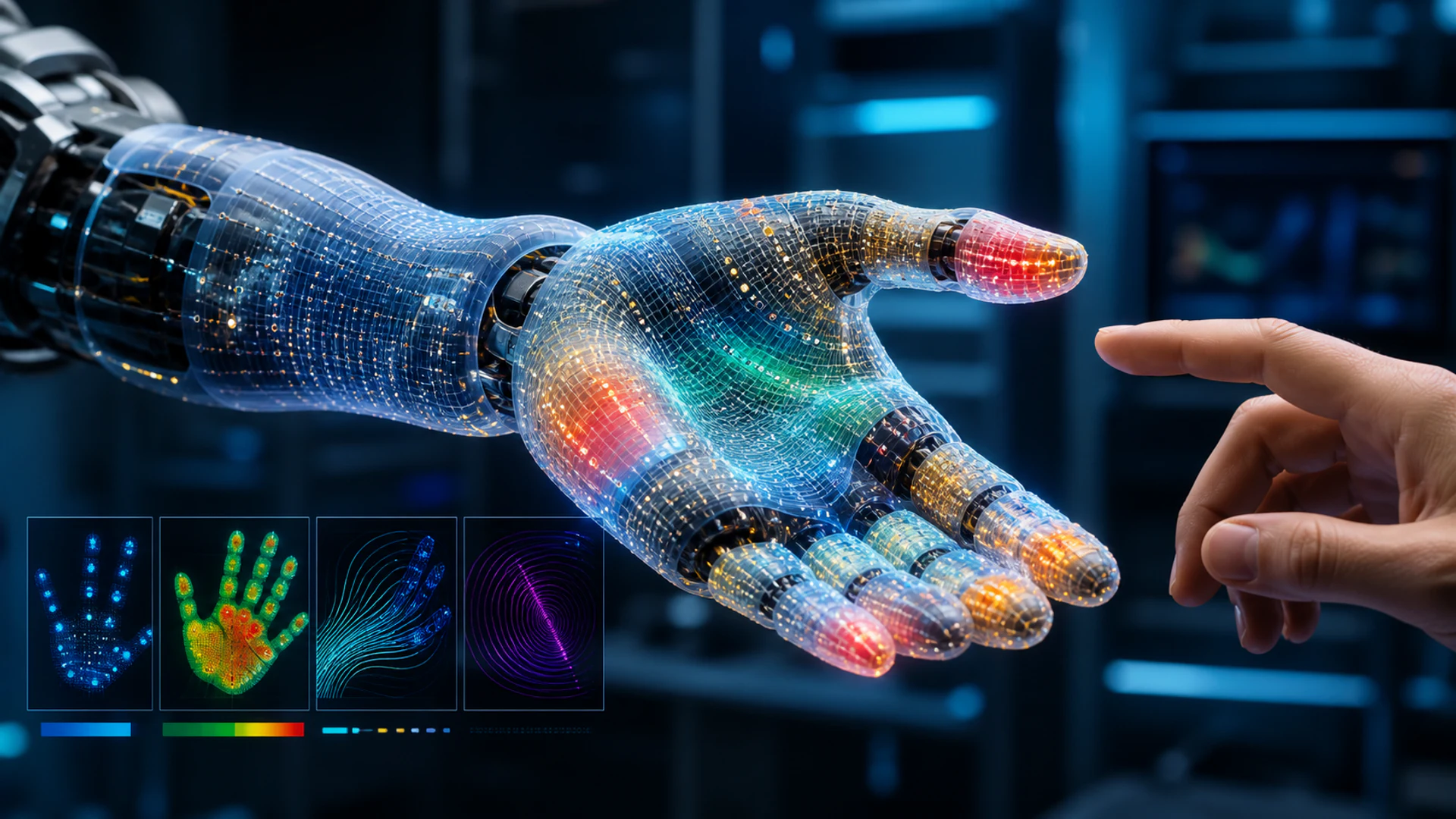
Electronic skin (e-skin) is a flexible or conformable sensing layer that gives a robot information about contact and the nearby environment. Depending on the design, it can measure pressure, shear, strain, temperature, vibration or proximity across a surface.
The original 2020 research highlighted on this page demonstrated energy-autonomous proximity sensing for human–robot interaction. Since then, the field has continued toward multimodal arrays, soft robotic hands and sensor systems that combine perception with feedback.
Key takeaways
- E-skin is a system of materials, sensors, wiring, signal conditioning and inference—not a single sensor.
- Different transduction methods convert force, deformation, heat or proximity into electrical signals.
- Spatial coverage, sensitivity, durability, wiring and calibration trade against one another.
- Safe robot behavior requires the tactile signal to be fused with control, not merely displayed.
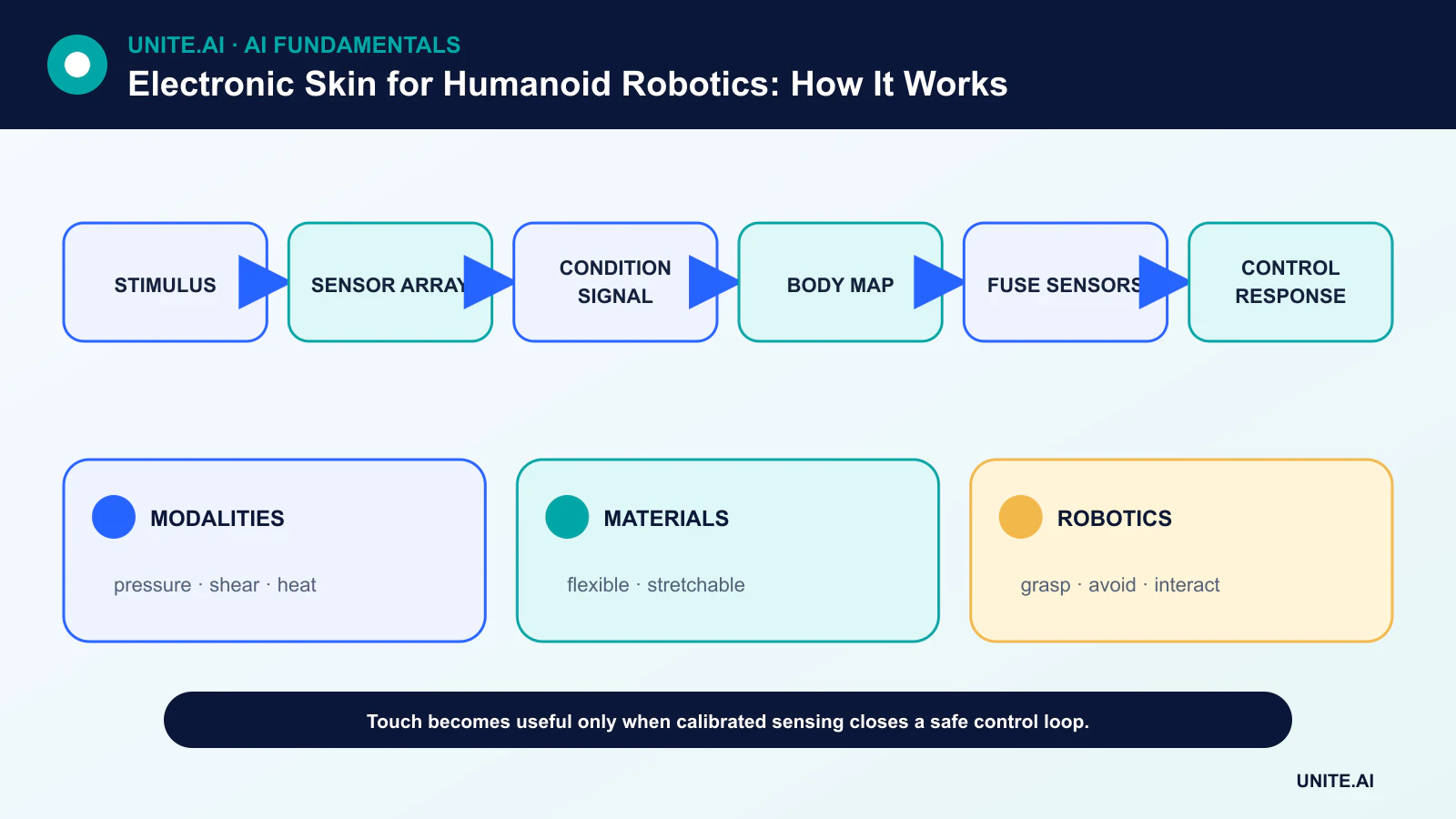
What an electronic skin measures
Pressure is force per area; shear is force parallel to the surface; strain describes deformation. Temperature and proximity add context before and during contact. A multimodal skin can help distinguish a gentle touch from slip, impact or a nearby obstacle.
Sensor density should follow the task. Fingertips may need fine spatial resolution, while a torso may prioritize broad collision detection and robust coverage.
Transduction and flexible materials
Capacitive sensors detect changes in capacitance; piezoresistive sensors change resistance under deformation; piezoelectric materials produce charge under dynamic stress; optical and magnetic designs infer deformation through light or field changes.
Flexible polymers, conductive composites, printed traces and soft encapsulation let arrays conform to curved bodies. Materials must survive repeated bending, abrasion, sweat, dust and temperature changes without losing calibration.
From raw signal to body map
Rows and columns of taxels—tactile pixels—are scanned and converted into digital values. Signal conditioning handles noise, drift and cross-talk. Calibration maps electrical response to physical quantities, often separately for each sensor and temperature range.
An edge AI processor can detect contact patterns locally, reducing latency and cable bandwidth. Neural networks may estimate contact location or slip, but they need data covering deformation and sensor aging.
Closing the robot-control loop
A controller combines tactile data with joint position, force, vision and task state. It may slow a gripper, change grasp force, withdraw from unexpected contact or alert a nearby person. Reaction deadlines and safe fallback behavior should be defined before model selection.
Reinforcement learning can train manipulation policies, but the e-skin must expose calibrated signals and the policy must respect hard safety limits.
Research and deployment limits
Large-area skins face wiring, power and repair challenges. Stretching changes geometry, and a damaged taxel can distort nearby measurements. Manufacturing a consistent laboratory prototype at humanoid scale remains difficult.
Evaluation should report sensitivity, hysteresis, response time, drift, cycle life, spatial resolution and performance on the intended curved surface. Demonstrating one stimulus in a controlled setup is not the same as robust daily interaction.
Materials and sensing mechanisms
Electronic skin is a flexible or stretchable sensor system designed to measure contact, pressure, strain, temperature, proximity, humidity, chemicals, or damage across a surface. Piezoresistive sensors change resistance under deformation; capacitive sensors change geometry and capacitance; piezoelectric and triboelectric materials generate charge from motion; optical, magnetic, and ionic mechanisms support other tradeoffs. A practical skin combines sensing elements with flexible conductors, encapsulation, signal routing, and attachment to a curved moving robot.
Performance is not one sensitivity number. Relevant measures include spatial resolution, pressure or strain range, hysteresis, drift, response and recovery time, repeatability, crosstalk, durability, temperature dependence, and minimum detectable signal. Soft materials can match human contact but fatigue, delaminate, or change calibration. Dense arrays create large wiring and data requirements, motivating multiplexing, local electronics, wireless links, or neuromorphic event encoding. Power and heat must remain compatible with safe contact.
Perception, calibration, and robot control
Raw signals need baseline correction, filtering, calibration, localization, and conversion into contact features. Models can classify material, detect slip, estimate force distribution, or infer grasp stability, but training data must cover robot geometry, speed, wear, temperature, objects, and contact angles. Separate sensor sessions and physical units across train and test to avoid learning one skin’s quirks. Ground truth from force plates, motion capture, or controlled fixtures should include uncertainty.
Control loops must match sensor latency and reliability. A manipulator can reduce grip force when slip disappears or stop when unexpected contact exceeds a threshold, but safety should not rely solely on a learned skin model. Use independent torque, position, and emergency controls. Define behavior for dead taxels, disconnected regions, saturation, and drift. Calibration and self-test should be observable to the robot rather than treating missing data as zero contact.
Manufacturing, safety, and applications
Applications include gentle grasping, collision detection, prosthetics, teleoperation, rehabilitation, and human–robot interaction. Production needs reproducible materials, repair, cleaning, biocompatibility where relevant, connector reliability, and replaceable modules. Evaluate repeated cycles and real contaminants, not only a short laboratory demonstration. Skin data can reveal touch patterns or health information, so access and retention need control. Electronic skin expands robot perception, but safe behavior emerges from the full sensing, estimation, control, mechanical, and governance stack.
Worked example: tactile grip control
A robotic gripper uses a flexible pressure-and-shear array to detect contact and incipient slip. Calibration covers force, object materials, temperature, curvature, and repeated cycles. A model estimates slip from temporal patterns, compared with deterministic thresholds. Train and test objects, sensor skins, and sessions are separated. Evaluation reports slip detection lead time, false release, force error, dead-taxel tolerance, and performance after wear and cleaning.
The controller can adjust grip within certified limits, but independent torque and emergency controls prevent injury or dropped hazardous objects. A self-test maps failed sensor regions and rejects operation when coverage is inadequate. Signals and firmware are versioned and monitored for drift. Human-touch data is not retained beyond need. Replacing the skin triggers recalibration and validation. The tactile model supports grasping; it does not infer pain, emotion, or human intent from contact.
Implementation evidence and operational readiness
A production decision needs more than a successful demonstration. Define the intended users, operating environment, inputs, outputs, dependencies, owner, and the consequence of each important failure. Establish a reproducible baseline and a versioned evaluation set before tuning. Test ordinary cases, boundary conditions, malformed or missing input, distribution shift, dependency outage, misuse, and the groups or environments most likely to be underserved. Measure task quality together with calibration or uncertainty, latency, throughput, resource cost, accessibility, privacy, and security. Record every transformation and threshold so an independent reviewer can reproduce the result and distinguish evidence from an attractive prototype.
Before launch, assign authority for release, exceptions, changes, rollback, and retirement. Use a staged rollout, preserve a safe fallback, and verify monitoring with deliberately injected failures. Operational telemetry should reveal input quality, output behavior, model or rule version, dependency health, human overrides, and confirmed outcomes without collecting unnecessary sensitive data. Define alert thresholds and a response owner, then review real-world evidence after deployment rather than assuming offline performance will persist. Reevaluate whenever data sources, users, models, vendors, policies, hardware, or objectives change. A maintained system also needs documented recovery, incident learning, deletion and retention procedures, and a clear point at which it should be disabled or replaced.
Frequently asked questions
Is electronic skin the same as artificial human skin?
It can mimic selected sensory or mechanical properties, but it does not reproduce the full biological functions of human skin.
Why does a robot need touch if it has cameras?
Vision cannot reliably infer every contact force, slip event or occluded interaction. Tactile sensing provides local physical evidence.
Primary references