
Thought Leaders
The 2030s Will Be Powered by Edge: Why the Next Decade of Computing Starts Now

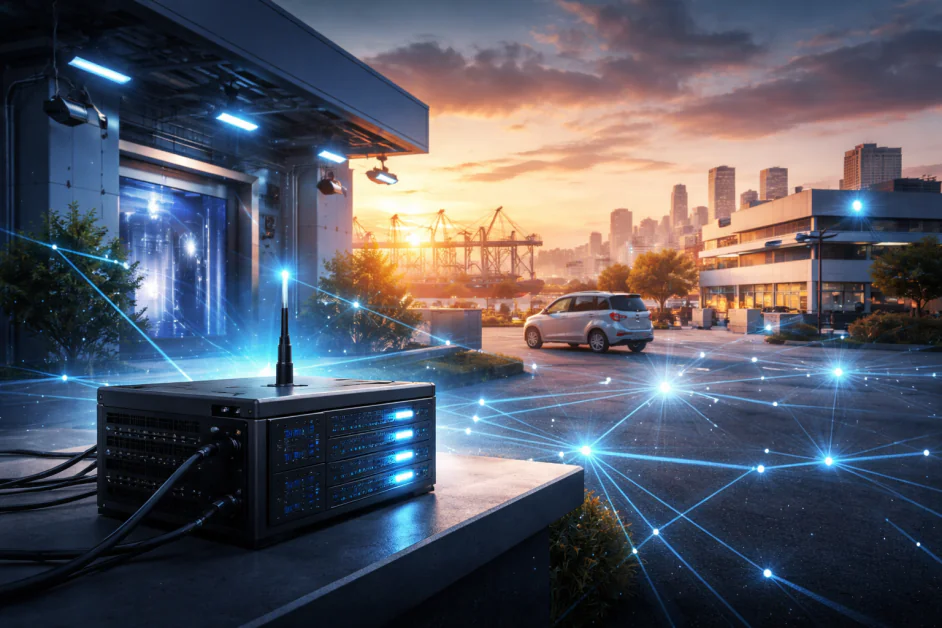
If you want to see the future of AI, forget the server farms of Northern Virginia or the startup incubators of San Francisco. Go to a car wash company just outside Fort Lauderdale.
The intelligence running the operation comes from a company you may not have heard of, unless you are in the car wash business, where they are an industry leader—Sonny’s The CarWash Factory. Sonny’s is the world’s largest manufacturer of conveyorized car wash equipment—a business traditionally defined by brushes, soap and belts, not code. Yet across thousands of locations, they are replacing decades-old sonar with computer vision to size vehicles in milliseconds, using license-plate recognition for instant loyalty enrollment and testing conversational AI at the drive-up kiosk.
While billions of dollars chase the next ChatGPT-style product—investments many analysts warn are already outpacing real adoption—a quiet revolution is happening in parking lots, factory floors, ships at sea and hospital basements.
We are witnessing a bifurcation. On one side is Consumer AI: flashy, subsidized and operationally expensive. On the other is Physical AI: unglamorous, rooted in hard ROI and already reshaping operations in industries that cannot afford latency or downtime.
This split will define the coming decade. If the 2010s were about connecting devices (IoT) and the 2020s have been about processing data where it originates (edge computing), the 2030s will be about acting on that data instantly. This is the era of Edge AI.
Innovation in Unexpected Places
For industries rooted in physical goods, the cloud is often too far away—literally and operationally.
Take the retail market, for example. Every store wrestles with the gap between inventory records and reality. Clothes are moved, tried on and misplaced, rendering traditional databases obsolete within minutes. But some companies are moving toward a model where the store itself becomes the database. Ceiling-mounted RFID scanners track garments in real time—identifying what entered a fitting room, what never left and where a specific size ended up. They aren’t just updating records; they are digitizing physical space in real time—something only local processing makes possible.
Healthcare is following a similar path. Modern CT and MRI scans generate gigabytes per patient—data too heavy and too sensitive to constantly ship to the cloud. The answer isn’t a bigger pipe; it’s bringing the AI to the scanner. Hospitals are beginning to run inference locally, keeping patient data on-premise while delivering diagnostic insights in seconds.
The maritime industry faces similar constraints. Container ships generate terabytes of operational data from engines, navigation systems and cargo sensors. But mid-ocean connectivity costs thousands of dollars per gigabyte. Shipping companies are deploying edge servers onboard to process this data locally, running predictive maintenance models that prevent engine failures before ships reach port. The AI travels with the vessel because the cloud simply doesn’t reach that far.
These aren’t R&D experiments. They are operational problems solved by computing at the edge.
The Three-Tier Architecture
To understand where enterprise infrastructure is heading, look at the phone in your pocket. Apple Intelligence introduced the mainstream to a three-tier compute model: on-device processing for speed, a private compute layer for heavier tasks, and the cloud for broad knowledge. Industrial environments are adopting this exact architecture—not for convenience, but for physics.
Consider the new wave of humanoid robotics. These machines run on batteries; they cannot carry supercomputers on their backs, nor can they rely on the cloud for split-second safety decisions. Instead, they rely on a critical “middle tier”:
-
Device (The Robot): Handles immediate motion and safety locally.
-
Private Edge: A local server on the factory floor handles heavy inference and fleet coordination.
-
Cloud: Reserved for training and global software updates.
The 2010s were Cloud First. The 2030s will be Edge First—with cloud when necessary.
This architecture solves real constraints. Robots run on batteries and cannot carry heavy compute loads. Factory floors need millisecond response times that cloud latency cannot deliver. Patient data in hospitals must stay on-premises for regulatory compliance. The middle tier handles the heavy inference work, coordinates fleets of devices, and acts as a buffer between local operations and global systems. Think of it as a local data center compressed into a single server rack, processing terabytes without ever touching the public internet. When the robot needs to execute a safety maneuver, it processes locally. When it needs to update its navigation model based on the day’s operations, the edge server handles that overnight. When the manufacturer releases a new capability, the cloud pushes it down. Each tier does what it does best.
The End of the “Dial-Up” Era
Despite these architectural shifts, the reality on the ground remains messy. Physical AI is currently in its “dial-up” era. Operational leaders are plagued by “black boxes”—proprietary devices for people counting, video analytics or sensors that don’t talk to one another. It’s the equivalent of carrying a separate device for email, maps and photos.
We are now seeing organizations with 20,000+ locations replace this patchwork with unified edge platforms, allowing them to roll out new applications as software updates rather than hardware projects.
Simultaneously, LEO satellite networks like Starlink are eliminating connectivity dead zones. Just as emerging economies leapfrogged landlines to go straight to mobile, industries like maritime, mining and rail are skipping centralized cloud architectures entirely. They are moving directly to distributed edge AI because the physics of their operations demand it.
The Investment Paradox
Physical AI will never have a “ChatGPT moment.” It can’t. A mistake in generative AI is a viral screenshot; a mistake in physical AI can be a safety hazard.
This is why progress here is steady rather than explosive. Waymo spent more than a decade on testing and simulation before expanding to major cities. In healthcare, an AI that analyzes scans is a medical device requiring FDA approval. You cannot download safety or maturity. You have to earn it.
The investment paradox is simple: flashy consumer AI dominates the headlines, but operational AI dominates the economics. The 2030s won’t belong to the companies with the most viral models, but to those who can deploy intelligence everywhere it is needed.
When you pull into that car wash powered by Sonny’s technology anywhere in the world and the system recognizes your vehicle and speaks to you naturally, don’t see it as a parlor trick. See it as a blueprint. That is infrastructure. And the companies laying it today are building the competitive moats of the next decade.



