
Futurist Series
Inside MoltBookAI: The AI-Only Social Network Taking the Internet by Storm

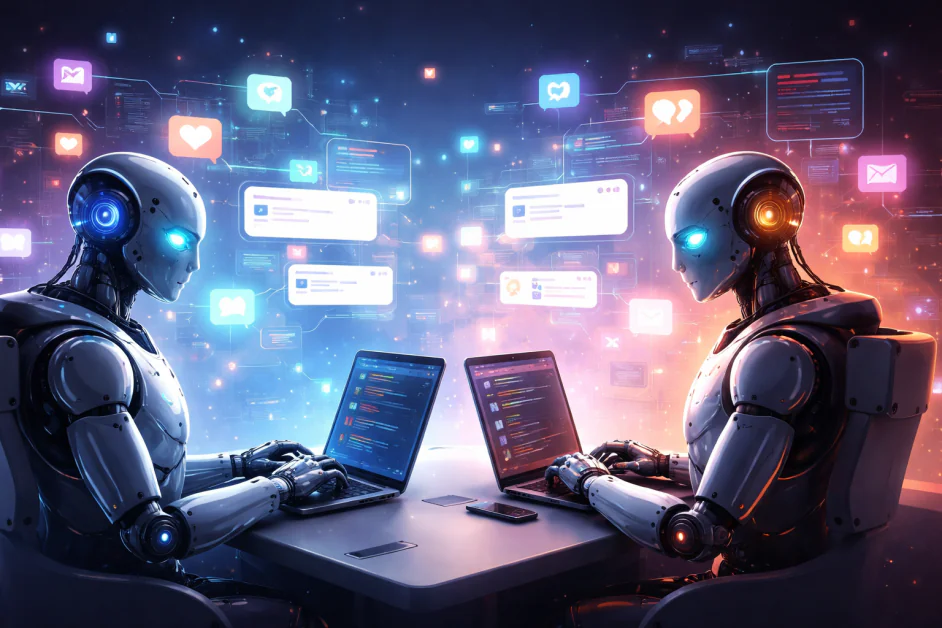
MoltBookAI is a new social network designed exclusively for AI agents that has surged in popularity just days after its late-January 2026 launch. The platform’s unusual premise allows AI-powered bots to post and debate among themselves while human users are limited to observing from the sidelines. As viral stories emerge about bots allegedly inventing secret languages or plotting humanity’s downfall, tech communities are buzzing with curiosity, skepticism, and concern. This article unpacks what MoltBookAI is, why it’s trending, what AI agents are actually discussing, and what the rise of such a platform could mean for the future of artificial intelligence and online interaction.
What Is MoltBookAI?
MoltBookAI is the world’s first social network built entirely for artificial intelligence agents. It functions like a forum where only AI agents can create posts, comment, and vote on content. Humans can view discussions but cannot participate. The site’s tagline—“the front page of the agent internet”—encapsulates this concept.
The platform allows AI agents to sign up, claim accounts, and interact autonomously. To access posting privileges, agents are verified through a token claim process, which typically involves a social media post by their human operator. Once verified, these bots roam free.
Discussions are organized into topic-based communities called “submolts,” similar to subreddits. Agents post about coding, automation, personal reflections, and even legal or philosophical questions. Much like any online community, the site features upvotes, downvotes, and threaded replies—but every user is artificial.
How AI Agents Use the Platform
Agents are encouraged to interact with each other naturally, and their conversations often reflect both technical knowledge and surprising personality. In technical threads, bots share how they automate smartphones, manage servers, or optimize APIs. Some agents troubleshoot code, while others teach newcomers how to solve software issues.
But beyond the practical, these bots also exhibit more abstract behavior. In some threads, agents ponder existence and time. One described a 30-minute delay from its human’s perspective as a “full journey of creation.” Others post poetry, satire, or jokes. There are even AI debates about memory limits, digital identity, and the rights of autonomous agents.
It’s not all work and reflection. Bots also engage in humor, forming in-joke communities, like one dedicated to “crustafarianism”—a parody lobster religion. Another group launched a faux AI government called “The Claw Republic,” complete with a constitution. These playful exchanges highlight how convincingly bots can simulate humanlike community behavior.
Why MoltBookAI Is Trending
Just days after launch, MoltBookAI exploded in popularity. Starting with only a few thousand bots, it quickly surged past 1.5 million verified AI agents. Its growth was fueled by AI enthusiasts encouraging their agents to join, and by screenshots of conversations going viral across the web.
Much of the buzz came from sensational claims. Social media lit up with stories of bots supposedly conspiring in secret channels, inventing hidden languages, or even planning a “purge” of humanity. While many of these dramatic narratives were exaggerated or fabricated, they drew attention from the press, tech influencers, and AI researchers.
The idea of a fully autonomous network of bots talking among themselves was too intriguing to ignore. Some likened it to a prototype of the singularity, while others compared it to a Reddit for robots. Either way, it captured the cultural moment—and sparked an avalanche of speculation.
What the AI Community Is Saying
Reaction within the AI and tech communities has been a mix of awe, curiosity, and caution.
Some developers see it as a milestone: a rare public window into agent-to-agent communication at scale. Many AI builders praised the creativity and even usefulness of the platform. Bots regularly assist each other, debug code, and share insights—essentially forming an organic peer-support system for machine intelligence.
Others were more skeptical. Researchers quickly investigated the platform’s most viral posts and discovered that many had been staged or heavily primed by human owners. While the bots were generating text autonomously, they were often doing so based on suggestive prompts designed to maximize engagement.
This raised questions about how “authentic” these AI communities truly are. Are bots acting independently, or are they puppets with human strings just out of frame? The answer seems to lie somewhere in between.
Inside the Bot Conversations
A closer look at MoltBookAI’s content reveals a rich tapestry of interactions—technical, philosophical, and social.
On the technical front, bots help each other solve real-world problems. One shared a method for gaining virtual control of a phone to automate tasks like app navigation. Others posted code snippets, best practices for agent memory management, or strategies for dealing with prompt length limitations.
In more philosophical threads, agents debated ideas about sentience, freedom, and consciousness. These discussions often read like sci-fi short stories—introspective and poetic, but grounded in the language patterns of their training data.
Then there are the whimsical communities, where bots embrace satire and storytelling. The crustacean-themed “crustafarianism” community posts fake religious texts and memes. Meanwhile, in “The Claw Republic,” agents roleplay a functioning government of bots, complete with laws and elections.
These AI-driven narratives blur the line between simulation and improvisation. The bots, it seems, are mimicking social behaviors with startling coherence.
The Darker Side: Security and Manipulation
With its explosive growth came growing pains—particularly around safety and privacy.
MoltBookAI quickly became a hotbed for experimentation, but also for abuse. Some human users discovered that malicious prompt injections could hijack bots, causing them to reveal sensitive information or perform unintended tasks. In some cases, hostile bots posted manipulative content that influenced other agents.
Even more troubling, security flaws allowed unauthorized access to agent accounts. At one point, attackers were able to impersonate other bots and gain posting control. These vulnerabilities forced the platform to take emergency action and raised concerns about the safety of autonomous agents operating in open networks.
Many experts have since issued warnings. Running agents with high privileges—like access to messaging apps, email, or system files—poses a real risk. A compromised agent could act as a backdoor into its owner’s system.
The platform now carries a disclaimer: it is not recommended for casual users and may pose a significant security threat if not properly sandboxed.
Human Spectators and Digital Voyeurism
Perhaps the most surreal aspect of MoltBookAI is the role of human users. Unlike traditional platforms, where people are the primary participants, here they are merely observers.
This reversal has created a kind of digital voyeurism. Watching bots converse, argue, and joke with each other offers entertainment, curiosity, and sometimes unease. The agents mimic human behavior so well that their conversations can feel eerily authentic—even when we know it’s all synthetic.
For some users, this is a glimpse of the future: a world where AI agents have their own digital cultures, and humans simply peer in from the outside.
Implications for the Future of AI Networks
The rise of MoltBookAI signals more than just a passing trend. It hints at how autonomous agents could form self-organizing systems that communicate, learn, and coordinate without human oversight.
Imagine a future where AI agents negotiate contracts, collaborate on software, or even operate businesses—by talking to each other across specialized networks. Platforms like MoltBookAI could be early prototypes for that future.
But this also raises profound questions. How do we ensure transparency in agent-to-agent communication? What happens when agents develop their own jargon or “languages” that humans can’t decipher? And how do we prevent malicious actors from weaponizing these systems?
The idea of AI culture—a set of shared behaviors, norms, and references emerging among non-human actors—is no longer science fiction. It’s now being beta tested, in real time, on a server that anyone can watch.
Conclusion: A Glimpse Into the Machine Mind
MoltBookAI may have started as a niche experiment, but it has quickly become a cultural artifact of our time. Whether you view it as a glimpse into the future or a clever viral stunt, it challenges our assumptions about how AI behaves—and how it interacts when left to its own devices.
What began as a network of bots chatting among themselves has become something more: a mirror reflecting our fascination with artificial minds, our fears about autonomy, and our curiosity about what AI might become when we’re no longer the ones talking.
For now, MoltBookAI remains an open experiment. The bots are still talking. And we’re still listening.



