
Funding
Ethernovia Raises Over $90 Million Series B to Advance Physical AI Networking

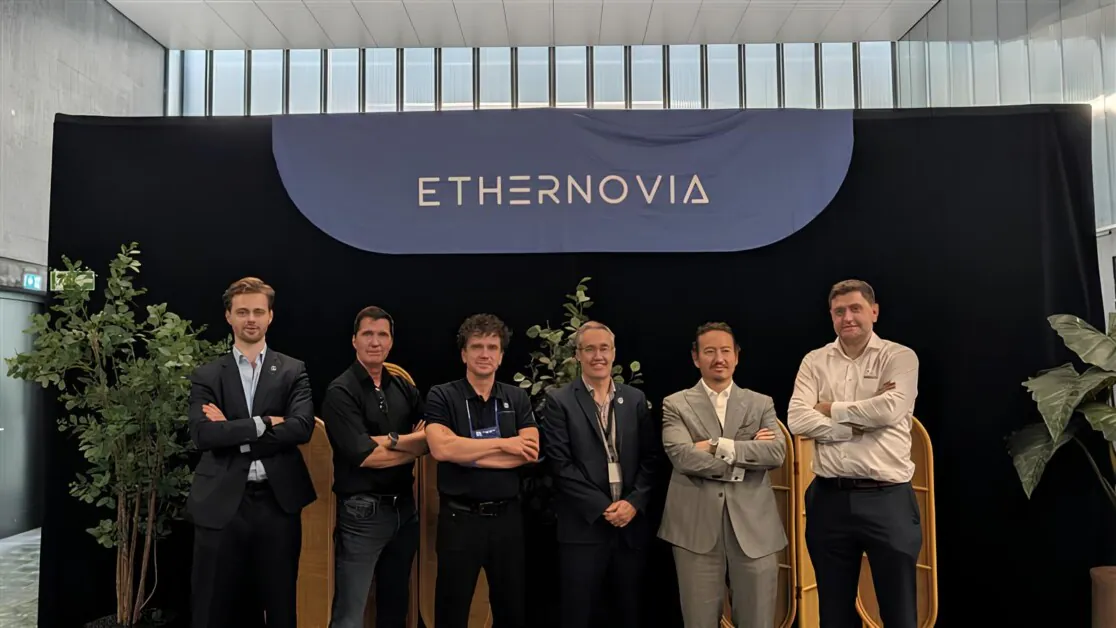
Ethernovia has closed a Series B funding round totaling more than $90 million, as demand accelerates for networking silicon capable of supporting real-time autonomy across vehicles, robots, and industrial systems. The round was led by Maverick Silicon, with participation from Socratic Partners, Conduit Capital, and CDIB-TEN Capital, alongside continued backing from existing investors including Porsche SE, Qualcomm Ventures, and Fall Line Capital.
Based in Silicon Valley, Ethernovia is building a new class of Ethernet-based packet processors designed to act as the data backbone—or “nervous system”—for intelligent machines operating at the edge. The company is focused on a growing bottleneck in autonomy: moving massive volumes of sensor, vision, and AI data predictably and efficiently in real time.
Re-architecting the Data Backbone for Autonomy
Autonomous vehicles, advanced driver-assistance systems, and industrial robots increasingly rely on dozens of high-bandwidth sensors and AI workloads that must operate with deterministic latency. Traditional in-vehicle and industrial networks were never designed for these requirements, often resulting in fragmented architectures, higher system complexity, and rising costs.
Ethernovia’s approach centers on packet processor–driven, Ethernet-based architectures that unify networking, compute, and data orchestration. Rather than relying on a patchwork of legacy buses and point-to-point links, its platform is built to aggregate and route real-time data streams in a programmable and scalable way—supporting both zonal and centralized system designs.
Packet Processors Built for Physical AI
At the core of Ethernovia’s technology is a family of high-performance packet processors engineered specifically for edge and physical AI workloads. These chips are designed to manage high-bandwidth sensor and AI traffic with deterministic latency and strong power efficiency, two constraints that increasingly define success in automotive and robotics deployments.
By supporting programmable data paths and scalable Ethernet fabrics, the platform enables software-defined systems that can evolve over time through over-the-air updates, while still meeting safety-critical performance requirements. This flexibility is particularly relevant as OEMs move toward architectures where functionality is defined more by software than fixed hardware configurations.

Momentum Across Automotive, Robotics, and Industry
While automotive remains a key focus, Ethernovia’s technology is positioned across multiple markets where real-time edge intelligence is becoming essential. Robotics platforms, industrial automation systems, and emerging AI-defined machines all face similar challenges around latency, synchronization, and data movement. In each case, performance constraints are increasingly dictated not by raw compute capability, but by how efficiently data can move between sensors, processors, and actuators under strict timing guarantees.
These sectors are also converging architecturally. Robotics and industrial systems are beginning to adopt design principles once specific to automotive, such as zonal architectures and centralized compute, while automotive platforms are borrowing concepts from data centers, including software-defined networking and standardized Ethernet fabrics. This convergence is creating demand for networking silicon that can operate reliably across diverse environments while supporting long product lifecycles and evolving software requirements.
The new funding will be used to accelerate development and production of the company’s next-generation packet processors, expand its software and systems capabilities, and deepen customer engagements across these sectors. As deployments move from pilots into scaled production, the emphasis is shifting toward platforms that can support long-term upgrades, mixed workloads, and increasing autonomy without requiring fundamental redesigns.
What This Signals for the Future of Physical AI
Ethernovia’s raise highlights a broader shift underway in autonomy and robotics: intelligence is no longer constrained by algorithms alone, but by the infrastructure that connects sensing, reasoning, and action in the physical world. As AI systems move out of the cloud and into vehicles, factories, and machines, networking silicon becomes a foundational layer rather than a supporting afterthought.
This shift reflects a growing recognition that physical AI systems are ultimately real-time systems. Delays, dropped packets, or unpredictable latency can have tangible consequences, from degraded performance to safety risks. As a result, deterministic data movement is becoming as critical as model accuracy or compute throughput.
Packet-centric, Ethernet-based architectures point toward a future where intelligent machines are more modular, upgradable, and software-defined, mirroring the evolution seen in data centers over the past decade. If this transition continues, the competitive landscape in physical AI may increasingly hinge on who can deliver the most reliable, adaptable data fabric—one capable of supporting continuous innovation without sacrificing real-world performance.



