
Artificial Intelligence
Apple Intelligence’s Hybrid AI Stack: Why Gemini Won the Core Role

Unite.AI is committed to rigorous editorial standards. We may receive compensation when you click on links to products we review. Please view our affiliate disclosure.
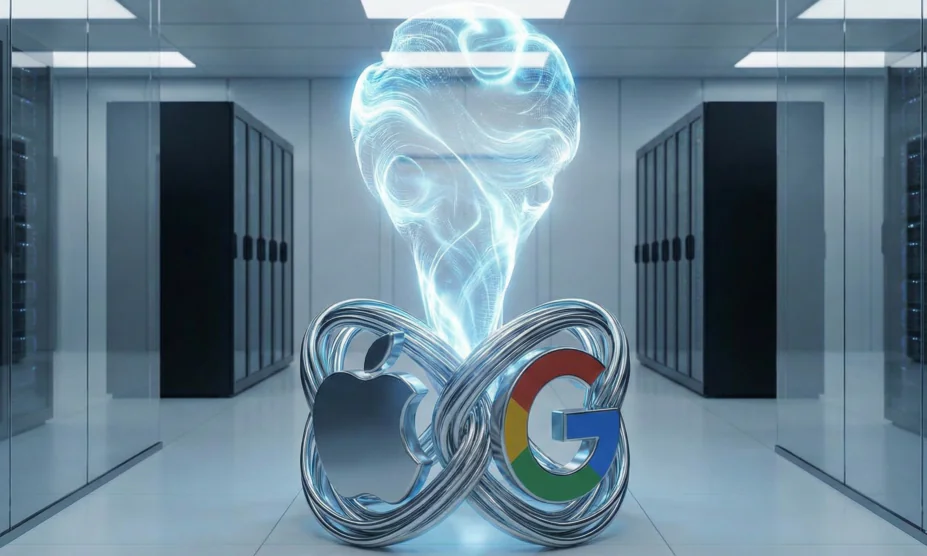
For the past year, the artificial intelligence sector has watched a high-stakes chess match between OpenAI, Google, and Anthropic, all vying for the most valuable real estate in consumer technology: the default layer of the iPhone. On January 12, 2026, the game ended. Apple and Google confirmed a multi-year partnership to integrate Gemini directly into the core of Apple Intelligence.
This is not merely a vendor swap; it is a fundamental restructuring of how AI will function on iOS. While the initial WWDC announcements highlighted ChatGPT, Apple’s long-term strategy required a partner that could offer not just a chatbot, but a scalable, multimodal reasoning engine capable of handling billions of daily queries with low latency. Google’s Gemini, powered by its custom TPU infrastructure, proved to be the only model ready for this scale.
The “Hybrid AI” Stack Explained
The integration introduces a sophisticated three-tier architecture for Apple Intelligence, designed to balance privacy with raw power. Understanding this stack is key to seeing why Gemini was chosen over GPT-4o or Claude.
1. On-Device Models (The Edge Layer)
For roughly 60% of daily tasks—sorting notifications, rewriting text, or searching local app data—Apple will continue to use its proprietary 3B and 7B parameter models running locally on the Neural Engine (NPU). This ensures zero latency and total privacy for personal data.
2. Private Cloud Compute (The Privacy Bridge)
When a request is too complex for the phone but requires sensitive data (e.g., “Check my calendar and book a table”), it is routed to Apple’s Private Cloud Compute (PCC). These servers run Apple-silicon-based LLMs that do not persist data.
3. Gemini (The World Knowledge Layer)
This is where the new partnership takes over. For “world knowledge” queries—complex reasoning, creative generation, or real-time information retrieval—Siri will now hand off the request seamlessly to Gemini. Unlike the previous implementation, where users had to confirm “Do you want to use ChatGPT?”, Gemini is integrated as a native system process.
Why Google Won the OS Layer
The decision to sideline OpenAI in favor of Google comes down to three critical factors: Infrastructure, Multimodality, and Context.
- Vertical Integration: OpenAI relies on Microsoft’s Azure infrastructure and Nvidia GPUs. Google controls its entire stack, from the Gemini models down to the custom Trillium TPUs in its data centers. This allows Google to offer Apple guaranteed throughput and lower latency at a cost basis OpenAI likely couldn’t match.
- Native Multimodality: Gemini was trained natively on video, audio, and text simultaneously. As Siri evolves into an agent that can “see” what is on your screen and “hear” ambient context, Gemini’s native architecture offered a smoother path for these features than stitching together separate models.
- The “Agentic” Future: Apple’s “App Intents” framework requires an AI that can plan multi-step actions across different applications. Google has spent the last year optimizing Gemini for agentic workflows (planning, reasoning, and tool use), aligning perfectly with Apple’s roadmap for Siri 2.0.
OpenAI’s New Reality: The “Plugin” Era
For OpenAI, this announcement marks a significant strategic contraction. While Sam Altman’s company remains the leader in pure model capability, losing the default slot on iOS restricts their access to the “context window” of the average consumer’s life.
ChatGPT will remain available on iOS, but it effectively becomes a specialized “plugin” or skill—similar to how Wikipedia or WolframAlpha functions today. Users can call upon it for specific creative writing tasks or coding assistance, but it will no longer be the ubiquitous brain powering the operating system’s daily interactions.
Privacy Engineering as a Firewall
Tech-savvy observers voiced immediate concerns about Google—a data advertising company—gaining access to iPhone queries. However, the technical implementation suggests a strict firewall.
Apple’s request routing anonymizes the data before it hits Google’s servers. IP addresses are masked, and the “context” sent to Gemini is stripped of personal identifiers. Crucially, the contract explicitly forbids Google from using any Apple-originated traffic to train its models. For Google, the value isn’t in the data, but in the normalization of Gemini as the standard utility for AI, preventing users from drifting to third-party apps.
What This Means for Developers
For the developer ecosystem, this consolidation brings stability. Apple’s CoreML and App Intents frameworks will now be optimized to work seamlessly with Gemini’s reasoning patterns. Developers building “Siri-aware” apps can expect more consistent behavior in how the AI interprets user intent and executes complex commands.
We are likely to see a surge in “Agentic Apps”—applications designed not just to be used by humans, but to be controlled by the Gemini-powered Siri. Whether it’s complex travel booking, automated financial planning, or cross-app content creation, the rails are finally being laid for true AI agents on mobile.
Conclusion: The Duopoly Solidifies
The AI wars of 2024 and 2025 were defined by a scramble for model dominance. 2026 is defining the distribution channels. By choosing Google, Apple has cemented a reality where the two largest mobile operating systems are powered by the same underlying intelligence architecture.
For the industry, it signals that owning the “last mile” to the user is just as important as having the smartest model in the lab. Gemini may not have started as the first mover, but by securing the iPhone, it has effectively become the standard operating mind of the mobile web.



