AI Fundamentals
What is Ensemble Learning?

 Add Unite.AI to your preferred sources on Google

Ensemble learning combines predictions from multiple models. The central idea is that models with different errors can produce a more accurate or stable result when their outputs are averaged, voted or passed to a meta-learner.
Adding models is not enough. If every member learned the same shortcut, their errors will be correlated and the ensemble may simply become more confident in the same mistake.
Key takeaways
- Ensembles work best when member models are individually useful and make meaningfully different errors.
- Bagging trains members in parallel on resampled data; boosting trains learners sequentially to correct errors.
- Stacking trains a meta-model on out-of-fold predictions, not in-sample predictions.
- Accuracy gains must be weighed against latency, calibration, interpretability and maintenance cost.
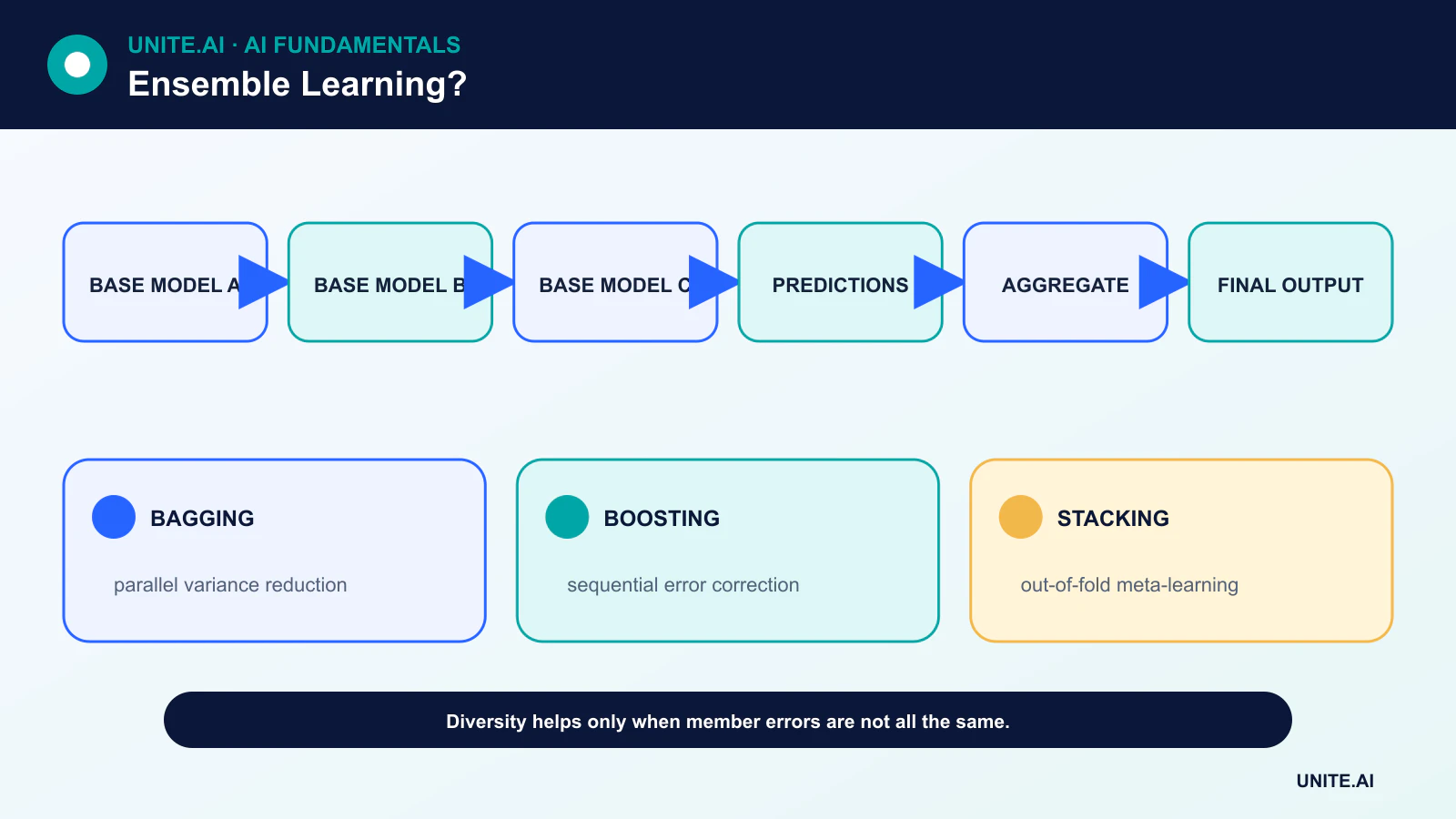
Voting and averaging
Hard voting selects the class with the most votes. Soft voting averages class probabilities, usually after calibration. Regression ensembles often average numeric predictions. Weighted versions give more influence to stronger members.
An average can reduce variance when errors are not perfectly correlated. It cannot repair a shared data defect, label error or missing subgroup. Diversity should be measured through disagreement and error overlap, not assumed from different model names.
Bagging and random forests
Bootstrap aggregating trains models on resampled datasets and averages them. A decision tree is high variance, making it a natural candidate for bagging.
Random forests add random feature selection at splits, reducing correlation among trees. Out-of-bag examples can estimate performance, but a final untouched test set remains valuable for model selection and deployment claims.
Boosting
Boosting builds an additive model in stages. Later learners focus on examples or residual patterns that the current ensemble handles poorly. AdaBoost changes example weights; gradient boosting fits learners to negative gradients of a chosen loss.
Boosted trees can model complex tabular relationships, but deep trees, excessive rounds and leakage can still overfit. Learning rate, tree depth, subsampling and early stopping are key controls.
Stacking and blending
Stacking creates a second-level model that learns how to combine base predictions. To avoid leakage, every training row for the meta-model must come from a base model that did not train on that row. Cross-validation generates these out-of-fold predictions.
Blending uses a separate holdout set for the meta-model, which is simpler but reduces data available for training. Both approaches require the same preprocessing and version control at inference.
Operational tradeoffs
An ensemble may multiply memory, compute and failure modes. It can be harder to explain, calibrate and update consistently. Distillation can compress an ensemble into a smaller model, but the student must be evaluated independently.
A practical selection compares performance, tail latency, calibration, resource use and error cost. Sometimes one well-regularized model is preferable to a small accuracy gain from a fragile stack.
Why ensembles work
Ensemble learning combines multiple models so their errors partially cancel or their strengths cover different regions. Bagging trains models on resampled data and averages predictions, reducing variance; random forests add random feature selection to decorrelate trees. Boosting trains learners sequentially to focus on residual error, often reducing bias but increasing sensitivity to noise and tuning. Stacking trains a meta-model on base-model predictions. Diversity must be useful: averaging identical models adds cost without much error reduction.
Correlation among errors determines benefit. Diversity can come from data samples, features, algorithms, hyperparameters, random initialization, or time windows. Hard voting discards confidence; soft voting averages probabilities but requires compatible calibration. Regression can average or use robust aggregation. In stacking, out-of-fold predictions are essential—training the meta-model on base predictions from the same fitted data causes leakage. Keep a simple averaging baseline before adopting a complex combiner.
Evaluation, calibration, and uncertainty
Compare each member and the ensemble on a held-out set with identical preprocessing. Report task metrics, calibration, subgroup errors, variance across folds or seeds, and resource cost. An ensemble can improve average quality while masking a shared blind spot caused by common data or labels. Inspect disagreement: it may identify uncertainty, but correlated confidently wrong models can agree. Calibrate the final ensemble, not only members, and validate abstention thresholds against review capacity and consequences.
Out-of-bag estimates are useful for bagged models but do not replace a final deployment-representative test. For temporal data, avoid resampling that breaks order. For safety-related use, test member failure, stale models, and adversarial input. Weighted ensembles can overfit validation data when many candidates are tried. Record candidate selection and use nested validation where tuning is extensive.
Serving and maintenance
Ensembles multiply memory, latency, energy, and operational dependencies. Distillation may compress combined behavior into one model, with a new validation requirement. Version members, preprocessing, weights, and routing as one artifact; define behavior when a member times out or produces an invalid result. Monitor member predictions and disagreement so silent failure is visible. Retire redundant members and retrain deliberately. Ensembles improve prediction when error diversity is real, but they do not turn biased training data or an invalid target into reliable evidence.
Worked example: an ensemble for severe-weather alerts
A forecasting team combines a physical-model feature set, gradient-boosted tree, neural sequence model, and calibrated statistical baseline. Out-of-fold predictions train a simple meta-model, and evaluation uses future storms entirely excluded from member training. Metrics include event recall, false alarms, lead time, calibration, geographic performance, and reliability during rare extreme conditions. Member error correlation is examined because shared input data can create shared blind spots.
Serving retains each prediction and the combined result. If a member is unavailable, the system uses a prevalidated degraded configuration rather than silently renormalizing. Disagreement prompts additional review but is not treated as uncertainty in all cases. Monitoring tracks member drift, latency, and storm outcomes, with weights updated only through controlled validation. Public warnings remain under authorized meteorological decision processes; the ensemble improves evidence but does not autonomously redefine alert policy.
Implementation evidence and operational readiness
A production decision needs more than a successful demonstration. Define the intended users, operating environment, inputs, outputs, dependencies, owner, and the consequence of each important failure. Establish a reproducible baseline and a versioned evaluation set before tuning. Test ordinary cases, boundary conditions, malformed or missing input, distribution shift, dependency outage, misuse, and the groups or environments most likely to be underserved. Measure task quality together with calibration or uncertainty, latency, throughput, resource cost, accessibility, privacy, and security. Record every transformation and threshold so an independent reviewer can reproduce the result and distinguish evidence from an attractive prototype.
Before launch, assign authority for release, exceptions, changes, rollback, and retirement. Use a staged rollout, preserve a safe fallback, and verify monitoring with deliberately injected failures. Operational telemetry should reveal input quality, output behavior, model or rule version, dependency health, human overrides, and confirmed outcomes without collecting unnecessary sensitive data. Define alert thresholds and a response owner, then review real-world evidence after deployment rather than assuming offline performance will persist. Reevaluate whenever data sources, users, models, vendors, policies, hardware, or objectives change. A maintained system also needs documented recovery, incident learning, deletion and retention procedures, and a clear point at which it should be disabled or replaced.
Frequently asked questions
Is a random forest an ensemble?
Yes. It combines many randomized decision trees, usually by voting or averaging.
Can identical models form a useful ensemble?
They can if training data, initialization or sampling creates sufficiently different errors, but mere duplication adds no benefit.
Primary references