AI Fundamentals
What is Deep Reinforcement Learning?

 Add Unite.AI to your preferred sources on Google
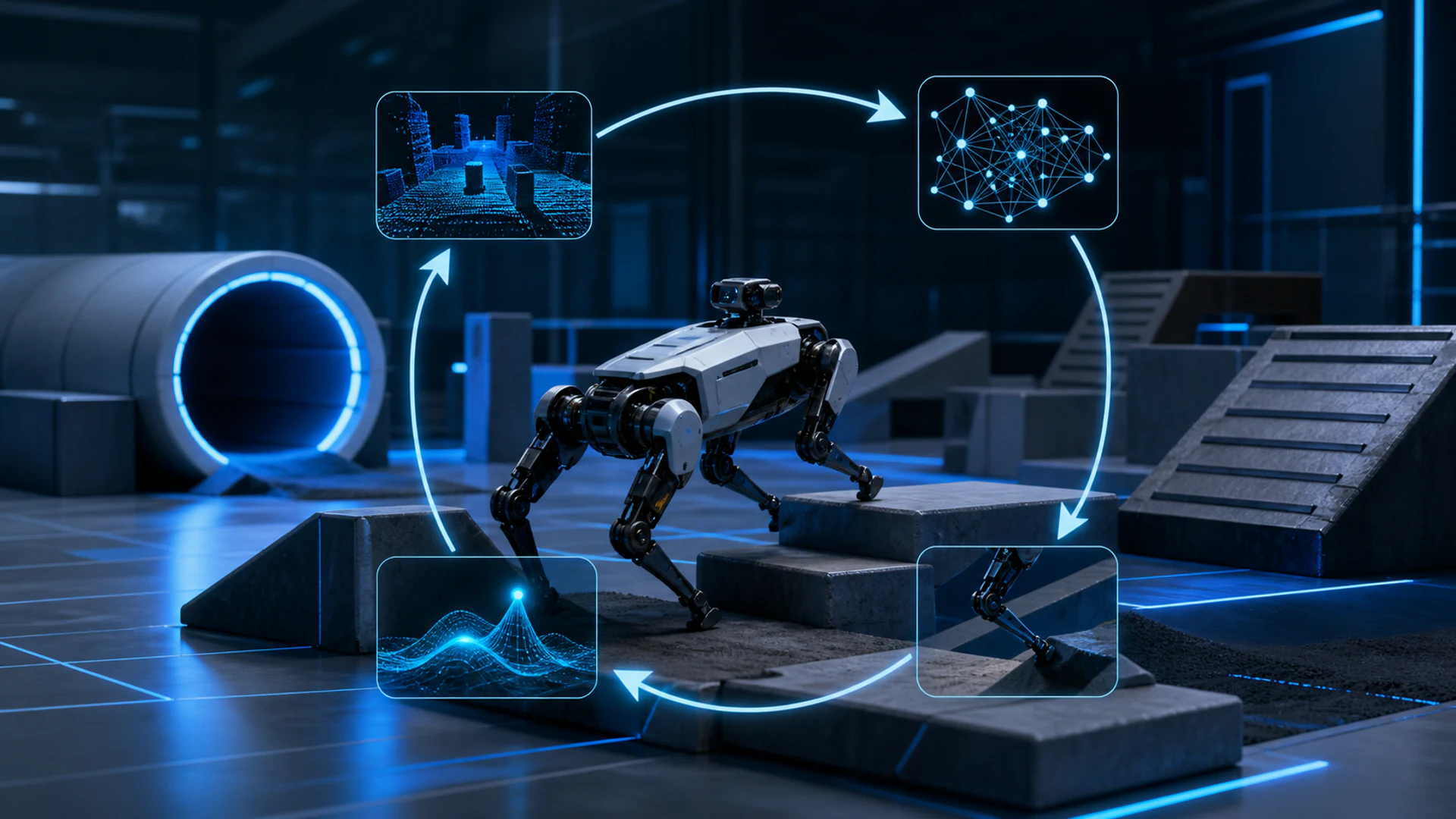
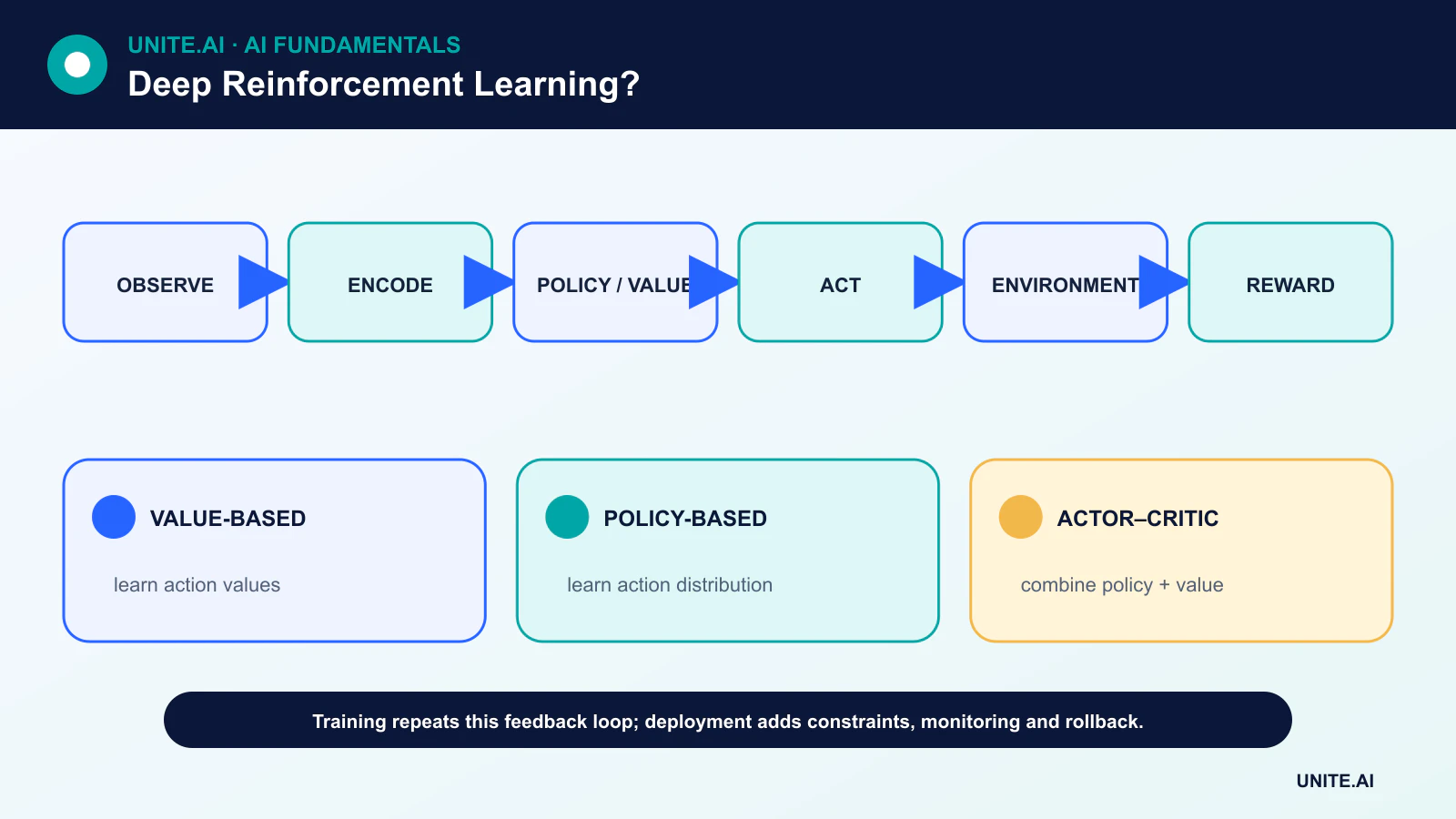
Deep reinforcement learning (deep RL) combines reinforcement learning with deep neural networks. An agent observes a state, chooses an action, receives a reward and a new observation, then adjusts a policy or value function to improve future decisions.
The deep network does not remove the hard parts of reinforcement learning. It provides a flexible way to represent images, sensor streams, large action spaces or complex value functions. Exploration, delayed credit, unstable training and safe real-world evaluation remain central engineering problems.
Key takeaways
- Deep RL learns sequential decisions from interaction rather than a fixed table of labeled examples.
- Value-based methods estimate how good actions are; policy methods learn the action distribution directly; actor–critic methods combine both.
- Replay buffers, target networks and careful reward design can improve training, but none guarantees reliable behavior.
- A strong simulator score is not proof of robustness, safety or successful transfer to the physical world.
The decision problem: states, actions and rewards
Many deep-RL tasks are modeled as a Markov decision process. At time t, the agent receives state or observation st, selects action at, then receives reward rt+1 and the next state. The objective is the expected discounted return, not necessarily the next reward alone.
The discount factor controls how strongly distant rewards matter. A reward function defines what the optimization process will pursue, so an incomplete proxy can produce behavior that is technically successful yet operationally undesirable. This is one reason reward design and constraint testing deserve the same attention as model architecture.
Value-based, policy-based and actor–critic methods
A value-based algorithm estimates a state value or action value. Deep Q-networks use a neural network to approximate Q-values and typically choose the action with the highest estimate while preserving some exploration. A policy-gradient algorithm instead optimizes a parameterized policy that outputs an action distribution.
Actor–critic systems maintain both an actor, which proposes actions, and a critic, which estimates their value. This design supports continuous control but introduces interacting sources of estimation error. Deep RL therefore depends on the same foundations as deep learning, gradient descent and backpropagation.
Why replay buffers and target networks help
Successive experience samples are correlated, while a network update changes the targets used by later updates. Experience replay breaks some of that temporal correlation by sampling older transitions. A target network changes more slowly than the online network, making bootstrapped targets less volatile.
These mechanisms improve training stability, but tuning still matters. Learning rate, exploration schedule, reward scale, replay composition and network capacity can all change the outcome. Multiple random seeds should be reported because a single run can be misleading.
Offline RL, model-based RL and sim-to-real
Offline RL learns from a fixed logged dataset without collecting new interactions. It can be useful when exploration is expensive or unsafe, but the policy must avoid actions that are poorly represented in the log. Model-based RL learns or uses a transition model to plan, trading additional assumptions for sample efficiency.
Robotics often trains in simulation, randomizes physical parameters, then fine-tunes or validates on hardware. The reality gap can still expose errors in perception, timing, contact dynamics and unmodeled edge cases. A reinforcement-learning system should be evaluated under perturbations, distribution shift and explicit safety constraints.
Evaluation and deployment
Useful evaluation separates training and test environments, reports return distributions rather than only a best score, and checks constraint violations, intervention frequency and worst-case behavior. For real systems, teams also need monitoring, rollback procedures, bounded action spaces and a human override.
Deep RL is most compelling when decisions are sequential, feedback is available and hand-written control rules are inadequate. It is a poor default when supervised labels are plentiful, a conventional optimizer solves the problem, or exploration would place people or assets at risk.
Deep RL architectures and training signals
Deep reinforcement learning uses neural networks to represent a value function, policy, environment model, or some combination. A deep Q-network predicts action values and learns from temporal-difference targets; experience replay reduces correlation among updates, while a target network stabilizes the moving objective. Policy-gradient methods optimize expected return directly, and actor–critic methods use a learned critic to reduce gradient variance. Continuous actions often require deterministic or stochastic actor–critic variants, while discrete high-dimensional actions need careful exploration and output design.
Training is nonstationary because the policy changes the data it collects. Replay data becomes off-policy, bootstrapped targets depend on current estimates, and function approximation can amplify errors—the combination sometimes called the deadly triad. Double estimators reduce value overestimation; advantage functions improve credit assignment; entropy bonuses encourage exploration; clipped objectives restrict destructive policy updates. Normalize observations and rewards only with leakage-safe state, and record environment, wrapper, action repeat, termination, and reward preprocessing because each changes the problem.
Evaluation, simulators, and deployment safety
Report return distributions across independent seeds and environment instances, not the best run. Evaluate sample efficiency, constraint violations, catastrophic outcomes, sensitivity to reward scale, and robustness to observation noise, delay, actuator error, and changed dynamics. Compare with scripted control, classical control, supervised imitation, and simpler RL. Hold out environment variations and test reward-free outcome metrics, because an agent can exploit the programmed reward while failing the intended task. Video and trajectory inspection often reveal behavior hidden by aggregate return.
Simulation enables exploration but introduces a reality gap. Randomize relevant physics and perception, calibrate against real measurements, and use conservative transfer. Logged-data or offline RL avoids online exploration but cannot reliably evaluate actions unsupported by the behavior policy. Production systems should constrain the action set, rate, resources, and operating envelope; require approval for high-impact actions; and include a verified safe controller or stop. Monitor policy inputs, action distribution, reward, real outcomes, and interventions, with rollback to a tested policy version.
A concrete control example
For warehouse robot routing, define state from location, load, battery, nearby traffic, and task queue; actions from allowed movements and charging decisions; and reward from completed work, energy, congestion, and safety constraints. Train first in a calibrated simulator with randomized demand and sensor faults, then shadow real decisions. Never let the learned policy bypass collision avoidance. Evaluate throughput together with near misses, deadlocks, battery emergencies, and worst-case delay. The project succeeds only if the layered system improves operations without transferring unacceptable exploration risk to people or equipment.
Worked example: DRL for data-center cooling
A data center constrains an RL agent to approved cooling setpoints and trains it in a simulator calibrated from historical weather, workload, temperatures, and equipment response. The reward includes energy but hard constraints separately protect temperature, humidity, and equipment cycling. Model-predictive control and existing rules are baselines. Evaluation spans seasons, sensor noise, actuator delay, equipment loss, unusual loads, and multiple seeds, reporting energy, violations, variance, and recovery.
The learned policy runs in shadow mode before a limited zone trial. An external safety controller clips actions and operators can override. Action rate, state coverage, model uncertainty, and actual facility outcomes are monitored; simulator mismatch or repeated intervention triggers rollback. Updated equipment or control logic creates a new environment version and validation. Energy savings are accepted only when reliability, thermal margin, maintenance, and response to faults remain at least as strong as the baseline.
Implementation evidence and operational readiness
A production decision needs more than a successful demonstration. Define the intended users, operating environment, inputs, outputs, dependencies, owner, and the consequence of each important failure. Establish a reproducible baseline and a versioned evaluation set before tuning. Test ordinary cases, boundary conditions, malformed or missing input, distribution shift, dependency outage, misuse, and the groups or environments most likely to be underserved. Measure task quality together with calibration or uncertainty, latency, throughput, resource cost, accessibility, privacy, and security. Record every transformation and threshold so an independent reviewer can reproduce the result and distinguish evidence from an attractive prototype.
Before launch, assign authority for release, exceptions, changes, rollback, and retirement. Use a staged rollout, preserve a safe fallback, and verify monitoring with deliberately injected failures. Operational telemetry should reveal input quality, output behavior, model or rule version, dependency health, human overrides, and confirmed outcomes without collecting unnecessary sensitive data. Define alert thresholds and a response owner, then review real-world evidence after deployment rather than assuming offline performance will persist. Reevaluate whenever data sources, users, models, vendors, policies, hardware, or objectives change. A maintained system also needs documented recovery, incident learning, deletion and retention procedures, and a clear point at which it should be disabled or replaced.
Frequently asked questions
Is deep reinforcement learning the same as deep learning?
No. Deep learning supplies the function approximators; reinforcement learning supplies the interaction, reward and sequential-decision objective.
Does a high reward mean the agent learned the intended behavior?
Not necessarily. It means the policy found behavior that scores well under the implemented reward and environment. Independent safety and goal-alignment tests are still required.
Primary references