AI Fundamentals
What is a Generative Adversarial Network (GAN)?

 Add Unite.AI to your preferred sources on Google

A generative adversarial network (GAN) trains two neural networks in competition. A generator converts random or conditioned input into synthetic samples. A discriminator tries to distinguish generated samples from real training examples. Each network’s feedback changes the other’s learning problem.
GANs can create sharp images and controllable synthetic data, but adversarial training is difficult to stabilize. Visual realism is not proof of diversity, factual validity or permission to use the training data.
Key takeaways
- The generator produces samples; the discriminator learns a real-versus-generated decision signal.
- Training seeks an equilibrium, but changing opponents can cause instability, oscillation or mode collapse.
- Conditional GANs control generation with labels, text or other context.
- Evaluation should test fidelity, coverage, memorization and downstream risk—not image quality alone.
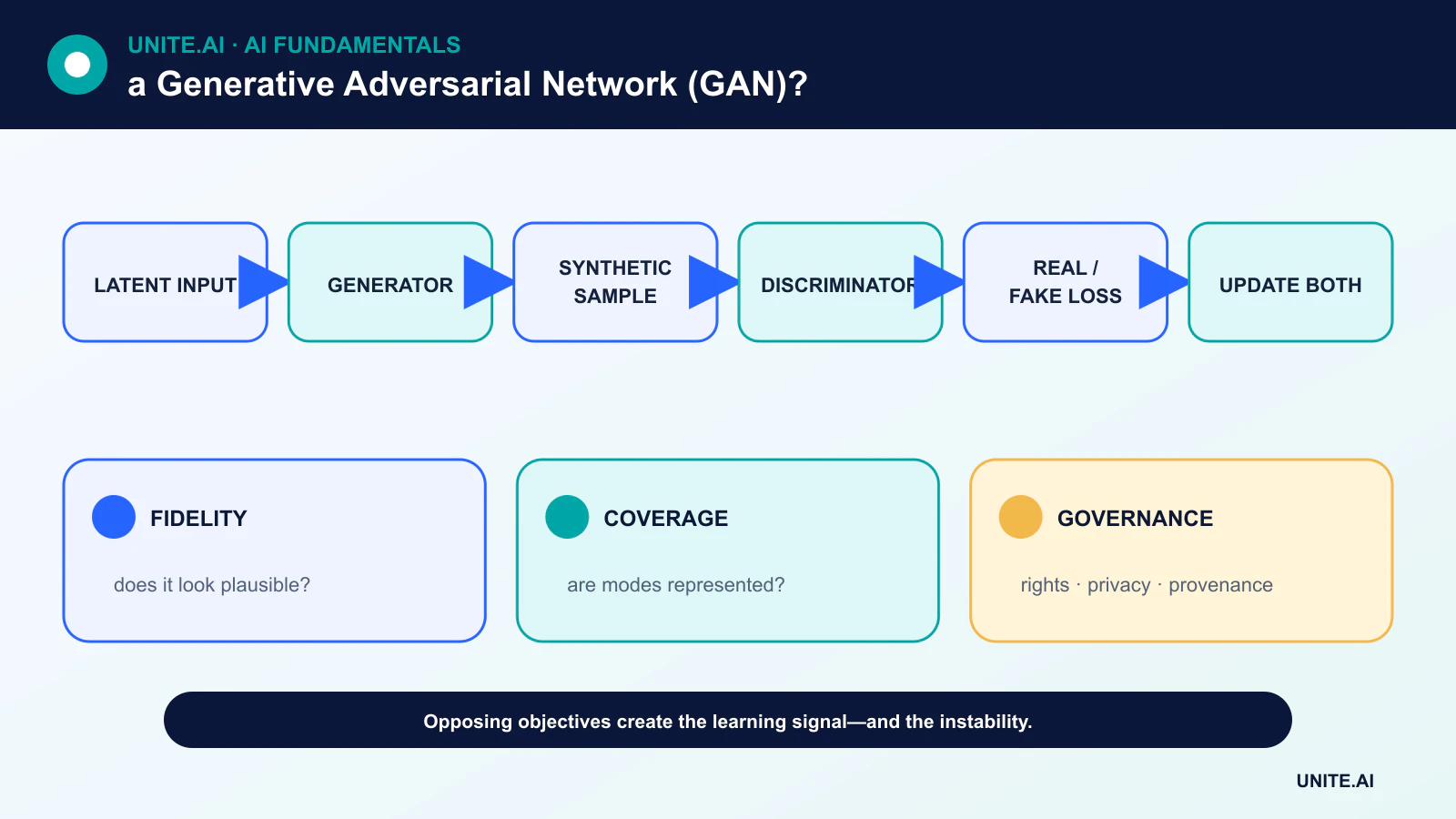
The adversarial game
The original formulation is a two-player minimax game. The discriminator improves at separating real data from generated data, while the generator improves at making samples the discriminator classifies as real. Both are trained with backpropagation.
If the discriminator becomes too accurate, its feedback to the generator may be unhelpful. If it is too weak, the generator can exploit easy shortcuts. Training therefore alternates updates and carefully balances capacity, losses and optimization settings.
Mode collapse and training stability
Mode collapse occurs when many latent inputs produce similar outputs, so samples look plausible but cover only part of the data distribution. Other failures include oscillation, exploding gradients and sensitivity to random initialization.
Wasserstein objectives, gradient penalties, spectral normalization, architecture changes and tuned update ratios can improve stability. They do not remove the need to inspect diversity and repeat experiments with multiple seeds.
Conditional generation and latent control
A conditional GAN provides the generator and discriminator with a label or other context, allowing targeted classes or attributes. Style-based architectures separate aspects of latent control at different resolutions and have produced highly realistic images.
Latent directions may correlate with human concepts, but editing one attribute can change others because the training data contain correlated features. Claims of controllability should be tested across diverse identities and contexts.
Evaluation, privacy and provenance
Metrics such as Fréchet Inception Distance compare feature distributions, but they inherit assumptions from the feature model and can miss memorization or subgroup failures. Nearest-neighbor analysis, precision/recall-style coverage tests and human review provide complementary evidence.
A GAN can memorize rare examples, reproduce bias or generate deceptive media. Teams should document datasets, rights, filtering, watermark or provenance mechanisms and misuse controls. Synthetic data are not automatically anonymous.
GANs, VAEs and diffusion models
Variational autoencoders optimize a likelihood-based latent objective and often trade sample sharpness for a structured latent space. Diffusion models learn to reverse a noising process and have become a common foundation for image generation.
GANs remain useful when fast one-pass sampling, specific image-to-image mappings or compact deployment matter. The right method depends on quality, diversity, latency, training stability and governance—not on which architecture is newest.
Adversarial objectives and training dynamics
A generative adversarial network trains a generator to produce samples and a discriminator to distinguish generated from real data. In the original minimax game, the discriminator estimates a density-ratio-related signal and the generator tries to fool it. Training alternates updates, so each network learns against a moving opponent rather than a fixed loss. If the discriminator becomes too strong, generator gradients can become unhelpful; if too weak, generated quality stagnates. Loss value alone does not correspond directly to sample quality.
Mode collapse occurs when the generator produces limited varieties that fool the discriminator. Oscillation, sensitivity to hyperparameters, and unstable normalization are also common. Wasserstein objectives, gradient penalties, spectral normalization, feature matching, minibatch statistics, and carefully balanced update schedules address different failure mechanisms. Conditional GANs use labels, text, or images to guide output; style-based architectures separate latent influences. Dataset quality and coverage remain fundamental because the generator reproduces and recombines the distribution it sees.
Evaluation and responsible use
Evaluate fidelity and diversity separately. Fréchet Inception Distance compares feature distributions but depends on sample size, feature model, preprocessing, and domain; Inception Score omits comparison with real data. Precision and recall for generative models, nearest-neighbor analysis, memorization checks, and human task evaluation add evidence. For scientific or medical synthesis, use domain metrics and downstream validation. Keep a held-out real set and compare with diffusion or autoregressive baselines at matched compute and resolution.
GANs can augment data, translate domains, super-resolve images, synthesize media, and support simulation, but synthetic data may amplify bias or leak training examples. Verify licensing, consent, identity, and provenance. Protect against nonconsensual impersonation and deceptive use, label or sign outputs where appropriate, and keep generation metadata. A photorealistic image is not documentary evidence; uncertainty and synthetic origin must remain visible when outputs affect decisions.
Deployment and reproducibility
Record generator, discriminator, optimizer, dataset, random seed, truncation, and sampling settings. Quantization or export can alter normalization and output, so validate the serving artifact. Monitor prompt or condition distribution, safety filters, output diversity, latency, and reports. Use rate limits and identity safeguards in public systems. GAN training is a coupled optimization experiment: selected showcase images cannot establish robustness, coverage, or absence of memorization, and a model should be evaluated on the complete distribution of intended generation tasks.
Worked example: synthetic defect images with a GAN
A manufacturer trains a conditional GAN to create rare surface-defect images. It verifies that training images have rights and separates production lots before training and evaluation. Generated samples are checked for nearest-neighbor memorization, defect geometry, background artifacts, diversity, and expert plausibility. A classifier trained with synthetic augmentation is evaluated only on independent real defects, against the same classifier with conventional augmentation.
Synthetic data is accepted only if real-world recall improves without increasing false rejects or subgroup errors. Generation settings and provenance remain attached to every image, and synthetic files never enter the test set or evidence archive as real inspections. Operators cannot use the generator to fabricate audit records. The team compares diffusion alternatives and the cost of collecting more real examples, recognizing that realistic appearance is not proof that the GAN captured the physical failure process.
Implementation evidence and operational readiness
A production decision needs more than a successful demonstration. Define the intended users, operating environment, inputs, outputs, dependencies, owner, and the consequence of each important failure. Establish a reproducible baseline and a versioned evaluation set before tuning. Test ordinary cases, boundary conditions, malformed or missing input, distribution shift, dependency outage, misuse, and the groups or environments most likely to be underserved. Measure task quality together with calibration or uncertainty, latency, throughput, resource cost, accessibility, privacy, and security. Record every transformation and threshold so an independent reviewer can reproduce the result and distinguish evidence from an attractive prototype.
Before launch, assign authority for release, exceptions, changes, rollback, and retirement. Use a staged rollout, preserve a safe fallback, and verify monitoring with deliberately injected failures. Operational telemetry should reveal input quality, output behavior, model or rule version, dependency health, human overrides, and confirmed outcomes without collecting unnecessary sensitive data. Define alert thresholds and a response owner, then review real-world evidence after deployment rather than assuming offline performance will persist. Reevaluate whenever data sources, users, models, vendors, policies, hardware, or objectives change. A maintained system also needs documented recovery, incident learning, deletion and retention procedures, and a clear point at which it should be disabled or replaced.
Frequently asked questions
Does a GAN understand the images it creates?
A GAN learns statistical structure useful for generation. That does not by itself establish human-like semantic or causal understanding.
Are GAN-generated samples safe to use as training data?
Only after checking coverage, label validity, memorization, bias and whether the synthetic distribution helps on a real held-out test set.
Primary references