AI Fundamentals
What is Transfer Learning?

 Add Unite.AI to your preferred sources on Google

Transfer learning reuses knowledge learned for one problem to improve learning on a related problem. Instead of initializing every parameter randomly, a practitioner starts from a pretrained model or representation and adapts it to a target task.
This approach is especially useful when the target dataset is small, labeling is expensive, or pretraining requires more compute than the target team can justify. Training a model from scratch is the alternative to transfer learning—not a type of transfer learning.
Key takeaways
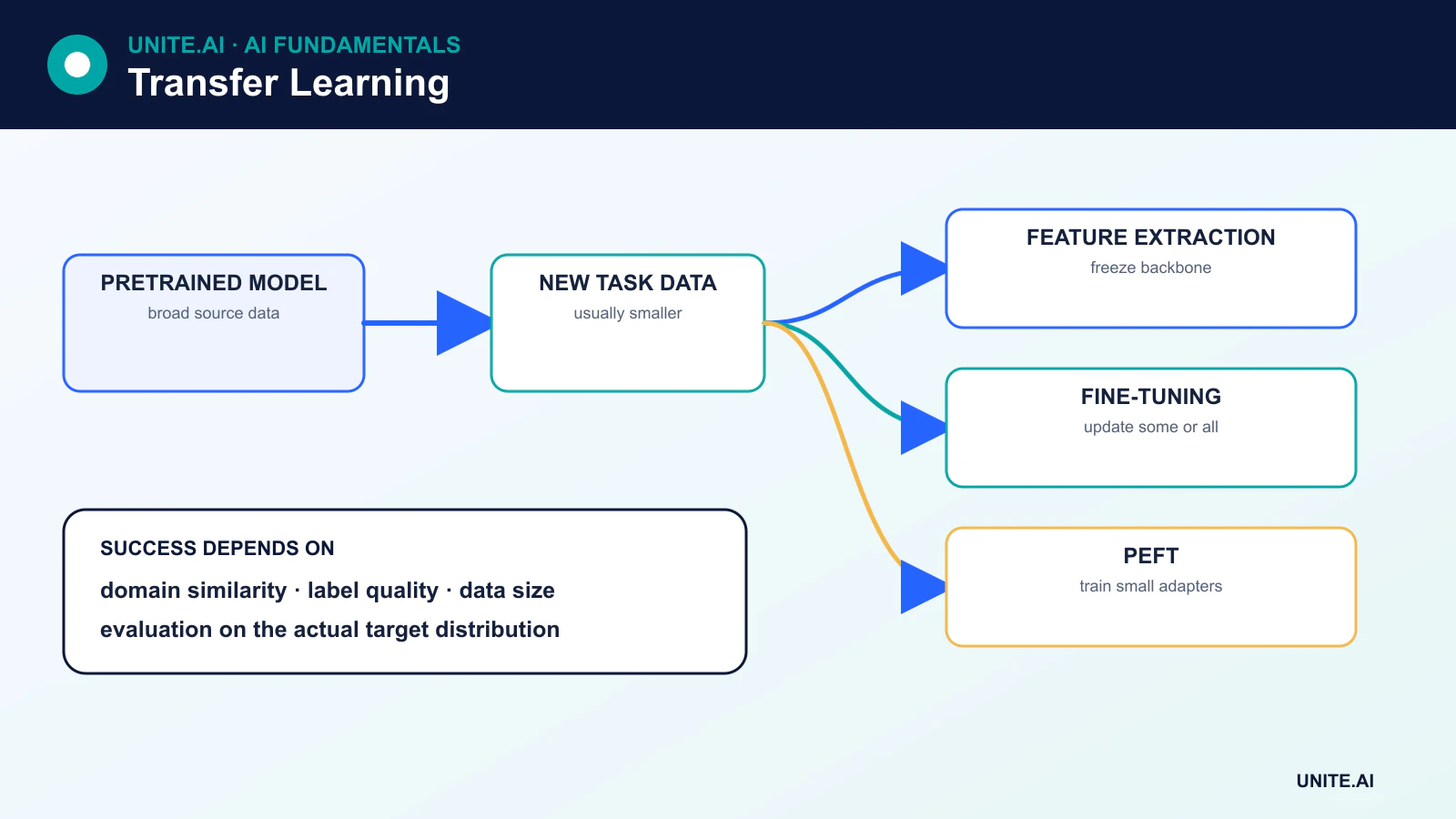
- Feature extraction keeps a pretrained base frozen and trains a new task-specific head.
- Fine-tuning updates some or all pretrained parameters using target-domain data.
- Parameter-efficient methods such as adapters and LoRA update a small fraction of the model.
- Transfer can fail when source and target domains differ, licenses conflict, or the source model carries unsuitable bias.
Why transfer learning works
Models often learn representations that are useful beyond the exact data on which they were trained. Early layers of an image model may capture reusable local patterns; a language model may learn syntax, semantics, and broad associations from self-supervised prediction. A target task can build on those representations rather than relearn everything from limited examples.
The benefit depends on similarity between the source and target tasks, the scale and quality of pretraining, and the way the model is adapted. Reuse is not guaranteed: transferred features can be irrelevant or actively harmful.
Feature extraction
In feature extraction, the pretrained base is frozen so its parameters do not change. Its output becomes the input to a new classifier, regressor, or other task-specific head. Only the new head is trained.
This is fast and data-efficient, and it reduces the risk of destroying useful pretrained representations. It can also underfit when the target domain differs substantially from pretraining. Layers such as batch normalization require special care because their stored statistics and training behavior can affect adaptation even when most weights are frozen.
Fine-tuning
Fine-tuning updates pretrained parameters on target data. A common workflow is:
- Load the pretrained model and replace or add the output head.
- Freeze the base and train the new head.
- Unfreeze selected layers—or the full model—and continue with a smaller learning rate.
- Validate for overfitting, forgetting, and target-domain performance.
There is no universal rule that only the final layers should be tuned. The best choice depends on architecture, target-data size, domain similarity, normalization layers, memory, and compute. Full fine-tuning can offer more capacity but requires more resources and may cause catastrophic forgetting.
Parameter-efficient fine-tuning
Large transformers make full fine-tuning expensive. Parameter-efficient fine-tuning (PEFT) modifies or adds a small set of parameters while leaving most of the base model frozen.
- Adapters insert small trainable modules into the network.
- LoRA represents weight updates with low-rank matrices, reducing trainable parameters and optimizer memory.
- Prompt and prefix tuning learn continuous task-specific inputs or internal prefixes.
PEFT can store many task adaptations around one base model, although inference serving, adapter compatibility, and merged-weight management still require careful engineering.
Transfer learning across data types
Image classifiers commonly start from models pretrained on large image datasets. Language systems start from a foundation model and adapt it through supervised fine-tuning, preference optimization, retrieval, or tool use. Speech, audio, protein, and multimodal models follow related patterns.
Transfer can also occur without changing the original model. A frozen model can produce embeddings for a downstream classifier, a vector similarity search system, or a retrieval pipeline.
Domain shift and negative transfer
Domain shift occurs when target inputs differ from source data. A medical image model, for example, may encounter equipment, populations, or acquisition protocols absent from pretraining. Negative transfer means reuse makes target performance worse than an appropriate from-scratch baseline.
Teams should compare adaptation strategies, evaluate meaningful subgroups, and keep a target-domain test set. If the source task is poorly matched, a smaller domain-specific model may outperform a larger general model.
Licensing, provenance, and security
A downloadable model is not automatically safe to deploy. Review the license, permitted uses, training-data disclosures, model-card limitations, and dependency chain. Models can reproduce bias, memorize sensitive data, or contain malicious serialized code. Use trusted formats, scan artifacts, and load untrusted weights in an isolated environment.
When to use transfer learning
Transfer learning is a strong default when a relevant pretrained model exists and target data is limited. Training from scratch may be preferable when the domain is highly specialized, licensing is incompatible, model size exceeds deployment limits, or a simple task does not benefit from a large pretrained representation. The decision should be validated empirically rather than assumed from model scale.
What transfers and how to adapt it
Transfer learning reuses representations learned on a source task or dataset for a target task. In vision, early features often capture edges and textures; in language, pretrained models encode statistical patterns across tokens and contexts. Transfer works when source representations contain information relevant to the target, but domain, label, modality, and acquisition differences can produce negative transfer. Start with a pretrained baseline, inspect its training license and documentation, and compare it with training a small target-specific model from scratch.
Feature extraction freezes the backbone and trains a new head; partial fine-tuning unfreezes selected layers; full fine-tuning updates the entire model. Parameter-efficient methods add adapters or low-rank updates, reducing trainable parameters but not necessarily inference memory. Use a lower learning rate for pretrained weights, preserve normalization behavior, and avoid catastrophic forgetting with schedules, regularization, rehearsal, or constrained updates where needed. Select checkpoints on target validation data and test several seeds because small target datasets produce high variance.
Data, evaluation, and deployment tradeoffs
Target data should represent deployment conditions and important subgroups, not merely be a convenient labeled sample. Split by subject, source, time, or location to prevent related examples from crossing partitions. Test both in-domain and shifted conditions. Compare frozen, partially tuned, and fully tuned variants on quality, calibration, training cost, latency, and robustness. An improvement in average score can hide a loss on rare classes inherited from source bias. Review failure examples for source-specific shortcuts, vocabulary gaps, or sensor differences.
Track the base model, weights, tokenizer or preprocessing, adapter, data, and license as one dependency graph. Hosted base models can change behavior; open weights can introduce supply-chain and patching responsibilities. Validate the merged or exported artifact and scan model files from untrusted sources. In production, monitor target drift and performance, and retain the ability to roll back both the adaptation and base version. Transfer reduces required target data; it does not eliminate labeling, evaluation, privacy, or domain expertise.
Worked example: adapting a vision model to a new clinic
A clinic adapts a pretrained imaging encoder to classify image quality before diagnostic review. It verifies the source model’s license and intended modality, collects local devices and acquisition conditions, and splits by patient. Frozen-feature, adapter, partial, and full fine-tuning variants are compared with a small local baseline. Metrics include class recall, calibration, subgroup behavior, compute, and sensitivity to device, site, and rare artifacts.
The adapted model cannot make a diagnosis and routes low-confidence or unsupported images to technologists. Export validation confirms local preprocessing and numeric equivalence. Model, adapter, device, and dataset versions are linked in the record. Monitoring detects new scanners, protocol changes, and output drift, while periodic reviewed samples estimate real performance. A source-model upgrade is treated as a new dependency requiring validation; transfer learning does not justify reusing old evidence automatically.
Implementation evidence and operational readiness
A production decision needs more than a successful demonstration. Define the intended users, operating environment, inputs, outputs, dependencies, owner, and the consequence of each important failure. Establish a reproducible baseline and a versioned evaluation set before tuning. Test ordinary cases, boundary conditions, malformed or missing input, distribution shift, dependency outage, misuse, and the groups or environments most likely to be underserved. Measure task quality together with calibration or uncertainty, latency, throughput, resource cost, accessibility, privacy, and security. Record every transformation and threshold so an independent reviewer can reproduce the result and distinguish evidence from an attractive prototype.
Before launch, assign authority for release, exceptions, changes, rollback, and retirement. Use a staged rollout, preserve a safe fallback, and verify monitoring with deliberately injected failures. Operational telemetry should reveal input quality, output behavior, model or rule version, dependency health, human overrides, and confirmed outcomes without collecting unnecessary sensitive data. Define alert thresholds and a response owner, then review real-world evidence after deployment rather than assuming offline performance will persist. Reevaluate whenever data sources, users, models, vendors, policies, hardware, or objectives change. A maintained system also needs documented recovery, incident learning, deletion and retention procedures, and a clear point at which it should be disabled or replaced.
Primary references