AI Fundamentals
Supervised vs Unsupervised Learning

 Add Unite.AI to your preferred sources on Google
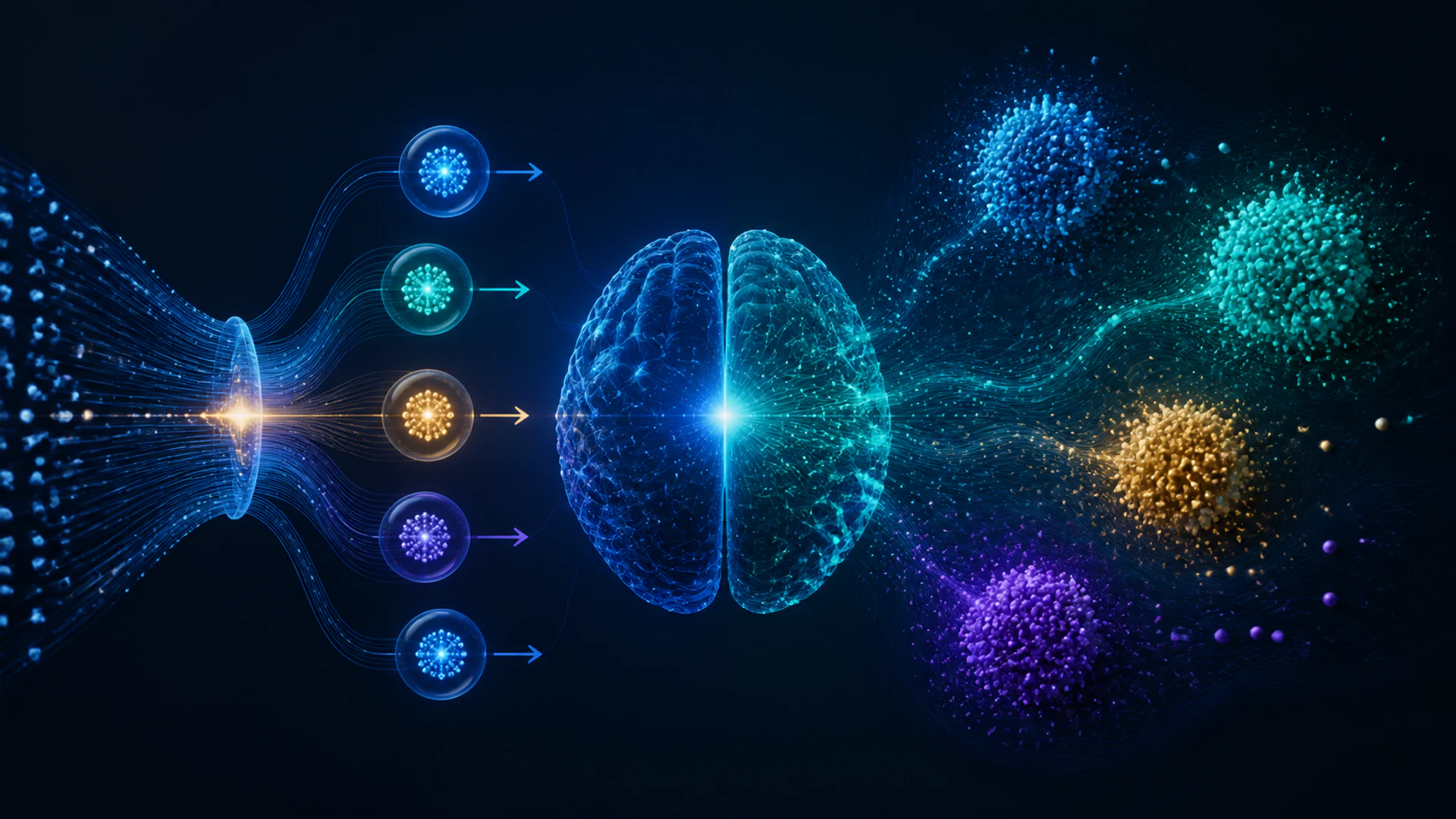
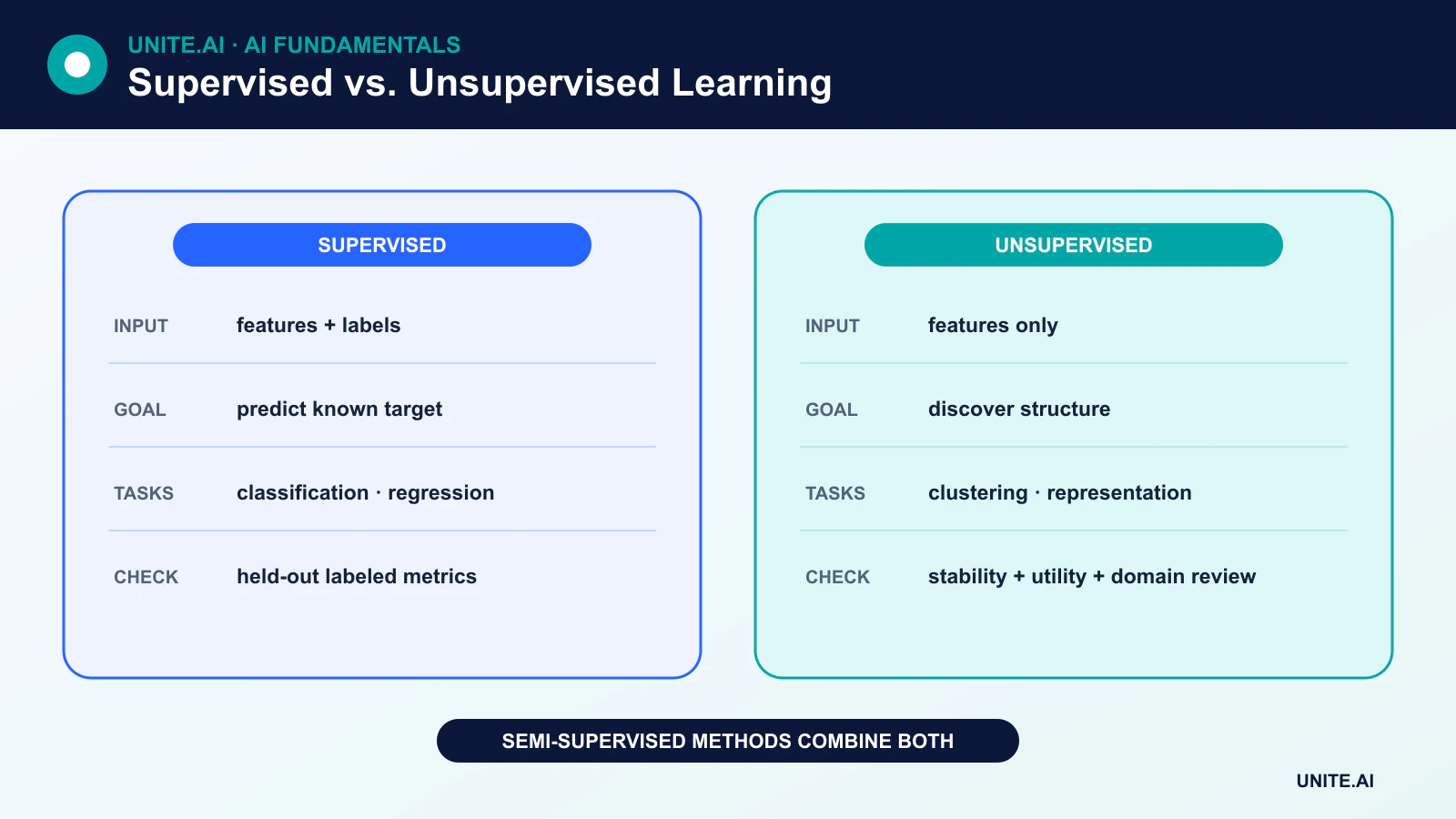
Supervised learning learns from examples paired with target answers. Unsupervised learning looks for structure in data without target labels. The difference is not which approach is more intelligent or accurate; it is the kind of learning signal available and the question the system is designed to answer.
These are two major paradigms inside machine learning, but modern systems also use semi-supervised, self-supervised, and reinforcement learning.
Key takeaways
- Supervised learning predicts a known target; unsupervised learning discovers patterns or representations.
- Classification and regression are supervised tasks; clustering, density estimation, and many dimensionality-reduction methods are unsupervised.
- Unsupervised outputs are not automatically real-world classes and can be harder to evaluate.
- Compute cost and accuracy depend on the algorithm, data, task, and evaluation—not on the paradigm alone.
How supervised learning works
A supervised dataset contains features X and a target y. Training adjusts a model so its predictions approximate the targets. Evaluation uses held-out labeled examples to estimate how well it generalizes.
Classification
Classification predicts a category: spam or not spam, one document topic among several, or one or more objects in an image. Relevant metrics include precision, recall, F1, calibration, and cost-sensitive measures. Accuracy can be misleading when one class is rare; a confusion matrix reveals which classes are being confused.
Regression
Regression predicts a continuous value, such as demand, duration, or temperature. Linear regression can use one or many features; it is not limited to drawing a relationship between two variables. Regression metrics include mean absolute error, root mean squared error, and task-specific costs.
Common supervised algorithms
Supervised methods include linear and logistic models, decision trees, random forests, gradient boosting, support vector machines, K-nearest neighbors, and neural networks.
Logistic regression produces a score or probability that can be converted to a class using a chosen threshold. A decision-tree leaf contains a prediction based on a region of the feature space, not necessarily one training observation. KNN predicts from nearby labeled training examples and still requires a sound train/validation/test design.
How unsupervised learning works
Unsupervised learning receives features without a target column. Its objective is defined indirectly—for example, minimize distance within clusters, reconstruct an input, estimate data density, or retain as much variance as possible in fewer dimensions.
Clustering
K-means assigns points to a chosen number of clusters and updates cluster centers to reduce within-cluster squared distance. The algorithm discovers geometric groupings under a particular distance and feature representation. Those groups do not automatically correspond to meaningful customer types, diagnoses, or other domain labels.
Dimensionality reduction
Dimensionality reduction represents data using fewer variables. Principal component analysis finds orthogonal directions that retain as much variance as possible under a linear projection. Other methods preserve different notions of structure and can produce very different visualizations.
Anomaly and density estimation
Unsupervised methods can estimate where data is dense and flag unusual observations. An anomaly score does not prove fraud, failure, or malicious behavior; it identifies a deviation under the chosen representation and model.
How unsupervised learning is evaluated
There is no universal notion of unsupervised “accuracy.” A practitioner may use internal metrics such as silhouette score, compare stability across samples, test usefulness in a downstream task, or ask domain experts whether the discovered structure is meaningful. If ground-truth labels exist for evaluation, external clustering metrics can be used without turning the training process into supervised learning.
Beyond the two-way comparison
Semi-supervised learning
Semi-supervised learning combines a smaller labeled set with a larger unlabeled set. Pseudo-labeling, consistency regularization, and graph-based methods are examples. The unlabeled data must still resemble the target distribution closely enough to help.
Self-supervised learning
Self-supervised learning derives targets from the input itself, such as predicting masked tokens or matching transformed views. It is a foundation for modern language, vision, and multimodal models, including transformers.
Reinforcement learning
Reinforcement learning optimizes decisions through rewards generated by interaction. It differs from both labeled prediction and static pattern discovery.
Choosing the right approach
Start with the decision or insight the system must produce. If reliable targets exist and prediction is the goal, supervised learning is natural. If the objective is exploration, representation, or grouping, an unsupervised method may fit. When labels are scarce, self-supervised or semi-supervised pretraining followed by supervised evaluation may be more effective.
In every case, data leakage, biased sampling, weak proxies, and distribution shift can dominate the choice of algorithm. A technically correct model trained on the wrong objective can still fail.
Learning signals, objectives, and representative methods
Supervised learning uses examples paired with target labels or values and optimizes predictive error. Classification, regression, ranking, and structured prediction differ in output and loss. Unsupervised learning seeks structure without target labels through clustering, density estimation, dimensionality reduction, representation learning, or generative modeling. Self-supervised learning creates prediction targets from the data itself, while semi-supervised learning combines a small labeled set with larger unlabeled data. These categories describe the learning signal; the same neural architecture can be trained under several paradigms.
Labels make an objective explicit but introduce annotation cost, noise, policy assumptions, and temporal lag. Unlabeled data is easier to collect but does not tell an algorithm which discovered structure is useful. A cluster can reflect lighting, document length, or acquisition source instead of a meaningful category. Define evaluation independently: supervised models use held-out labeled outcomes, while unsupervised models need stability, reconstruction, likelihood, retrieval, downstream utility, or expert validation. Visual separation alone is not proof of valid structure.
Choosing a paradigm and preventing common errors
Use supervised learning when a stable target and representative labels exist. Use unsupervised exploration to summarize, detect novelty, compress, or generate hypotheses, but treat outputs as provisional. Self-supervised pretraining is valuable when raw data is abundant and downstream tasks share representations. Semi-supervised methods help only when assumptions about unlabeled data and class structure hold. Compare with simple baselines and account for the total cost of collection, labeling, review, computation, and errors rather than assuming unlabeled automatically means inexpensive.
Prevent leakage by separating related entities before deriving labels, augmentations, or pseudo-labels. Monitor class balance, annotation agreement, cluster stability, collapse, and drift. Pseudo-labels can reinforce early mistakes; clustering can encode sensitive attributes; a pretrained representation can transfer source bias. Human review should focus on boundary cases and consequences. In production, document how the learning signal was created and when it becomes obsolete. The paradigm determines where supervision enters the system, not whether human choices and values are present.
Worked example: discovering and labeling support topics
A company first uses unsupervised embeddings and clustering to explore themes in de-identified support messages. Analysts inspect representative and boundary examples and find that some clusters reflect message length and channel rather than issues. They develop a supervised taxonomy with an unknown class, annotation guidance, and measured agreement. A classifier is then evaluated on later time periods, languages, and products against keyword and nearest-neighbor baselines.
Unlabeled new messages support drift discovery but do not retrain the classifier automatically. Reviewers label selected uncertain and emerging cases through active learning, with quality checks and a sealed evaluation set. Monitoring tracks topic prevalence, confidence, disagreement, and routing outcomes. When a new product launches, the taxonomy and capacity of downstream teams are updated together. The workflow uses unsupervised methods for hypothesis generation and supervised evidence for operational routing.
Implementation evidence and operational readiness
A production decision needs more than a successful demonstration. Define the intended users, operating environment, inputs, outputs, dependencies, owner, and the consequence of each important failure. Establish a reproducible baseline and a versioned evaluation set before tuning. Test ordinary cases, boundary conditions, malformed or missing input, distribution shift, dependency outage, misuse, and the groups or environments most likely to be underserved. Measure task quality together with calibration or uncertainty, latency, throughput, resource cost, accessibility, privacy, and security. Record every transformation and threshold so an independent reviewer can reproduce the result and distinguish evidence from an attractive prototype.
Before launch, assign authority for release, exceptions, changes, rollback, and retirement. Use a staged rollout, preserve a safe fallback, and verify monitoring with deliberately injected failures. Operational telemetry should reveal input quality, output behavior, model or rule version, dependency health, human overrides, and confirmed outcomes without collecting unnecessary sensitive data. Define alert thresholds and a response owner, then review real-world evidence after deployment rather than assuming offline performance will persist. Reevaluate whenever data sources, users, models, vendors, policies, hardware, or objectives change. A maintained system also needs documented recovery, incident learning, deletion and retention procedures, and a clear point at which it should be disabled or replaced.
Primary references