
Cybersecurity
Why AI Is Making It Harder Than Ever to Know What to Worry About in Cybersecurity

 Add Unite.AI to your preferred sources on Google
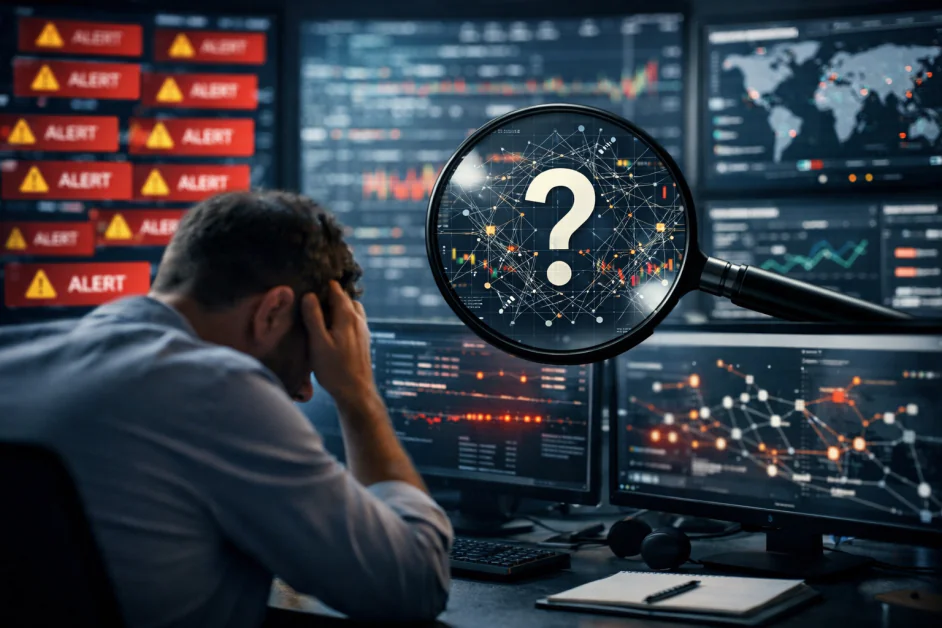
Artificial intelligence has transformed cybersecurity. Security operations centers now process more telemetry, detect anomalies faster, and automate repetitive investigations. On paper, this should represent a golden era for cyber defense.
In practice, many teams feel more overwhelmed than ever.
Detection capabilities have improved dramatically, but clarity has not. The paradox of modern cybersecurity is that better visibility often leads to greater uncertainty. When everything looks suspicious, knowing what truly matters becomes the central challenge.
More Detection Does Not Equal Better Protection
AI-driven security tools generate alerts at an unprecedented scale. Behavioral analytics, endpoint detection, cloud monitoring, identity anomaly detection, and threat hunting engines constantly scan for deviations from baseline activity.
The result is a deluge of alerts.
Research shows that teams face around 4,484 alerts per day, and due to resource constraints, a significant percentage are ignored. That volume illustrates the gap between detection capability and response capacity. AI has increased visibility, but it has also increased noise.
For security leaders, this creates operational strain. Analysts spend valuable hours investigating events that ultimately pose minimal risk. Meanwhile, high-impact threats may hide among lower-priority signals.
The Prioritization Problem
The issue is not data scarcity. It is context scarcity.
Security platforms are excellent at identifying anomalies. They are less effective at explaining which anomalies matter most in a specific business environment. A vulnerability flagged on a development server is not equivalent to the same vulnerability exposed on a customer-facing payment system.
This is where a modern threat intelligence platform becomes strategically important. Rather than simply aggregating alerts, it correlates external threat feeds with internal asset context, exploit availability, and exposure data. It answers a more meaningful question: which alerts intersect with active threat campaigns and critical assets?
Prioritization transforms volume into focus. Without it, teams default to reactive triage, often driven by whichever alert arrives first.
AI Has Raised the Stakes on Both Sides
It is also important to recognize that AI is not exclusive to defenders. As recent coverage has highlighted, AI has empowered the other side of this cyber battlefield. Threat actors now leverage machine learning models to automate reconnaissance, craft highly convincing phishing campaigns, and dynamically adapt malware behavior.
Large language models can generate localized phishing emails at scale. Automated scanning tools can identify misconfigured cloud resources in minutes. Credential harvesting campaigns are refined continuously based on response patterns.
This acceleration compresses timelines. The interval between initial compromise and lateral movement is shrinking. Defensive teams must interpret and act on signals faster than ever before.
The imbalance becomes clear when automation amplifies attack velocity while defensive teams remain constrained by human response bandwidth.
The Illusion of Comprehensive Coverage
Many organizations attempt to solve alert fatigue by adding more tools. Additional detection engines, more dashboards, more feeds. The assumption is that greater visibility will reduce risk.
In reality, fragmented tooling often increases complexity. Separate consoles produce separate alerts without a unified context. Analysts manually cross-reference data between systems, extending investigation cycles.
The strategic question shifts from “How do we detect more?” to “How do we interpret what we detect?”
A mature approach focuses on correlation across telemetry sources. Network activity, identity anomalies, endpoint signals, and vulnerability data must converge into a unified risk model. This convergence enables security teams to distinguish between routine noise and coordinated attack activity.
Context Is the New Differentiator
High-performing security programs increasingly rely on contextual intelligence rather than isolated alerts. Context includes asset criticality, business impact, exploit likelihood, and active threat campaigns.
For example, a vulnerability that is theoretically severe but not actively exploited may warrant monitoring rather than immediate remediation. Conversely, a moderate-severity flaw tied to an ongoing campaign targeting similar organizations demands rapid action.
Threat intelligence feeds provide this external perspective. When combined with internal exposure data, they create a prioritized remediation roadmap rather than a list of disconnected alerts.
This is where AI should assist, not overwhelm. Instead of producing more alerts, AI models should surface correlations that human analysts might miss under time pressure.
From Detection to Exposure Management
The conversation in cybersecurity is gradually shifting toward exposure management. Rather than focusing solely on identifying attacks after they begin, organizations are mapping and reducing exploitable paths before they are triggered.
Continuous exposure management frameworks evaluate how vulnerabilities, misconfigurations, and identity permissions intersect. They simulate potential attack paths to determine where risk accumulates.
A threat intelligence platform integrated into this model enhances accuracy. It helps determine whether an exposure is theoretical or actively targeted in the wild. That distinction directly affects prioritization decisions.
Reducing exposure proactively is often more impactful than investigating another false positive.
The Human Factor
Behind every alert queue are analysts making judgment calls under pressure. Alert fatigue is not simply an operational inconvenience. It is a human sustainability issue.
When professionals process thousands of low-value alerts, cognitive fatigue increases. Decision quality declines. Burnout rises. Talent retention becomes difficult in an already constrained labor market.
AI was expected to reduce that burden. In some environments, it has. In others, it has simply multiplied signal volume without improving clarity.
The next phase of AI integration must emphasize quality over quantity. Models should be tuned to minimize false positives and enhance risk scoring precision.
What Maturity Looks Like in 2026
Cybersecurity maturity in 2026 will not be defined by how many alerts a company can generate. It will be defined by how quickly and accurately it can convert intelligence into action.
Organizations that integrate contextual threat intelligence, exposure analysis, and automated prioritization into a cohesive system will outperform those that rely on detection alone. The goal is not to eliminate alerts entirely. It is to ensure that each alert represents meaningful risk.
Security teams need fewer, higher-confidence decisions. They need visibility that clarifies rather than obscures.
AI remains central to this transformation. When implemented strategically, it reduces cognitive overload and sharpens prioritization. When implemented without integration, it amplifies chaos.
The difference lies in architecture, not in the algorithm alone.



