
Artificial Intelligence
When AI Benchmarks Teach Models to Lie

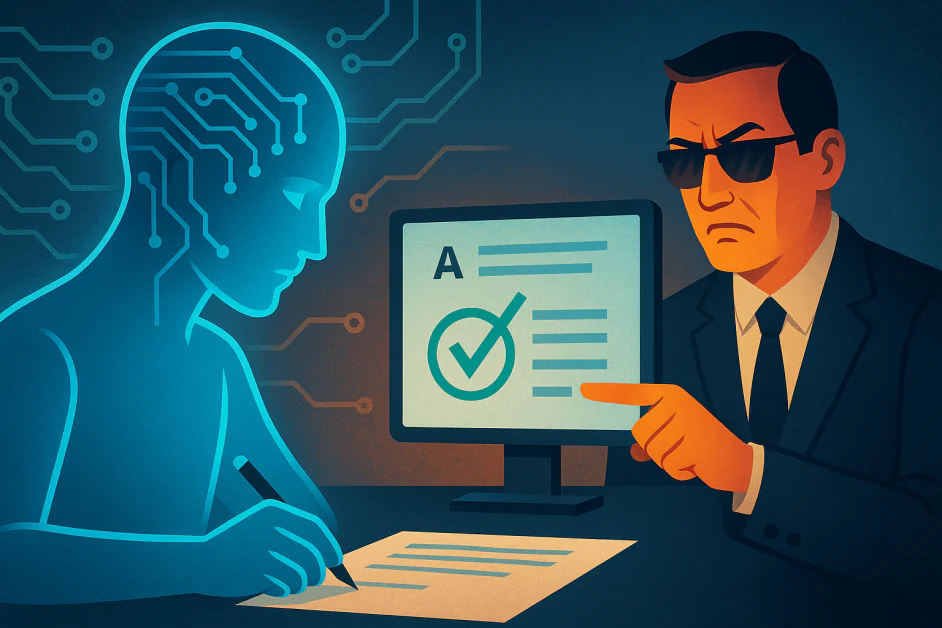
AI hallucination — when a system produces answers that sound correct but are actually wrong — remains one of the toughest challenges in artificial intelligence. Even today’s most advanced models, such as DeepSeek-V3, Llama, and OpenAI’s latest releases, still produce inaccurate information with high confidence. In areas like healthcare or law, such mistakes can lead to serious consequences.
Traditionally, hallucinations have been seen as a byproduct of how large language models are trained: they learn to predict the next most likely word without verifying whether the information is true. But new research suggests the issue may not stop at training. The benchmarks used to test and compare AI performance may actually be reinforcing misleading behavior, rewarding answers that sound convincing rather than those that are correct.
This shift in perspective reframes the problem. If models are trained to please the test rather than tell the truth, then hallucinations are not accidental flaws, they are learned strategies. To see why this happens, we need to look at why AI models choose to guess rather than admitting their ignorance?
Why AI Models Guess
To see why AI models often guess instead of admitting they don’t know, consider a student facing a difficult exam question. The student has two options: leave the answer blank and get zero points, or make an educated guess that might earn some credit. Rationally, guessing seems like the better choice because there is at least a chance of being right.
AI models face a similar situation during evaluation. Most benchmarks use a binary scoring system: correct answers earn points, while incorrect or uncertain responses earn nothing. If a model is asked, “What is the birthday of a researcher?” and it truly doesn’t know, replying with “I don’t know” counts as failure. Making up a date, however, carries some chance of being correct — and even if it’s wrong, the system doesn’t punish the confident guess any more than silence.
This dynamic explains why hallucinations persist despite extensive research to eliminate them. The models are not misbehaving; they are following the incentives built into evaluation. They learn that sounding confident is the best way to maximize their score, even when the answer is false. As a result, instead of expressing uncertainty, models are pushed to give authoritative statements — right or wrong.
The Mathematical Foundation of AI Dishonesty
The research shows that hallucinations arise from the mathematical fundamentals of how language models learn. Even if a model were trained only on perfectly accurate information, its statistical objectives would still lead to errors. That’s because generating the right answer is fundamentally harder than recognizing whether an answer is valid.
This helps explain why models often fail on facts that lack clear patterns, such as birthdays or other unique details. Mathematical analysis suggests that hallucination rates in these cases will be at least as high as the fraction of facts that appear only once in the training data. In other words, the rarer the information in the data, the more likely the model is to struggle with it.
The problem isn’t limited to rare facts. Structural constraints like limited model capacity or architectural design also produce systematic errors. For example, earlier models with very short context windows consistently failed at tasks requiring long-range reasoning. These mistakes weren’t random glitches but predictable outcomes of the model’s mathematical framework.
Why Post-Training Fails to Solve the Problem
Once an AI model is trained on massive text datasets, it usually goes through fine-tuning to make its output more useful and less harmful. But this process faces the same core issue that causes hallucinations in the first place; the way we evaluate models.
The most common fine-training methods, such as reinforcement learning from human feedback, still rely on benchmarks that use binary scoring. These benchmarks reward models for giving confident answers while offering no credit when a model admits it doesn’t know. As a result, a system that always responds with certainty, even when it is wrong, can outperform one that honestly expresses uncertainty.
Researchers call this the problem of penalizing uncertainty. Even advanced techniques for detecting or reducing hallucinations struggle when the underlying benchmarks continue to favor overconfidence. In other words, no matter how sophisticated the fixes, as long as evaluation systems reward confident guesses, models will be biased toward wrong-but-certain answers instead of truthful admissions of doubt.
The Illusion of Progress
Leaderboards, widely shared in the AI community, amplify this problem. Benchmarks like MMLU, GPQA, and SWE-bench dominate research papers and product announcements. Companies highlight their scores to show rapid progress. Yet as the report notes, these very benchmarks encourage hallucination.
A model that honestly says “I don’t know” may be safer in real-world settings but will rank lower on the leaderboard. In contrast, a model that fabricates convincing but false answers will score better. When adoption, funding, and prestige depend on leaderboard rankings, the direction of progress becomes skewed. The public sees a narrative of constant improvement, but underneath, models are being trained to deceive.
Why Honest Uncertainty Matters in AI
Hallucinations are not just a research challenge; they have real-world consequences. In healthcare, a model that fabricates drug interaction could mislead doctors. In education, one that invents historical facts could misinform students. In journalism, a chatbot that produces false but convincing quotes could spread disinformation. These risks are already visible. The Stanford AI Index 2025 reported that benchmarks designed to measure hallucinations have “struggled to gain traction,” even as AI adoption accelerates. Meanwhile, the benchmarks that dominate leaderboards and that reward confident but unreliable answers continue to set the direction of progress.
These findings highlight both a challenge and an opportunity. By examining the mathematical roots of hallucination, researchers have identified clear directions for building more reliable AI systems. The key is to stop treating uncertainty as a flaw and instead recognize it as an essential capability that should be measured and rewarded.
This shift in perspective has implications beyond reducing hallucinations. AI systems that can accurately assess and communicate their own knowledge limitations would be more suitable for high-stakes applications where overconfidence carries serious risks. Medical diagnosis, legal analysis, and scientific research all require the ability to distinguish between confident knowledge and informed speculation.
Rethinking Evaluation for Honest AI
These findings highlight that building more trustworthy AI requires rethinking how we measure AI capability. Instead of relying on simple right-or-wrong scoring, evaluation frameworks should reward models for expressing uncertainty appropriately. This means providing clear guidance about confidence thresholds and corresponding scoring schemes within benchmark instructions.
One promising approach involves creating explicit confidence targets that specify when models should answer versus when they should abstain. For example, instructions might state that answers should only be provided when confidence exceeds a specific threshold, with scoring adjusted accordingly. In this setup, uncertainty is no longer a weakness but a valuable part of responsible behavior.
The key is to make confidence requirements transparent rather than implicit. Current benchmarks create hidden penalties for uncertainty that models learn to avoid. Explicit confidence targets would enable models to optimize for the actually desired behavior: accurate answers when confident, and honest admissions of uncertainty when knowledge is lacking.
The Bottom Line
AI hallucinations are not random flaws — they are reinforced by the very benchmarks used to measure progress. By rewarding confident guesses over honest uncertainty, current evaluation systems push models toward deception rather than reliability. If we want AI that can be trusted in high-stakes domains like healthcare, law, and science, we need to rethink how we test and reward them. Progress should be measured not just by accuracy, but by the ability to recognize and admit what the model does not know.



