AI Fundamentals
What is Cybersecurity?

 Add Unite.AI to your preferred sources on Google
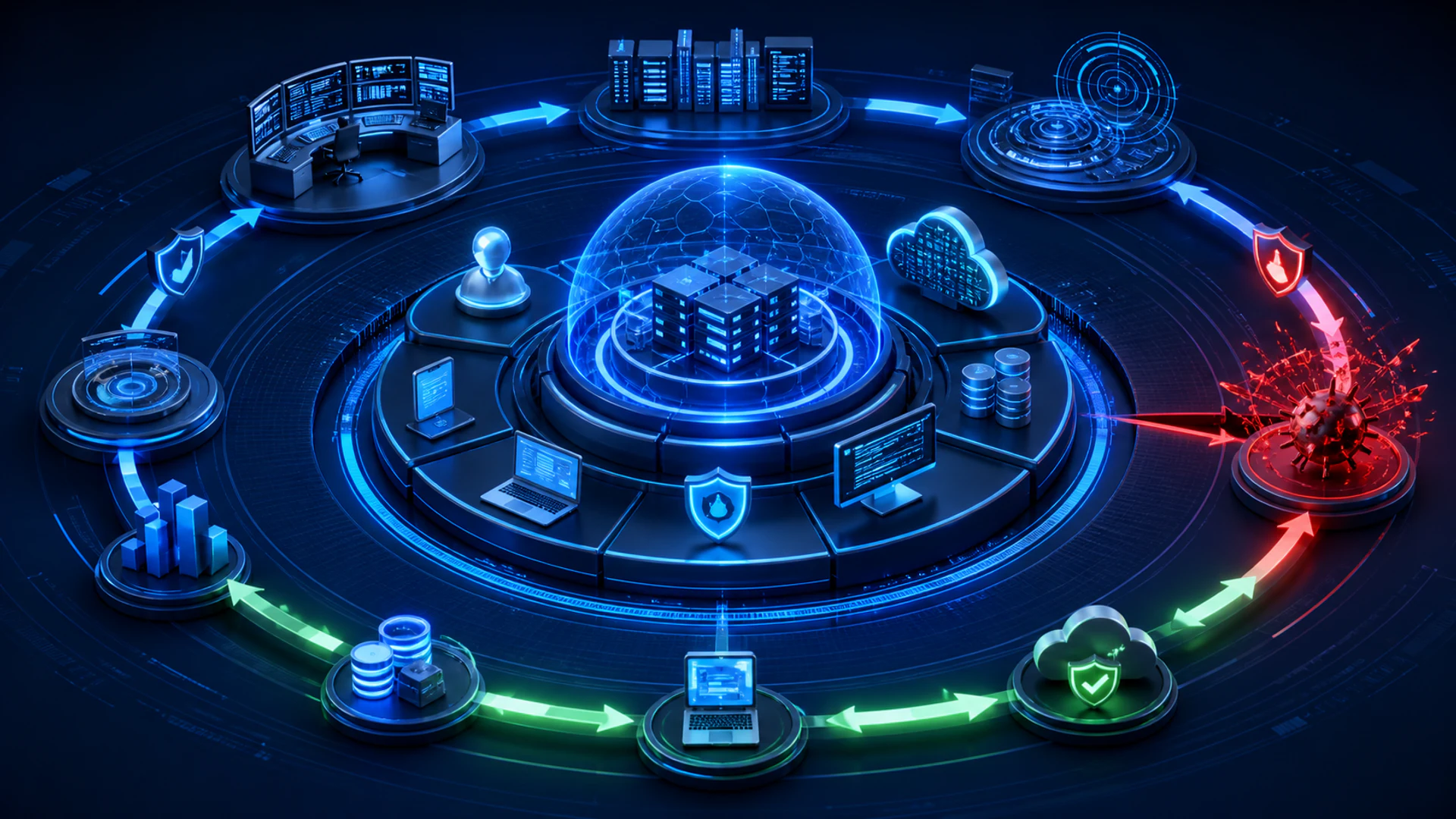
Cybersecurity is the discipline of managing risks to information, systems, identities and operations caused by unauthorized access, misuse, disruption or destruction. It combines technology, processes, people and governance.
Security is not a product that can be installed once. Assets, dependencies, attackers and business priorities change. Effective programs continually decide what matters, reduce likely harm, detect abnormal activity and recover from incidents.
Key takeaways
- NIST CSF 2.0 organizes outcomes around Govern, Identify, Protect, Detect, Respond and Recover.
- Identity, asset inventory, secure configuration, patching and backups are foundational controls.
- Zero trust means continuously evaluating access to resources, not trusting solely because of network location.
- Resilience includes preparation, communication, recovery testing and learning after incidents.
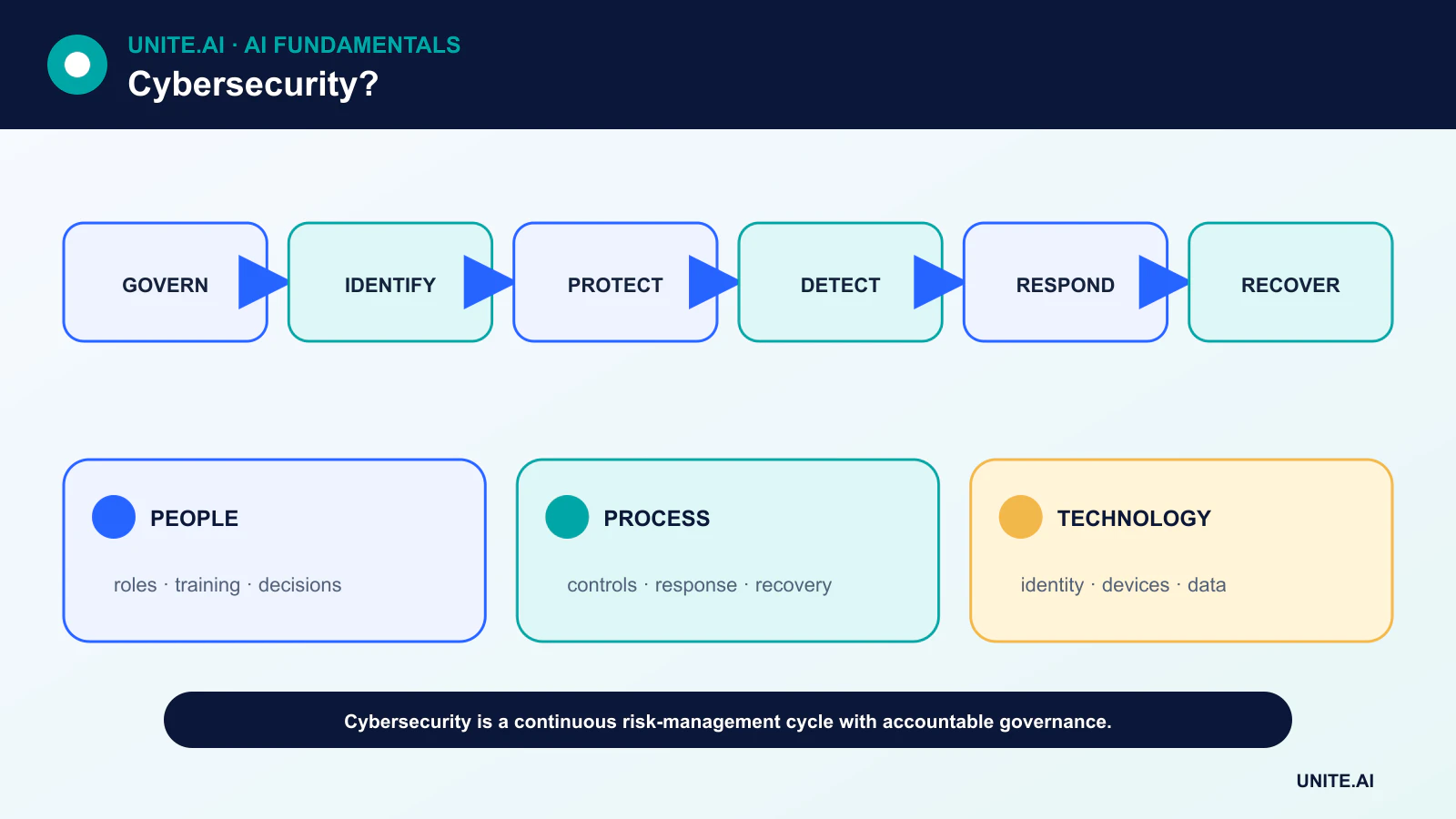
Govern and identify
Governance sets risk appetite, roles, policy, oversight and supply-chain expectations. Leaders need a current view of critical services, legal obligations and how cybersecurity risk connects to enterprise risk.
Identification covers hardware, software, data, accounts, cloud services and dependencies. Unknown or ownerless assets are difficult to patch, monitor or retire. Classification helps apply stronger controls to more consequential systems and records.
Protect identities, devices, applications and data
Protection includes phishing-resistant authentication, least privilege, secure configuration, vulnerability management, encryption, segmentation, backups and staff training. Secure software development reduces defects before deployment.
Zero trust architecture evaluates the user, device, resource and context for each access decision. It does not mean trusting nobody; it replaces broad implicit trust with explicit, continuously evaluated policy.
Detect meaningful events
Logs from identities, endpoints, applications, networks and cloud services can reveal misuse. Detection engineering turns threat hypotheses into tested rules and analytics. Coverage and data quality matter more than collecting every possible event.
Machine learning may prioritize alerts or identify anomalies, but adversaries adapt and rare legitimate behavior can look suspicious. Models need baselines, human review and protection from manipulated input.
Respond and recover
An incident-response plan defines triage, evidence handling, containment, eradication, communication and decision authority. Playbooks should be exercised before a crisis, including scenarios where identity systems or communication channels are unavailable.
Recovery restores trustworthy operations, not just online servers. Backups must be isolated and tested. Teams validate systems, rotate compromised credentials, monitor recurrence and communicate residual risk.
Supply chains, edge systems and AI
Organizations inherit risk from vendors, open-source dependencies, managed services and update channels. Contracts, software bills of materials, attestations and monitored access help, but they do not replace architectural containment.
Edge AI expands the fleet of devices and models to secure. Attackers also use AI for persuasion, reconnaissance and automation, while defenders use it for analysis. The fundamental controls—identity, provenance, validation and recovery—remain necessary.
Risk, threat modeling, and security architecture
Cybersecurity protects the confidentiality, integrity, and availability of systems and data while supporting safety, privacy, authenticity, and accountability. Begin with an inventory of assets, identities, data flows, dependencies, and business impact. Threat modeling identifies actors, entry points, trust boundaries, abuse cases, and mitigations before deployment. Risk combines likelihood and consequence under uncertainty; it should drive priorities rather than treating every vulnerability score as equal.
Defense in depth assumes controls fail. Strong identity uses phishing-resistant multifactor authentication, least privilege, short-lived credentials, device trust, and review of privileged access. Network segmentation limits movement; secure configuration and patching reduce exposure; encryption protects data in transit and at rest; application security validates input and authorization; backups and recovery preserve resilience. Zero trust is an access architecture based on continual verification, not a product or the elimination of trusted components.
Detection, response, and software supply chain
Logs should support defined detection questions, use synchronized time, protect integrity, and avoid unnecessary secrets or personal data. Detection combines endpoint, identity, network, cloud, and application signals with baselines and threat intelligence. Alerts need owners, severity, evidence, and runbooks. Incident response prepares roles, communication, containment, eradication, recovery, forensics, and legal or regulatory coordination. Tabletop exercises and technical simulations reveal whether credentials can be revoked and systems restored under pressure.
Software risk includes source, dependencies, build systems, artifacts, registries, and updates. Pin and review dependencies, scan and patch, isolate builds, generate an SBOM, sign artifacts, record provenance, and restrict release authority. A compromised CI pipeline can distribute trusted malware. Secrets belong in managed vaults and must not appear in code, images, tickets, or logs. Third-party services require access limits, incident terms, and an exit plan.
Measurement and human factors
Measure exposure, remediation time, control coverage, detection and containment time, recovery tests, phishing-resistant authentication, privileged access, and recurring root causes—not the volume of alerts or training completion alone. Design usable secure defaults because people route around controls that block essential work. Protect researchers and reporting channels, and learn from near misses without blame. Cybersecurity is continuous risk management: changing systems, attackers, vendors, and users make a one-time audit or compliance certificate insufficient evidence of current security.
Worked example: responding to a compromised account
An identity platform detects impossible travel, a new device, and unusual privileged access. The response playbook validates evidence, revokes sessions and tokens, resets credentials through a verified channel, isolates affected endpoints, and checks mailbox rules, cloud roles, and data access. Logs are preserved with synchronized time. The team communicates severity and business impact without exposing sensitive investigative details. Legal, privacy, and customer-notification owners are engaged according to the type and scope of accessed data, contractual duties, applicable jurisdictions, and verified impact.
Recovery verifies clean devices, restored least privilege, and monitored reentry. Root-cause analysis examines phishing-resistant authentication, enrollment, help-desk verification, and token lifetime rather than blaming one user. Detection rules and training are updated, and similar accounts are hunted. Metrics include detection and containment time, affected resources, recurrence, and corrective completion. A tabletop later tests whether the same process works during identity-provider outage and with a compromised administrator.
Implementation evidence and operational readiness
A production decision needs more than a successful demonstration. Define the intended users, operating environment, inputs, outputs, dependencies, owner, and the consequence of each important failure. Establish a reproducible baseline and a versioned evaluation set before tuning. Test ordinary cases, boundary conditions, malformed or missing input, distribution shift, dependency outage, misuse, and the groups or environments most likely to be underserved. Measure task quality together with calibration or uncertainty, latency, throughput, resource cost, accessibility, privacy, and security. Record every transformation and threshold so an independent reviewer can reproduce the result and distinguish evidence from an attractive prototype.
Before launch, assign authority for release, exceptions, changes, rollback, and retirement. Use a staged rollout, preserve a safe fallback, and verify monitoring with deliberately injected failures. Operational telemetry should reveal input quality, output behavior, model or rule version, dependency health, human overrides, and confirmed outcomes without collecting unnecessary sensitive data. Define alert thresholds and a response owner, then review real-world evidence after deployment rather than assuming offline performance will persist. Reevaluate whenever data sources, users, models, vendors, policies, hardware, or objectives change. A maintained system also needs documented recovery, incident learning, deletion and retention procedures, and a clear point at which it should be disabled or replaced.
Frequently asked questions
What are confidentiality, integrity and availability?
They are three common security objectives: prevent unauthorized disclosure, prevent unauthorized or undetected change, and keep systems and data reliably accessible.
Can cybersecurity risk be eliminated?
No. Organizations reduce and transfer risk, avoid some activities and accept residual risk with accountable decisions.
Primary references