AI Fundamentals
What is a Digital Twin?

 Add Unite.AI to your preferred sources on Google

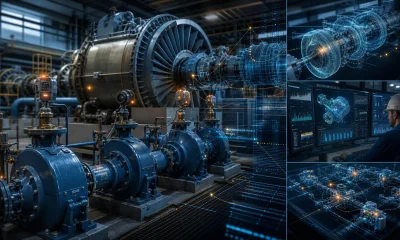
A digital twin is a fit-for-purpose digital representation of a real-world entity or process that is connected to observations of its counterpart and maintained for defined monitoring, prediction, testing or decision-support tasks.
The connection and purpose distinguish a twin from a static 3D model. Synchronization can be continuous, event-driven or periodic; it does not need to be perfectly real time, but its latency and uncertainty must be appropriate for the decision.
Key takeaways
- A twin combines a physical or operational counterpart, data connection, digital representation, models and services.
- Verification asks whether the model was built correctly; validation asks whether it is adequate for its intended use.
- A digital thread connects data and decisions across lifecycle stages; it is related to but broader than one twin.
- Cybersecurity, interoperability and uncertainty determine whether a twin can be trusted.
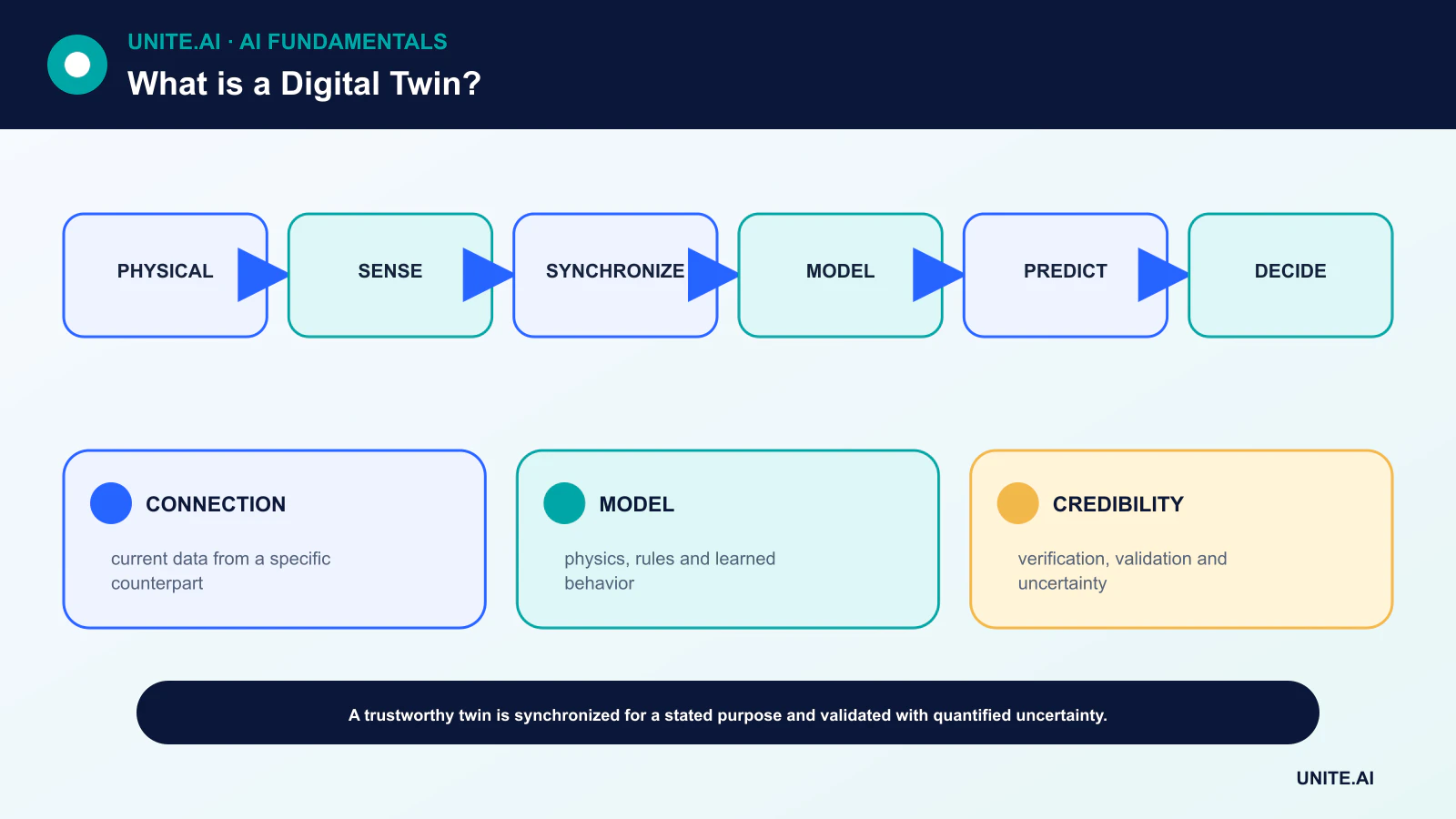
Core components and synchronization
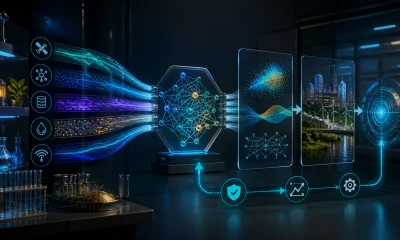
Sensors, control systems, maintenance records and enterprise data describe the counterpart. A data layer aligns identifiers, units, timestamps and quality. Models may combine physics, statistics, rules and machine learning, while services expose status, forecasts or recommendations.
Synchronization is bidirectional in some systems: physical observations update the twin, and an approved decision can influence the physical system. Other twins are read-only. State the cadence, allowed control path and behavior when data are stale.
Models, simulation and what-if analysis
A simulation can test one scenario without an ongoing connection to a specific asset. A twin uses synchronized context so the scenario reflects the current or recent state of its counterpart. It may run many simulations, but the terms are not synonyms.
Forecasting can support maintenance, quality, scheduling or energy decisions. Machine learning can complement physical models, while constraints prevent a statistical fit from recommending impossible states.
Verification, validation and uncertainty
Verify software, equations, interfaces and numerical implementation. Validate predictions against independent observations across the intended operating range. Quantify uncertainty from sensors, parameters, model structure and future conditions.
A twin is fit for purpose, not universally accurate. A model validated for short-term temperature prediction may be unsuitable for safety certification or long-term fatigue. Record versions, calibration history and unsupported conditions.
Digital threads and lifecycle integration
A digital thread links requirements, design, manufacturing, operation, maintenance and retirement records. Twins at different lifecycle stages can use that thread to preserve traceability and avoid incompatible identifiers or duplicated truth.
Interoperability depends on shared semantics and interfaces, making a data fabric or similar metadata governance useful. Ownership must remain clear when vendors and organizations contribute different layers.
Security and human decision authority
A twin increases the value and connectivity of operational data. Threats include sensor spoofing, model tampering, unauthorized control, confidential-design leakage and dependency compromise. Apply identity, segmentation, signed updates, monitoring and safe failure modes.
Recommendations should show evidence and uncertainty, with human approval for high-impact actions. A twin can improve a decision, but it does not own the consequences of changing a factory, building, vehicle or care process.
Digital-twin architecture and synchronization
A digital twin is a maintained digital representation of a physical asset, process, system, or environment connected to observations and used for a defined decision. It differs from a one-time simulation because state and parameters are updated over the lifecycle. Architecture links asset identity, sensors, operational history, geometry or topology, physics or data-driven models, simulation, and applications. The useful scope might be one motor, a production line, a building, or a fleet; claiming a complete twin without a bounded decision makes validation impossible.
Synchronization combines telemetry, inspections, maintenance records, and external conditions. Time alignment, units, calibration, missing data, and asset hierarchy are foundational. State estimation methods reconcile noisy observations with a model, while parameter estimation adapts behavior. Update frequency should match the process: milliseconds for control-related state, hours for energy planning, or months for structural degradation. More real-time data is not automatically better if measurement uncertainty and causal relevance are unknown.
Models, validation, and uncertainty
Physics-based twins encode conservation laws and mechanisms; empirical twins learn from historical data; hybrid twins combine them. Simulation can test what-if scenarios, optimize schedules, estimate remaining life, or support commissioning. Validate predictions against withheld operating periods and controlled interventions, across loads and failure modes. Quantify parameter and measurement uncertainty, and avoid presenting one trajectory as certainty. A model calibrated only under normal operation may be least reliable during the rare failure it is meant to predict.
Verification asks whether equations and software are implemented correctly; validation asks whether the twin represents reality adequately for its use. Maintain traceability from requirement to model, data, calibration, and acceptance test. Review sensitivity to assumptions and compare with simple baselines. For safety-related decisions, keep independent protective controls and require human authorization.
Lifecycle, security, and value
Secure connections between operational technology and the twin through segmentation, gateways, least privilege, and signed updates. A compromised twin can leak design and production data or influence unsafe maintenance. Version models and asset configuration, record calibration, and retire stale twins. Measure avoided downtime, energy, yield, maintenance quality, and decision time against a baseline, including sensor and integration cost. A digital twin creates value only when its validated representation changes an accountable decision.
Worked example: a digital twin for a wind turbine
A turbine twin links asset configuration, SCADA telemetry, vibration, weather, inspections, and maintenance history to physics and data-driven models. State estimation reconciles noisy sensors, while simulation predicts loads and component temperature under candidate operation. Validation uses withheld seasons and known maintenance events, reporting uncertainty, error by wind regime, and sensitivity to sensor bias. The twin does not issue safety-critical control commands.
A rising bearing-risk estimate prompts inspection planning with the contributing evidence and uncertainty. The resulting finding updates the asset record and model calibration. Sensor replacement, blade modification, or controller update creates a new twin configuration. Network segmentation separates diagnostics from control, and model updates are signed. Value is measured through avoided downtime, energy, maintenance, and decision lead time against historical and comparable turbines, including the cost of sensing and maintaining the twin.
Implementation evidence and operational readiness
A production decision needs more than a successful demonstration. Define the intended users, operating environment, inputs, outputs, dependencies, owner, and the consequence of each important failure. Establish a reproducible baseline and a versioned evaluation set before tuning. Test ordinary cases, boundary conditions, malformed or missing input, distribution shift, dependency outage, misuse, and the groups or environments most likely to be underserved. Measure task quality together with calibration or uncertainty, latency, throughput, resource cost, accessibility, privacy, and security. Record every transformation and threshold so an independent reviewer can reproduce the result and distinguish evidence from an attractive prototype.
Before launch, assign authority for release, exceptions, changes, rollback, and retirement. Use a staged rollout, preserve a safe fallback, and verify monitoring with deliberately injected failures. Operational telemetry should reveal input quality, output behavior, model or rule version, dependency health, human overrides, and confirmed outcomes without collecting unnecessary sensitive data. Define alert thresholds and a response owner, then review real-world evidence after deployment rather than assuming offline performance will persist. Reevaluate whenever data sources, users, models, vendors, policies, hardware, or objectives change. A maintained system also needs documented recovery, incident learning, deletion and retention procedures, and a clear point at which it should be disabled or replaced.
Frequently asked questions
Is a 3D model a digital twin?
Not by itself. It becomes part of a twin when it is connected to a specific counterpart and maintained for a defined operational purpose.
Must a digital twin control the physical asset?
No. Some twins only monitor or predict. When control exists, its authorization and safety boundaries must be explicit.
Primary references