
Artificial Intelligence
The GPU Wall is Cracking: The Unseen Revolution in Post-Transformer Architectures

For the past five years, the artificial intelligence industry has been effectively synonymous with one word: Transformer. Since the release of the seminal “Attention Is All You Need” paper in 2017, this architecture has swallowed the field. From GPT to Claude, virtually every headline-grabbing model relies on the same underlying mechanism of self-attention. We have largely assumed that the path to better AI is simply a matter of scale. In practice, this means training bigger Transformers with more data on larger clusters of GPUs.
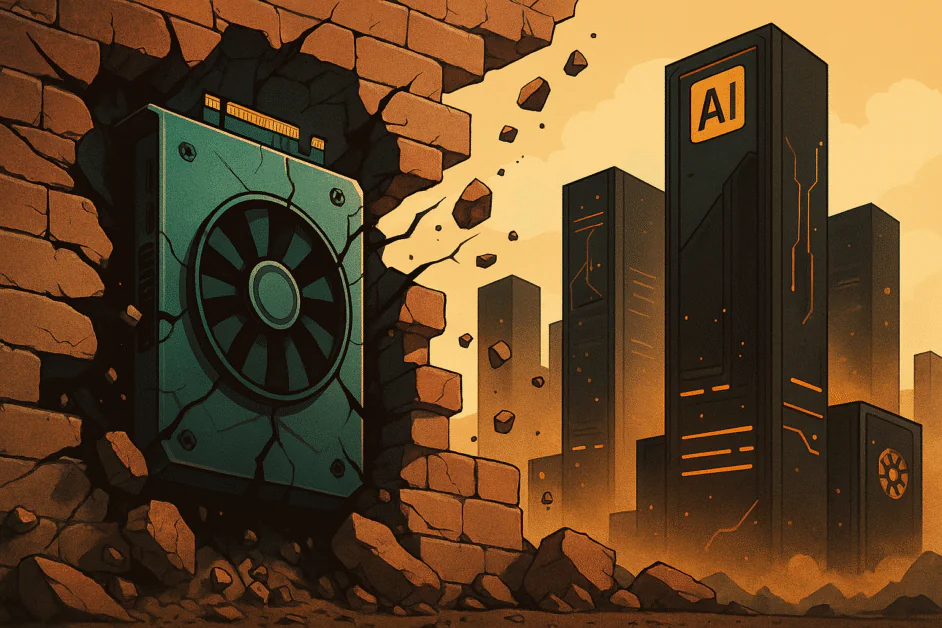
While this belief has driven many breakthroughs, it is now reaching its limits. We are hitting a “GPU Wall,” a barrier not just of raw compute power, but of memory bandwidth and economic sustainability. While the world focuses on the race for trillion-parameter models, a radical shift is taking place in research labs. A new wave of “Post-Transformer architectures” is emerging to shatter the limitations of the current paradigm. This shift promises to make AI more efficient, accessible, and capable of reasoning over infinite contexts.
The Silicon Ceiling: Why Transformers Are Hitting a Wall
To understand why we need a shift, we first need to understand the bottleneck of the current regime. Transformers are incredibly powerful, but they are also remarkably inefficient in specific ways. The core of their ability lies in the “attention mechanism,” which allows the model to look at every token in a sequence and calculate its relationship to every other token. This is what gives them the ability to understand context remarkably well.
However, this capability comes with a fatal flaw of quadratic scaling. If you double the length of the document, you want the AI to read, the computational work required does not just double, it quadruples. As we strive for “infinite context” models that can read entire libraries or codebases, the computational demands become extremely high.
But the more immediate problem is memory, specifically the “KV Cache” (Key-Value Cache). To generate text fluently, a Transformer must keep a running history of everything it has just said in the GPU’s high-speed memory (VRAM). As the conversation grows longer, this cache bloats, consuming massive amounts of memory just to remember what happened three paragraphs ago.
This creates the “GPU Wall.” We are not just running out of chips; we are running out of memory bandwidth to feed them. We have built engines that are getting bigger and bigger, but they are becoming impossible to fuel. For a long time, the industry’s solution was simply to buy more NVIDIA H100s. But this brute force is hitting a point of diminishing returns. We do not need an engine that consumes fuel quadratically but a new architecture.
The Unseen Revolution
While mainstream research has been focused on LLMs, a group of researchers has been revisiting an old idea: Recurrent Neural Networks (RNNs). Before Transformers, RNNs were the standard for language. They processed text sequentially, word by word, updating a hidden internal “state” as they went. They were incredibly efficient because they did not need to look back at the entire history, they just carried the “gist” of it in their memory.
RNNs failed because they could not handle long dependencies; they would “forget” the beginning of a sentence by the time they reached the end. They were also slow to train because you could not parallelize them. This means you had to process word A before you could process word B. Transformers solved this by processing everything at once (parallelization) and keeping everything in memory (attention).
Now, we are witnessing the rise of architectures that combines the best of both worlds. These are broadly known as State Space Models (SSMs). They offer the training speed of Transformers (parallelizable) but the inference efficiency of RNNs (linear scaling).
One of the prominent architectures on this new wave is Mamba. Released in late 2023 and refined throughout 2024, Mamba is a fundamental shift in how models handle information. Unlike a Transformer, which keeps an original copy of every word it has ever seen in its memory buffer, Mamba uses a “selective state space.”
We can understand the difference between Transformer and Mamba by imagining Transformer as a scholar who keeps every book, they have ever read open on a massive desk, constantly scanning back and forth to find connections. Mamba, by contrast, is a scholar who reads the book once and compresses the key insights into a highly efficient notebook. When Mamba generates the next word, it does not need to look back at the raw text; it looks at its compressed state.
This distinction changes the economics of AI deployment. With Mamba and similar architectures like RWKV (Receptance Weighted Key Value), the cost of generating text does not explode as the sequence gets longer. You can theoretically feed these models a million words of context, and the computational cost to generate the next token remains the same as if you had fed it ten words.
The Return of Recurrence
The technical breakthrough behind Mamba is “selectivity.” Previous attempts to modernize RNNs failed because they were too rigid. They compressed information equally, regardless of whether it was important or noise. Mamba introduces a mechanism that allows the model to dynamically decide what to remember and what to forget as it streams data.
If the model gets an important piece of information, like a variable definition in a code block, it “opens the gate” and writes it strongly into its state. If it faces filler words or irrelevant noise, it closes the gate, preserving its limited memory capacity for what matters.
This selectivity effectively solves the “forgetting” problem that challenged older RNNs. In many tests, Mamba-based models match the performance of Transformers of the same size but run up to five times faster during inference. More importantly, their memory footprints are much smaller. This opens the door for high-performance LLMs to run on devices that were previously thought incapable of handling them, such as laptops, edge-computing networks, or even smartphones, without offloading to the cloud.
We are also seeing the rise of Hyena, another sub-quadratic architecture that uses long convolutions to process data. Like Mamba, Hyena aims to remove the heavy “attention” layers of the Transformer and replace them with mathematical operations that are far cheaper for the hardware to execute. These models have now begun to challenge Transformer incumbents on major leaderboards.
The Rise of the Hybrids
The revolution, however, might not be a complete replacement of the Transformer, but rather an evolution into hybrid forms. We are already seeing the emergence of models like Jamba (from AI21 Labs), which combines Transformer layers with Mamba layers.
This hybrid approach offers a practical way to address Transformer limitations. Transformers remain exceptionally strong at certain tasks, especially for copying precise details from context. By mixing Mamba layers (which handle the bulk of the data processing and long-term memory) with a few Transformer attention layers (which handle the sharp, immediate reasoning), we get a model that brings together the best of both worlds.
A hybrid model creates a massive context window that is actually usable. Currently, many “long context” Transformers claim to handle 100,000 tokens, but their performance degrades rapidly as the context fills up. This phenomenon is known as “lost in the middle.” Hybrid architecture maintains their coherence much better over long distances because the SSM layers are specifically designed to compress and carry state over time.
These developments shift the industry focus from “Training Compute” (how big of a cluster do I need to build the model?) to “Inference Economics” (how cheaply can I serve this model to a billion users?). If a hybrid model can serve a user for 10% of the cost of a Transformer, the business case for AI applications changes overnight.
The Future of AI Deployment
The implications of this post-Transformer revolution are not just limited to the data center. The GPU Wall has historically served as a gatekeeper, ensuring that only the largest tech giants with billions of dollars in hardware could build and run state-of-the-art models. Efficient architectures like Mamba and RWKV democratize this power. If you can run a GPT-4 level model on a consumer-grade card because you no longer need terabytes of VRAM for the Key-Value cache, the centralized control of AI begins to loosen. We could see a resurgence of local, private AI agents that live entirely on your computer, processing your private data without ever sending a packet to the cloud.
Furthermore, this efficiency is the key to unlocking “Agentic AI” systems that run in the background for hours or days to complete complex tasks. Current Transformers are too expensive and slow to run in continuous loops for long periods. An efficient, linear-time architecture can “think” and process loops continuously without bankrupting the user or overheating the hardware.
The Bottom Line
The Transformer has dominated AI headlines, but behind the scenes, a quiet revolution is underway. The GPU Wall is pushing researchers to rethink how models handle memory and computation. Post-Transformer architectures like Mamba and hybrid models are proving that efficiency, not just scale, will define the next era. These innovations make massive context windows practical, inference cheaper, and advanced AI accessible beyond data centers. The future of AI lies not in bigger models, but in smarter ones that remember, reason, and scale efficiently.



