
Artificial Intelligence
The AI Arms Race Intensifies: AMD’s Strategic Partnership with OpenAI

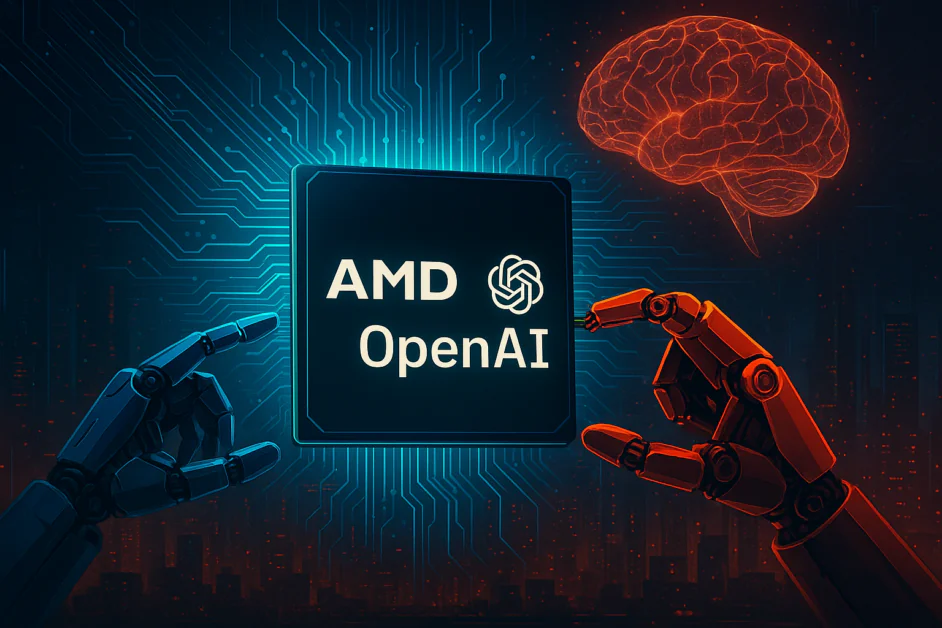
On October 6, 2025, AMD and OpenAI announced one of the largest compute partnerships in modern Artificial Intelligence (AI). Under this deal, OpenAI plans to use up to six gigawatts of AMD Instinct GPUs across several future product generations. The first phase will begin in 2026 with the deployment of AMD’s Instinct MI450 chips. AMD also issued OpenAI warrants for approximately 160 million shares, which could give OpenAI a close to 10% stake if exercised in full.
The market reacted immediately, and AMD’s stock rose more than 20% within a few hours. This reaction showed that investors expressed strong confidence in the announcement. The deal also has a broader meaning. It brings AMD into OpenAI’s long-term compute plans and increases the pressure on Nvidia, which has led the data center AI market for many years.
Because of this, partnership is being considered an important moment in the AI compute race. It indicates that future work on advanced models will depend on a broader group of chip suppliers. It also suggests that competition in this field is becoming stronger, which may define the next phase of global AI development.
Strategic Reasons Behind OpenAI’s AMD Partnership
Modern AI models require enormous and sustained compute resources, and the global demand for high-performance GPUs has grown faster than supply can keep pace. Nvidia has long held a dominant position in the AI accelerator market, creating both supply bottlenecks and price volatility for large AI customers. By partnering with AMD, OpenAI reduces its reliance on a single vendor and secures predictable, large-scale compute capacity essential for training and deploying advanced models.
The partnership also provides important strategic advantages beyond just supply. Collaborating with AMD strengthens OpenAI’s negotiating position with all hardware vendors and gives the company greater control over the timing and execution of model rollouts. Furthermore, this agreement complements OpenAI’s existing relationships with Nvidia and other custom chip partners, forming a multi-vendor strategy designed for resilience and scalability. In addition, it enables closer coordination on hardware and software optimization, ensuring that the compute infrastructure can evolve in step with OpenAI’s increasingly complex AI models.
Technical Overview: MI300X to MI450 and Data Center Deployment
AMD’s Instinct GPU family currently includes the MI300X, which was designed with high memory capacity and bandwidth to handle large AI models. These GPUs have already been deployed in early cloud and hyperscale environments, such as Microsoft Azure, giving AMD valuable experience in operating at scale. Building on this foundation, the upcoming MI450 series is scheduled for initial deployment in 2026. This new generation is expected to deliver higher throughput and improved energy efficiency. According to industry reports, the MI450 will use an advanced process node and achieve better performance per watt, making it suitable for very large AI workloads.
However, deploying GPUs in hyperscale data centers requires more than simply installing the hardware. Rack systems must integrate MI450 GPUs with optimized power delivery and cooling infrastructure. Engineers need to monitor critical metrics such as memory bandwidth per card, GPU interconnect speeds, and overall rack-level density to ensure reliable operation. Moreover, hardware performance depends heavily on software. AMD’s ROCm platform has matured to support large AI models, and collaboration with OpenAI is expected to focus on aligning both hardware and software. This coordination will help maximize throughput and efficiency across OpenAI’s multi-gigawatt deployments.
Market Response, Financial Details, and Strategic Considerations
The announcement of the AMD–OpenAI partnership led to a notable reaction in financial markets. AMD’s stock rose sharply on the day of the news, reflecting investor confidence in the company’s expanded role in AI infrastructure. Analysts quickly revised their forecasts, noting the potential for substantial revenue growth tied to this agreement. While AMD emphasized the opportunity to expand its data center AI market, independent analysts cautioned that the financial outcome would largely depend on the pace of GPU deliveries and the mix of customers that utilize the technology.
A significant financial component of the deal is the issuance of warrants to OpenAI, covering roughly 160 million AMD shares. These warrants are structured to vest in stages, aligned with GPU deployment milestones. This arrangement links AMD’s execution to OpenAI’s potential financial benefit, creating a shared interest in the successful and timely rollout of the compute infrastructure. Consequently, both companies have incentives to coordinate closely, ensuring that deployment targets are met and operational goals are achieved.
The strategic motives for each party further illustrate the depth of the partnership. For OpenAI, the agreement reduces reliance on a single supplier, provides predictable pricing for large-scale AI workloads, and secures access to next-generation compute resources. This approach helps model training and inference to continue without interruption while supporting long-term research and development. Moreover, the close collaboration with AMD enables co-optimization of hardware and software, which is critical for achieving maximum efficiency and performance across multi-gigawatt deployments.
AMD, in turn, benefits from gaining a marquee hyperscale customer. The partnership validates its AI product strategy and strengthens its position in the competitive data center market. Beyond revenue, the collaboration signals credibility to other cloud providers and enterprise clients. Unlike a standard equipment sale, this agreement involves engineering alignment, joint testing, and shared problem-solving, emphasizing a long-term strategic relationship rather than a purely transactional arrangement.
Implications for the Global AI Arms Race
The partnership between AMD and OpenAI shows how crucial both hardware and software have become in AI competition. While high-performance GPUs are essential, software is equally important for getting the most out of the hardware. AMD’s ROCm platform now supports major frameworks such as PyTorch, JAX, and Triton, and works with platforms including Hugging Face and Azure. Progress in this area helped secure OpenAI’s commitment, and the partnership sets the stage for close collaboration on compilers, memory management, and scheduling. This coordination ensures that large-scale AI models run efficiently across the multi-gigawatt deployments planned by OpenAI.
The deal also changes how companies approach AI infrastructure. With such a large commitment, AMD is positioned as a major provider of hyperscale compute resources. Other vendors may need to consider multi-vendor strategies as more organizations seek reliable, scalable solutions. This creates a more diverse and competitive environment, where choices depend on the specific requirements of workloads and software support rather than on a single dominant supplier.
There are clear benefits for the broader AI ecosystem. Hyperscale cloud providers and research labs gain better access to powerful GPUs, which makes planning and scaling AI projects more predictable. Enterprise customers can expect improved availability and better price-to-performance outcomes as competition grows. Software and MLOps platforms that support multi-vendor clusters are also likely to see more demand, encouraging innovation in managing and optimizing these systems. On the other hand, smaller hardware providers or those without strong software support may struggle to secure large contracts, highlighting the importance of effectively combining hardware with software.
Risks and Challenges in Scaling AI Compute
While the AMD–OpenAI partnership represents a major step in the global AI arms race, it carries significant risks and uncertainties. Delivering six gigawatts of advanced compute is a complex task for both companies. AMD must scale production of the MI450 GPUs at advanced process nodes, maintain high yields, and assemble large volumes of rack-scale systems. Meanwhile, OpenAI faces the challenge of designing, building, and operating multi-gigawatt data centers while coordinating multiple GPU generations and vendors within a unified infrastructure. Any delays in production, integration, or deployment could limit the expected value of the partnership. Software is another critical factor. Although ROCm has matured, it must continue to evolve alongside rapidly changing AI frameworks and models while preserving performance and reliability.
Energy, regulatory, and geopolitical factors add further complexity. Multi-gigawatt data centers consume enormous amounts of power, which could lead to scrutiny from local regulators or communities concerned about environmental impact. Approval processes or grid limitations may slow the rollout of new capacity in some regions. Additionally, the supply of advanced chips depends on complex global networks, and shifts in export controls or trade policy could affect where and how particular hardware can be deployed.
Competition also presents a strategic challenge. Rival firms may respond with aggressive pricing, customized solutions for large customers, or expanded software support. While these responses could benefit buyers by lowering costs or offering better features, they may also put pressure on vendor margins. Over time, such dynamics could create a more volatile market, where maintaining leadership requires careful execution, strategic planning, and rapid adaptation to both technological and regulatory developments.
The Bottom Line
The AMD–OpenAI partnership represents a significant step in the development of AI infrastructure. By committing to multi-gigawatt GPU deployments, OpenAI secures the compute capacity needed for increasingly advanced models, while AMD strengthens its role as a key provider of hyperscale resources. The collaboration emphasizes the close connection between hardware and software, with ROCm and optimization efforts ensuring efficient operation at scale.
At the same time, the agreement highlights operational, regulatory, and competitive challenges that must be managed carefully. As the AI ecosystem expands, multi-vendor strategies and coordinated development between chipmakers and AI organizations are likely to become essential. This partnership demonstrates how large-scale collaboration can support growth, reliability, and innovation in AI technology over the coming years.



