
AI Models & Platforms
How RL-as-a-Service is Unleashing a New Wave of Autonomy

 Add Unite.AI to your preferred sources on Google
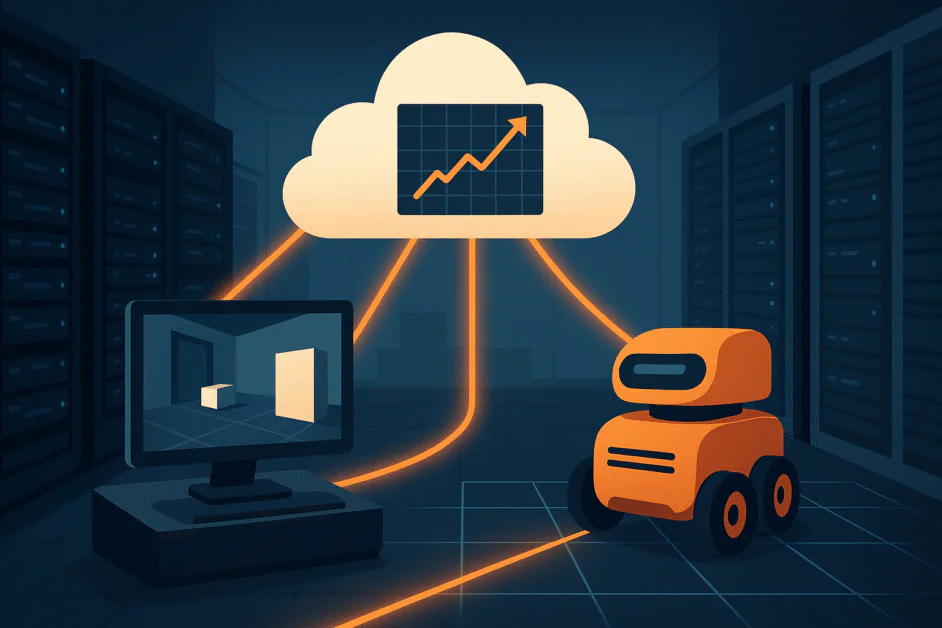
Reinforcement learning has long been one of artificial intelligence’s most promising yet an under explored fields. This is the technology behind the most incredible AI achievements, from algorithms that beat world champions in Go and StarCraft to systems that optimize complex logistics networks. Yet despite its remarkable potential, RL has remained largely confined to tech giants and well-funded research labs due to its immense complexity and cost. But now, a new paradigm is emerging that could democratize RL in the same way that cloud computing democratized infrastructure. We are witnessing a fundamental shift in form of RL-as-a-Service, or RLaaS. Just as AWS transformed how organizations approach computing infrastructure, RLaaS promises to transform how enterprises access and deploy reinforcement learning.
Understanding RL-as-a-Service
At its core, Reinforcement Learning is a type of machine learning where an agent learns to make decisions by interacting with an environment. The agent performs actions, receives feedback in the form of rewards or penalties, and gradually learns a strategy to achieve its goal. The underlying principle is similar to training a dog. You give it a treat when it does something right. The dog learns through trial and error which actions lead to rewards. RL systems work on a similar principle, but at a massive scale of data and computation.
Reinforcement Learning as a Service (RLaaS) extends this concept through the cloud. It abstracts away the massive infrastructure, engineering effort, and specialized expertise traditionally required to build and operate RL systems. Just as AWS provides on-demand servers and databases, RLaaS delivers the core components of reinforcement learning as a managed service. This includes tools for building simulation environments, training models at scale, and deploying learned policies directly into production applications. In essence, RLaaS transforms what was once a highly technical and resource-intensive process into a more manageable process of defining a problem and letting a platform handle the heavy lifting.
The Challenges of Scaling RL
To understand the significance of RLaaS, it’s essential to first understand why reinforcement learning is so difficult to scale. Unlike other AI methods that learn from static datasets, RL agents learn by interacting with dynamic environments through trial and error. This process is fundamentally different and more complex.
The key challenges are fourfold. First, the computational demands are enormous. Training an RL agent can require millions or even billions of environmental interactions. This level of experimentation demands immense processing power and time, often putting RL out of reach for most organizations. Second, the training process is inherently unstable and unpredictable. Agents can show signs of progress and then abruptly collapse into failure by forgetting everything learned or exploiting unintended loopholes in the reward system that produce meaningless results.
Third, RL follows a Tabula Rasa approach for learning. Throwing an agent into a blank slate environment and expecting it to learn complex tasks from scratch is a daunting challenging task. This setup requires careful engineering of the simulation environment itself and, most critically, the reward function. Designing a reward that accurately reflects the desired outcome is more an art than a science. Finally, building accurate, high-fidelity simulation environment is a significantly challenge task. For applications such as robotics or autonomous driving, the simulation must closely mirror real-world physics and conditions. Any mismatch between simulation and reality can lead to complete failure once the agent is deployed in the real world.
Recent Breakthroughs Enabling RLaaS
So, what has changed now? Why RLaaS now become a viable technology? Several technological and conceptual developments have converged to make this possible.
Transfer learning and foundation models have reduced the burden of training from scratch. Just as large language models can be fine-tuned for specific tasks, RL researchers have developed techniques to transfer knowledge from one domain to another. RLaaS platforms can now offer pre-trained agents that capture general principles of decision-making. This development is dramatically reducing training time and data requirements for training RL agents.
Simulation technology has evolved dramatically. Tools like Isaac Sim, Mujoco, and others have matured into robust, efficient environments that can run at scale. The gap between simulation and reality has narrowed through domain randomization and other techniques. This means RLaaS providers can offer high-quality simulation without requiring users to build it themselves.
Algorithmic advances have made RL more sample-efficient and stable. Methods like Proximal Policy Optimization, Trust Region Policy Optimization, and distributed actor-critic architectures have made training more reliable and predictable. These are no longer difficult-to-implement techniques known to a handful of researchers. They are well-understood and tested algorithms that can be implemented in production systems.
Cloud infrastructure has become powerful enough and affordable enough to support computational demands. When GPU clusters cost millions of dollars, only the largest organizations could experiment with RL at scale. Now, organizations can rent computational capacity on demand, paying only for what they use. This has transformed the economics of RL development.
Finally, the RL talent pool has expanded. Universities have been teaching RL for years now. Researchers have published extensively. Open-source libraries have proliferated. While expertise remains valuable, it is no longer as scarce as it was five years ago.
Promise and the Reality
The advent of RLaaS makes reinforcement learning accessible to a much wider range of organizations by offering several key advantages. It removes the need for specialized infrastructure and technical expertise, allowing teams to experiment with RL without the heavy upfront investment. Through cloud-based scalability, companies can train and deploy intelligent agents more efficiently, paying only for the resources they use.
RLaaS also accelerates innovation by providing ready-to-use tools, simulation environments, and APIs that streamline every stage of the RL workflow from model training to deployment. This makes it easier for businesses to focus on solving their specific challenges rather than building complex RL systems from scratch. It can also dramatically accelerate the development cycle, turning what was once a multi-year research project into a matter of weeks or months. This accessibility opens the door for RL to be applied to a vast new set of problems beyond games and academic research.
While progress on RLaaS is well underway, it is important to understand that it may not eliminate all the challenges of reinforcement learning. For example, the challenge of reward specification does not disappear, as it has always depended on the specific requirements of the application. Even with a managed service, users must clearly define what success looks like for their system. If the reward function is vague or misaligned with the desired outcome, the agent will still learn the wrong behavior. This issue remains central to reinforcement learning and is often referred to as the alignment problem. Furthermore, the gap between sim and real world remains a persistent issue. An agent that performs flawlessly in a simulation may fail in the real world due to unmodeled physics or unexpected variables.
The Bottom Line
The journey of reinforcement learning from a research discipline to a utility is a critical maturation for the field. Just as AWS allowed startups to build global-scale software without owning a single server, RLaaS will allow engineers to build adaptive, autonomous systems without a PhD in reinforcement learning. It lowers the barrier to entry and allows innovation to focus on the application, not the infrastructure. The true potential of RL is not just in beating grandmasters at games, but in optimizing our world. RLaaS is the tool that will finally unlock that potential, turning one of AI’s most powerful paradigms into a standard utility for the modern world.



