
Artificial Intelligence
The Multi-Agent Paradox: Why More AI Agents Can Lead to Worse Results

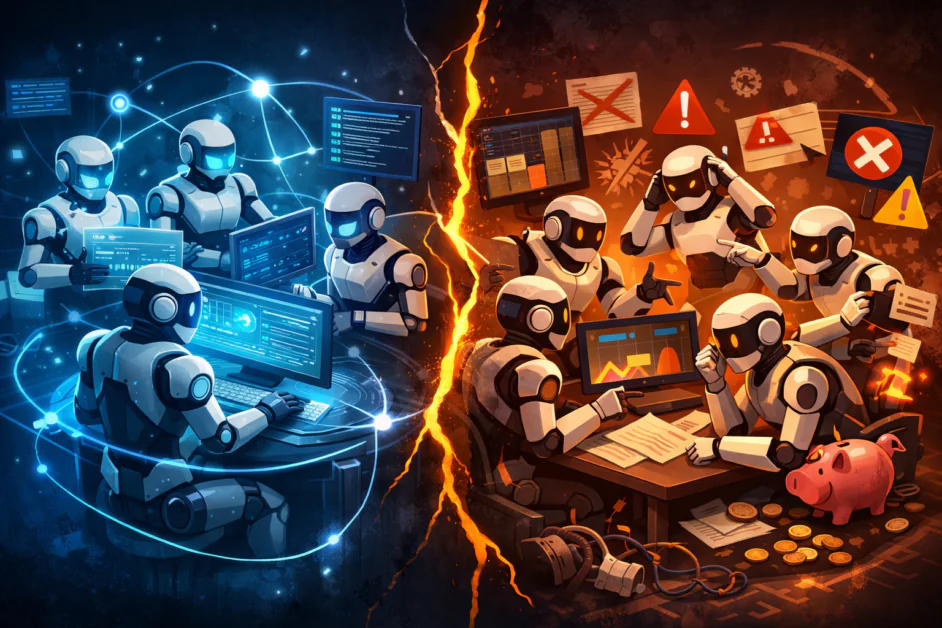
For much of the last two years, multi-agent systems have been treated as the natural next step in artificial intelligence. If one large language model can reason, plan, and act, then several working together should do even better. This belief has driven the rise of agent teams for coding, research, finance, and workflow automation. But new research reveals a counterintuitive paradox. It appears that adding more agents to a system does not always result in better performance. Rather, it makes the system slower, more expensive and less accurate. This phenomenon, which we refer to as the Multi-Agent Paradox, shows that more coordination, more communication, and more reasoning units do not always lead to better intelligence. Instead, adding more agents introduce new failure modes that outweigh the benefits. Understanding this paradox matters because agent systems are moving quickly from demos to deployment. Teams building AI products need clear guidance on when collaboration helps and when it hurts. In this article, we examine why more agents can lead to worse results and what this means for the future of agent-based AI systems.
Why Multi-Agent Systems Became So Popular
The idea of multi-agent systems is inspired by how humans work together in teams. When faced with a complex problem, the work is divided into parts, specialists handle individual tasks, and their outputs are combined. Early experiments support this approach. On static tasks such as math problems or code generation, multiple agents that debate or vote often outperform a single model.
However, many of these early successes come from tasks that do not reflect real-world deployment conditions. They typically involve short reasoning chains, limited interaction with external systems, and static environments with no evolving state. When agents operate in settings that require continuous interaction, adaptation, and long-term planning, the situation changes dramatically. Moreover, as tools advance, agents gain the ability to browse the web, call APIs, write and execute code, and update plans over time. This makes it increasingly tempting to add more agents to the system.
Agentic Tasks Are Different from Static Tasks
It is important to recognize that agentic tasks are fundamentally different from static reasoning tasks. Static tasks can be solved in a single pass: the model is presented with a problem, it produces an answer and then stops. In this setting, multiple agents function much like an ensemble where simple strategies like majority voting often produce better results.
Agentic systems, by contrast, operate in a very different setting. They require repeated interaction with an environment, where the agent must explore, observe outcomes, update its plan, and act again. Examples include web navigation, financial analysis, software debugging, and strategic planning in simulated worlds. In these tasks, each step depends on the one before it, making the process inherently sequential and highly sensitive to earlier mistakes.
In such settings, mistakes made by multiple agents do not cancel out the way they do in an ensemble. Instead, they accumulate. A single incorrect assumption early in the process can derail everything that follows, and when multiple agents are involved, those mistakes can quickly spread across the system.
Coordination Comes with a Cost
Every multi-agent system pays a coordination cost. Agents must share their findings, align goals, and integrate partial results. This process is never without expense. It consumes tokens, time, and cognitive bandwidth, and can quickly become a bottleneck as the number of agents grows.
Under fixed computational budgets, this coordination cost becomes especially critical. If four agents share the same total budget as one agent, each agent has less capacity for deep reasoning. The system may also need to compress complex thoughts into brief summaries for communication, and in the process, it may lose important details which can further weaken the system’s overall performance.
This creates a trade-off between diversity and coherence. Single-agent systems keep all reasoning in one place. They maintain a consistent internal state throughout the task. Multi-agent systems offer a diversity of perspectives, but at the cost of fragmenting context. As tasks become more sequential and state-dependent, fragmentation becomes a critical vulnerability, often outweighing the benefits of multiple agents.
When More Agents Actively Harm Performance
Recent controlled studies show that on sequential planning tasks, multi-agent systems often underperform single-agent based systems. In environments where each action changes the state and affects future options, coordinating between agents interrupts their reasoning, slows progress, and increases the risk of errors being accumulated. This is especially the case when agents operate in parallel without communication. In such settings, agents’ mistakes go unchecked, and when results are combined, errors accumulate rather than being corrected.
Even systems with structured coordination are not immune to failure. Centralized systems with a dedicated orchestrator can help contain errors, but they also introduce delays and bottlenecks. The orchestrator becomes a compression point where extended reasoning is reduced to summaries. This often leads to wrong decisions on long, interactive tasks than those produced by a single, focused reasoning loop. This is the core of the multi-agent paradox: Collaboration introduces new failure modes that do not exist in single-agent systems.
Why Some Tasks Still Benefit from Multiple Agents
The paradox does not mean multi-agent systems are useless. Rather, it highlights that their benefits are conditional. These systems are most effective when tasks can be clearly divided into parallel, independent subtasks. One example of such a task is financial analysis. In this task, an agent can be used to analyze revenue trends, another to examine costs, and a third to compare competitors. These subtasks are largely independent, and their outputs can be combined without careful coordination. In such cases, centralized coordination often provides better outcomes. Dynamic web browsing is another case where having multiple agents work independently can be useful. When a task involves exploring multiple information paths at the same time, parallel exploration can help.
A key takeaway is that is that multi-agent systems work best when tasks can be divided into independent pieces that do not require tight coordination. For tasks that involve step-by-step reasoning or careful tracking of changing conditions, a single focused agent usually performs better.
The Capability Ceiling Effect
Another important finding is that stronger base models reduce the need for coordination. As single agents become more capable, the potential gains from adding more agents shrink. Beyond a certain performance level, adding agents often leads to diminishing returns or even worse outcomes.
This happens because the cost of coordination stays roughly the same while the benefits decrease. When a single agent can already handle most of the task, additional agents tend to add noise rather than value. In practice, this means multi-agent systems are more useful for weaker models and less effective for frontier models.
This challenges the assumption that model intelligence naturally extends with more agents. In many cases, improving the core model delivers better results than surrounding it with additional agents.
Error Amplification Is the Hidden Risk
One of the most important insights from recent research is how errors can be amplified in multi-agent systems. In multi-step tasks, a single early mistake can propagate through the entire process. When multiple agents rely on shared assumptions, that error spreads more quickly and becomes harder to contain.
Independent agents are especially vulnerable to this problem. Without built-in verification, incorrect conclusions can appear repeatedly and reinforce each other, creating a false sense of confidence. Centralized systems help reduce this risk by adding validation steps, but they cannot eliminate it entirely.
Single agents, by contrast, often have a built-in advantage. Because all reasoning happens within a single context, contradictions are easier to spot and correct. This subtle ability to self-correct is powerful but often overlooked when evaluating multi-agent systems.
The Bottom Line
The key lesson from the Multi-Agent paradox is not to avoid collaboration, but to be more selective. The question should not be how many agents to use, but whether coordination is justified for the task.
Tasks with strong sequential dependencies tend to favor single agents, while tasks with a parallel structure can benefit from small, well-coordinated teams. Tool-heavy tasks require careful planning, since coordination itself consumes resources that could otherwise be used for action. Most importantly, the choice of agent architecture should be guided by measurable task properties, not intuition. Factors like decomposability, error tolerance, and interaction depth matter more than team size when it comes to achieving effective outcomes.



