
Funding
Starship Technologies Raises $50M to Drive Autonomous Delivery into U.S. Cities

 Add Unite.AI to your preferred sources on Google
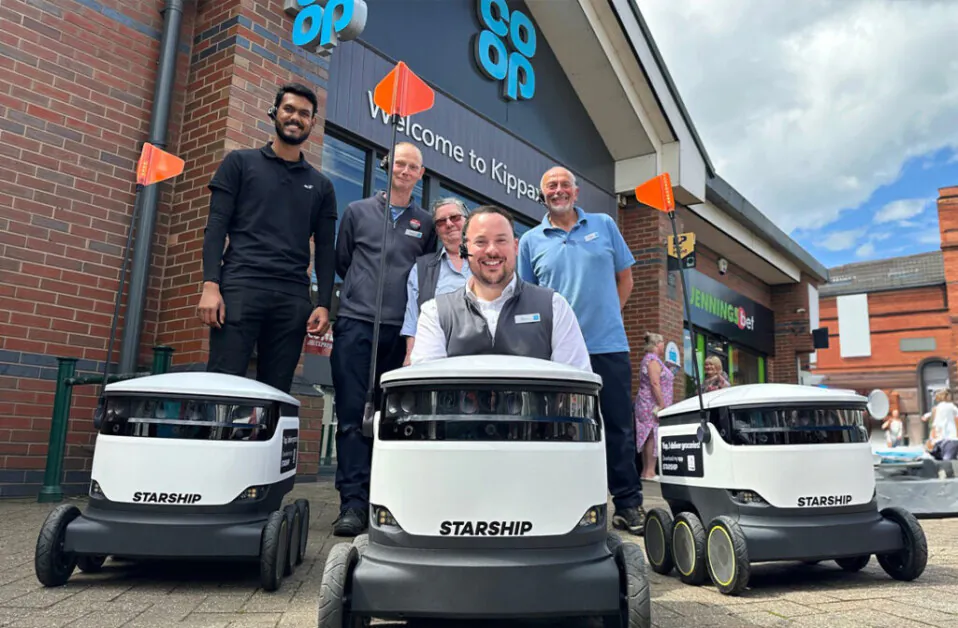
Starship Technologies — the autonomous delivery pioneer founded by Skype veterans Ahti Heinla and Janus Friis — has announced a $50 million Series C funding round led by Plural, with participation from Karma.vc, Latitude, Coefficient Capital, SmartCap, and Skaala. This latest investment brings the company’s total funding to over $280 million, positioning it to scale its proven autonomous delivery model across major U.S. cities.
With more than 9 million deliveries completed across seven countries, Starship stands as the most experienced operator in the field. While many competitors remain in pilot stages, Starship has achieved true commercial viability, completing millions of deliveries at scale and crossing roads autonomously multiple times per second. Each delivery adds to a growing dataset that refines the company’s routing, obstacle avoidance, and safety systems, strengthening its lead in the race toward fully autonomous logistics.
From Campuses to City Streets
Until now, Starship has been best known for its success on university campuses, where its fleet of small, six-wheeled delivery robots transport food, groceries, and packages with remarkable efficiency. Operating on over 60 campuses in the United States, Starship has demonstrated that autonomous delivery can be both practical and profitable within confined environments.
With this latest funding, the company plans to extend that success to dense urban areas — bringing robot delivery to everyday consumers across the country. Having already proven its model in more than 30 European cities, Starship aims to replicate that playbook in the United States, adapting to new regulatory frameworks and urban landscapes along the way.
Scaling the World’s Largest Delivery Fleet
Starship currently operates more than 2,700 delivery robots worldwide and plans to scale its fleet to over 12,000 by 2027. Each robot is capable of operating with Level 4 autonomy, meaning it can navigate complex pedestrian environments with little to no human intervention.
Unlike many robotics startups still testing limited prototypes, Starship has already reached operational profitability in several markets. Its robots run daily routes, making thousands of deliveries at a fraction of the cost of traditional courier services. The company’s model blends artificial intelligence, machine learning, and advanced sensor technology to achieve reliability that rivals — and in some areas, surpasses — human-driven delivery.
Building a New Kind of Delivery Network
Rather than competing directly with major delivery apps, Starship has positioned itself as the autonomous backbone for existing platforms. Its robots already integrate with Grubhub in the U.S. and major European food delivery services such as Bolt, Wolt, and Foodora. This partnership-driven strategy allows retailers and restaurants to expand their delivery reach without building new infrastructure, while consumers continue to order through familiar interfaces.
This approach not only streamlines adoption but also reduces the environmental and logistical impact of traditional delivery fleets. Starship’s zero-emission robots have already prevented more than 650 tonnes of CO₂ emissions through their operations in Europe — a number that will grow significantly as the company expands its footprint.
A Sustainable Model for the Last Mile
Each Starship robot is fully electric, designed to operate for up to 18 hours on a single charge. They use cameras, radar, and ultrasonic sensors to navigate safely across intersections, curbs, and sidewalks. When parked, they recharge autonomously, maintaining a constant readiness for operation.
Beyond sustainability, security and reliability are built into every delivery. Each robot’s cargo compartment is locked throughout transit and can only be accessed by the customer through secure mobile verification. If tampered with, the robot immediately alerts its operations center, adding an extra layer of safety and accountability to the process.
This combination of autonomy, safety, and environmental stewardship positions Starship as a key player in redefining the future of last-mile delivery.
The Future of Autonomous Delivery
Starship’s latest funding marks more than a financial milestone — it represents a pivotal moment in the evolution of autonomous logistics. As the company scales into major U.S. cities, the future of autonomous delivery will depend not only on technology but also on how society, infrastructure, and policy adapt around it.
The transition from controlled environments, such as university campuses and smaller European cities, to dense American urban centers introduces a new layer of complexity. Regulations governing sidewalk robots vary widely across municipalities, and the ability to navigate these differences will determine how quickly the technology becomes mainstream. Building partnerships with city planners, local businesses, and policymakers will be essential for ensuring that autonomous delivery integrates safely and efficiently into daily life.
Economics will play an equally important role. For delivery robots to move beyond novelty status, they must prove themselves at scale — not just as a technological triumph but as a sustainable business model. Starship’s claim of cost-efficient, zero-emission delivery highlights what’s possible when automation meets efficiency, yet replicating those margins across diverse terrains, climates, and customer expectations remains a challenge.
At the core of this progress lies data. Each delivery teaches the robots to handle new conditions — from busy intersections and unpredictable pedestrians to weather changes and uneven sidewalks. Every mile traveled strengthens the company’s AI models, creating a feedback loop that makes future deliveries smarter and safer. Over time, these systems may evolve into mixed networks combining small autonomous vehicles, drones, and micro-hubs, creating a seamless web of logistics that extends far beyond sidewalks.
Public perception will also shape what comes next. In the early stages, delivery robots capture curiosity and goodwill. But as they become a fixture of daily life, expectations rise. People will demand reliability, safety, and subtlety — robots that coexist naturally with pedestrians rather than standing out as intrusions in public spaces. The companies that master this balance will define the long-term future of the industry.
Ultimately, Starship’s $50 million raise is more than a step toward expansion — it’s a reflection of where last-mile logistics is headed. The lines between human and automated delivery are beginning to blur, and what once seemed futuristic is quickly becoming part of everyday infrastructure. The next few years will determine whether autonomous delivery remains an impressive experiment or becomes an invisible, indispensable part of how cities move goods — quietly, cleanly, and efficiently.



