
Thought Leaders
Importance of Human-in-the-Loop (HITL) AI for High-Stakes Healthcare

AI’s Emerging Role in Healthcare
Artificial intelligence is significantly reshaping healthcare as more advanced machine learning algorithms and foundation models become available. It’s impacting diverse fields such as diagnostics, predictive analytics, and surgery. As a result, AI-driven medical tools are advancing from the R&D setting into clinical practice, continuing their march from nice-to-have to must-have for both healthcare providers and health systems.
Unlike traditional care, AI can encode widely shared medical knowledge into models deployable anywhere. This opens the door to democratizing specialized expertise, allowing patients in remote areas to benefit from insights developed at top medical centers. Generative AI tools are also reducing physician workload. Physicians today spend nearly two hours on Electronic Health Record tasks for one hour of patient care. Generative AI systems now draft medical documentation via ambient digital scribes, cutting down the hours doctors spend on paperwork. This saves physicians an estimated 15,791 hours of documentation time a year, improves patient-physician interactions, and enhances doctor satisfaction.
As of 2025, the FDA has approved multiple AI technologies across specialties like radiology, cardiology, and gastroenterology. Marketplaces will start to emerge for competing algorithms, and the provider’s role will evolve to include mediating which tool to utilize. Yet the most important currency, patient trust and buy-in, brings with it the unmet challenge of systematic AI governance that needs to be addressed. This is where human-in-the-loop (HITL) becomes vital; it keeps AI’s power anchored in human oversight as it scales across healthcare.
Robotics and AI in Surgery
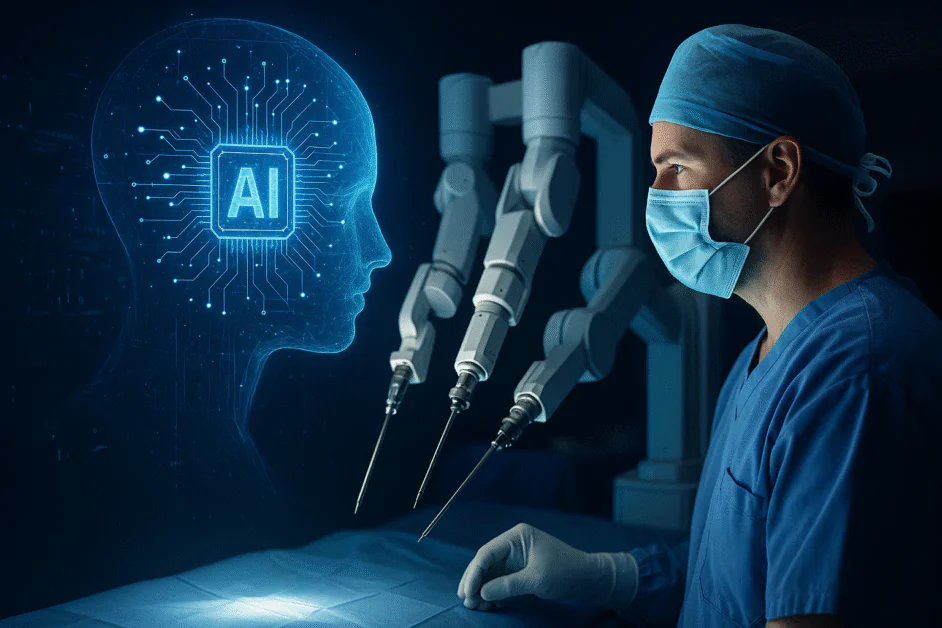
In high-stakes healthcare scenarios such as surgery, where every decision can be life or death, the convergence of AI and robotics represents the ultimate game-changer. Robotic-assisted surgery (RAS) has been used in the profession for years; however, as agentic AI and multimodal data fusion advance, these systems will move from passive assistance toward active collaboration. This means they’ll be performing routine actions under supervision while the surgeon retains authority over complex decisions. With advances in AI and computer vision, these robots now have “eyes” and, in a sense, clinical intuition.
Every robotic surgery generates gigabytes of high-definition video, instrument telemetry, and patient information. Hidden in this data are patterns that AI can learn. However, raw data alone is useless without meticulous data labeling, which is taking unstructured data like medical images, surgical videos, or clinical notes, and marking them with precise, expert-driven insights. This overlying layer of data, called the metadata, is the core of what machine learning algorithms use to uses to understand the thoughts and decisions of experts, learn patterns, and ultimately, make predictions. This expert input on scarce and proprietary data represents the next frontier of advancing AI from general functionality to long-tail, narrow domain, and highly valuable applications.
As this co-creation between data and human expertise matures, its impact is already being felt where it matters most: in live surgeries. In 2025, a team at Johns Hopkins demonstrated an AI-trained surgical robot that removed gallbladders from pig specimens with 100% success and no human intervention. The system, called Smart Tissue Autonomous Robot (STAR), was trained on hours of surgical videos and could perform all the critical steps (cutting tissue, placing clips, avoiding vital structures) by itself. Another example is the use of robots in pelvic surgeries, leading to demonstrably better outcomes. Smaller incisions, less trauma, and more meticulous maneuvering are translating into faster recoveries and fewer complications for patients.
HITL: Why It Matters in Surgical AI
HITL bridges the speed and scale of AI with human judgment and context awareness, essential in high‑stakes environments like surgery. Surgeons bring something no algorithm today can replicate: intuition and creativity. These uniquely human qualities give context to data and meaning to outcomes. High-performing surgical AI systems are built on this collaboration. Their intelligence depends on meticulously labeled images and videos, data that teaches algorithms to recognize a bleeding vessel, trace a tumor margin, or predict complications before they arise. Only seasoned surgeons can interpret the subtle cues of anatomic variation and operative technique that enrich data with intelligence. As AI evolves toward greater autonomy, the human role doesn’t diminish; it deepens. HITL then becomes the critical mechanism for oversight, continuous learning, and ethical alignment in an era where machines are learning to make decisions that can save lives.
Case Study: HITL Acceleration in Surgical AI
A leading global surgical device manufacturer recently demonstrated how HITL workflows can redefine the pace and precision of AI innovation. By integrating human expertise directly into the training, auditing, and monitoring pipeline, the company delivered the project months ahead of schedule while achieving over 99% frame-level accuracy, a benchmark rarely met in medical data operations. The impact was profound: after training on this expertly annotated dataset, the company’s surgical AI experienced a 72% leap in recognition accuracy for instruments and surgical events.
In practical terms, the robot became significantly “smarter” about understanding what was happening in the surgical field. It can interpret scenes with near-human clarity and respond with greater precision. This level of improvement emphasizes the convergence of human expertise and machine intelligence. It further proves that this co-creation can lead to faster, safer development and a more capable technology that amplifies the surgeon’s skill and elevates patient outcomes.
The Future is Collaborative
The trajectory of mission-critical healthcare like surgical AI mirrors the broader transformation across the healthcare sector. It recognizes a shift from passive augmentation to trusted, high-impact integration. What was once confined to research labs is now entering operating rooms as advanced visualizations but will ultimately be AI and robotics combine to redefine what’s possible in precision, safety, and access.
The intent isn’t to replace doctors and surgeons; it’s to extend their capabilities, sharpen their precision, and amplify their impact on patient care. As algorithms advance, human judgment must remain the anchor of the industry. HITL governance systems create a virtuous cycle of feedback, building the reliability that regulators and clinicians demand. This co-creation between human and machine makes it more accountable, more transparent, and ultimately, more humane. It’s this balance of innovation and oversight that will determine how AI earns the trust to move from promising technology to indispensable partner in the future of patient care.



