Thought Leaders
On the Factory Floor, Humans and Robots Are Learning to Work as Partners

 Add Unite.AI to your preferred sources on Google
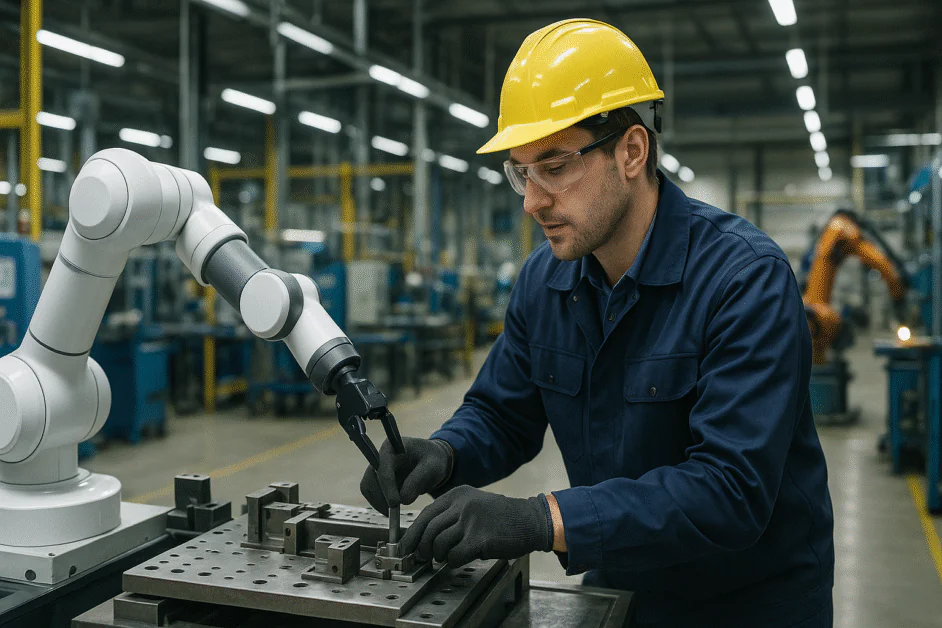
Walk through almost any small or mid-sized machine shop in the United States today and a new scene is emerging. Amid the familiar soundtrack of mills and grinders, a robotic arm might be tending a machine, stacking parts, or assisting with inspection, often just a few feet from a human operator. These collaborative robots, or cobots, are becoming fixtures in places that historically lacked the budget or staff to automate.
Their rise coincides with one of the most pressing challenges in U.S. industry: a widening manufacturing labor gap. A 2024 Deloitte report estimates that 3.8 million manufacturing positions will need to be filled between 2024 and 2033, and warns that up to 1.9 million of those jobs could go unfilled if skills and applicant gaps aren’t addressed. Employers trying to meet production commitments are increasingly turning to automation that can be deployed quickly, run reliably, and coexist with a limited workforce.
I’ve spent my career in manufacturing, first as an engineer at Ford, then co-founding Fictiv to help bridge digital design and physical production. I’ve walked countless factory floors over the past decade. What is happening right now feels different and exciting.
Cobots aren’t new; they were invented by Northwestern University professors J. Edward Colgate and Michael Peshkin in 1996 and successfully commercialized by Universal Robots in 2008. But they’ve never been more accessible than they are now. These safer, smarter, smaller robots are well within the reach of companies that don’t have the resources to support large, costly, complex traditional automation. The impact is enormous.
The Labor Gap Becomes a Catalyst
Manufacturers describe cobots as a practical response to a workforce shortage that shows few signs of easing. These machines excel at repetitive, fatigue-inducing, or ergonomically risky tasks like palletizing, machine tending, deburring, and basic in-line inspection; i.e., the kinds of duties that fall under the “Four Ds” of robotization (Dull, Dirty, Dangerous, and Dear, or “expensive”) and make retention difficult on factory floors.
A recent PwC analysis of robotics in manufacturing describes the current environment bluntly: even with competitive wages, many manufacturers simply cannot staff key technical roles, and a “chronic labor shortage is accelerating automation.” Today’s cobots are not the caged industrial robots of the past. PwC points out that modern systems are safer, smarter, and more affordable, designed to work alongside people on precise tasks without heavy guarding, thanks to advances in machine vision, force limiting, and intuitive programming interfaces.
This matters for small and mid-sized manufacturers in particular. When you don’t have a bench of automation engineers, you need tools your existing team can deploy. IBM’s work on reshoring and “digital labor” frames cobots as part of a broader strategy: use automation to take on repetitive, dangerous, or complex tasks, while redeploying people into higher-value work like problem-solving, process optimization, and maintenance.
On the ground, that’s exactly what many shops are doing. With cobots taking on monotonous work, experienced operators spend more time on setup, troubleshooting, inspection, and continuous improvement, those areas where human judgment remains essential. Instead of competing with humans, cobots are absorbing work that was increasingly hard to hire for in the first place.
Reshoring Meets Economic Reality
The momentum behind North American reshoring is real, driven by a desire for supply chain resilience after years of global disruption. Yet rebuilding domestic production capacity is complex. Higher domestic labor costs and a shortage of skilled workers make it difficult for smaller manufacturers to scale output by “just hiring” their way to capacity.
This is where cobots are beginning to reshape the economic equation.
Robots are no longer the domain of giant global manufacturers. According to the International Federation of Robotics (IFR)’s World Robotics 2025 Report, factories worldwide installed 542,000 industrial robots in 2024, more than double the annual volume seen a decade ago. It marks the fourth consecutive year that installations have exceeded half a million units. The United States accounted for 68% of installations in the Americas in 2024. That kind of volume is driving down cost and improving availability across the board, including collaborative systems.
At the same time, policymakers and industry leaders view automation as the lever that makes domestic production economically viable. The emerging consensus is that the next era of U.S. manufacturing competitiveness won’t be built on low-cost labor abroad, but on automation, smart logistics, and a highly skilled domestic workforce.
Cobots fit perfectly into this picture. Their relatively low upfront cost, small footprint, and flexible programming allow shops to automate individual processes or end-to-end workflows without the multimillion-dollar investment associated with traditional robotics cells. That flexibility aligns well with the realities of U.S. production, where many operations are high-mix, low-volume (prototyping, custom machining, rapid-turn contract manufacturing), rather than the extremely high-volume, single-SKU lines more common in offshore mega-factories.
It’s impossible to talk about automation without mentioning China. IFR data shows that China represents 54% of global deployments, with 295,000 industrial robots installed in 2024, the highest annual total on record. By comparison, the U.S. is a smaller but rapidly growing market. The contrast is useful: China leans on automation to push massive scale and throughput; U.S. manufacturers are increasingly using cobots to make high-mix, local production economically viable despite higher labor costs.
AI Opens the Door for Smaller Factories
For many years, the barrier to automation in the “factory next door” wasn’t cost alone, but complexity. Programming industrial robots used to require specialist skills and long commissioning cycles. That is changing fast.
A recent Results in Engineering review article on AI-enhanced collaborative robotics describes how cobots integrated with AI, machine learning, and smart sensing are enabling safer, more adaptable, and more human-centric automation. AI-driven cobots can reduce cycle times, improve product quality, and support adaptive manufacturing across sectors like automotive and logistics, while safety features such as force-limiting and speed-and-separation monitoring make close human-robot collaboration feasible on crowded factory floors.
On the applied side, AI is being used to enhance cobots in concrete ways: vision-guided pick-and-place, predictive maintenance, dynamic path planning, and more. These enhancements are pushing the traditional benefits of cobots (flexibility, ease of deployment) to a higher level of performance and reliability. Instead of hard-coded routines, manufacturers get systems that can learn from demonstration, adjust to variation in parts, and respond to changing production schedules.
This shift is showing up in the market numbers. Allied Market Research estimates that the global collaborative robot market was about $1.4 billion in 2022 and could reach $27.4 billion by 2032, implying compound annual growth above 30%. That trajectory is driven in large part by adoption among small and mid-sized manufacturers that previously found robots too expensive or too difficult to integrate.
Importantly, these investments are increasingly framed as workforce multipliers, not workforce replacements. IBM cites research suggesting that AI and machine learning alone could drive a 37% increase in labor productivity by 2025, and highlights how collaborative robots and AI tools can take over repeatable tasks while workers upskill into higher-value roles.
In other words, AI-powered cobots are expanding both the capability and accessibility of automation, technically and economically, for the kinds of shops that underpin local manufacturing ecosystems.
A Future Built Around People and Automation
The spread of cobots across smaller U.S. factories signals a broader turning point. Automation is no longer confined to the largest or most capital-rich manufacturers. It’s becoming a standard tool for the workshops that keep American industry running.
Whether the goal is to keep up with demand, reshore production, or future-proof a business against workforce volatility, cobots are emerging as a practical and increasingly essential part of the toolkit. And as AI-powered systems mature, their role on the factory floor is poised to expand even further.
But all this technology means nothing if we forget the humans behind it.
The best manufacturers I’ve met treat automation as an investment in people. They train workers to use it, involve them in setup and programming, and make them stakeholders in the process. When people feel ownership over the machines they work with, magic happens. Productivity goes up, yes, but so does morale. Safety improves; turnover drops. Suddenly, the skills gap doesn’t look so insurmountable, because the job itself has evolved.
This is what I mean by human-centered automation: building an environment where technology amplifies human creativity, judgment, and well-being, rather than optimizing people out of the process. As companies reshore production, digital labor investments must be paired with real upskilling and reskilling to unlock the full value of automation. The future is one where humans and machines work side by side in ways that elevate both.
For many manufacturers, the most consequential change underway is cultural, not technical. Robots are no longer seen as threats to jobs, but as partners that help teams do more with the talent they have. In an era defined by labor shortages and supply chain recalibration, that partnership is reshaping how—and where—things get manufactured in America.
I, for one, can’t wait to see how the future is made.