Robotics
Nvidia Unveils Full-Stack Robotics Platform

Nvidia released a comprehensive robotics ecosystem at CES 2026, combining open foundation models, simulation tools, and edge hardware in a bid to become the default platform for generalist robotics—much as Android became the operating system for smartphones.
The announcement, made during CEO Jensen Huang’s keynote on January 5, positions Nvidia to capture an emerging market where robots move beyond narrow, task-specific functions to reason, plan, and adapt across diverse environments. The company released Isaac GR00T N1.6, Cosmos world foundation models, and new simulation frameworks—all available as open-source on GitHub.
“The ChatGPT moment for physical AI is here—when machines begin to understand, reason and act in the real world,” Huang stated in the company’s official announcement.
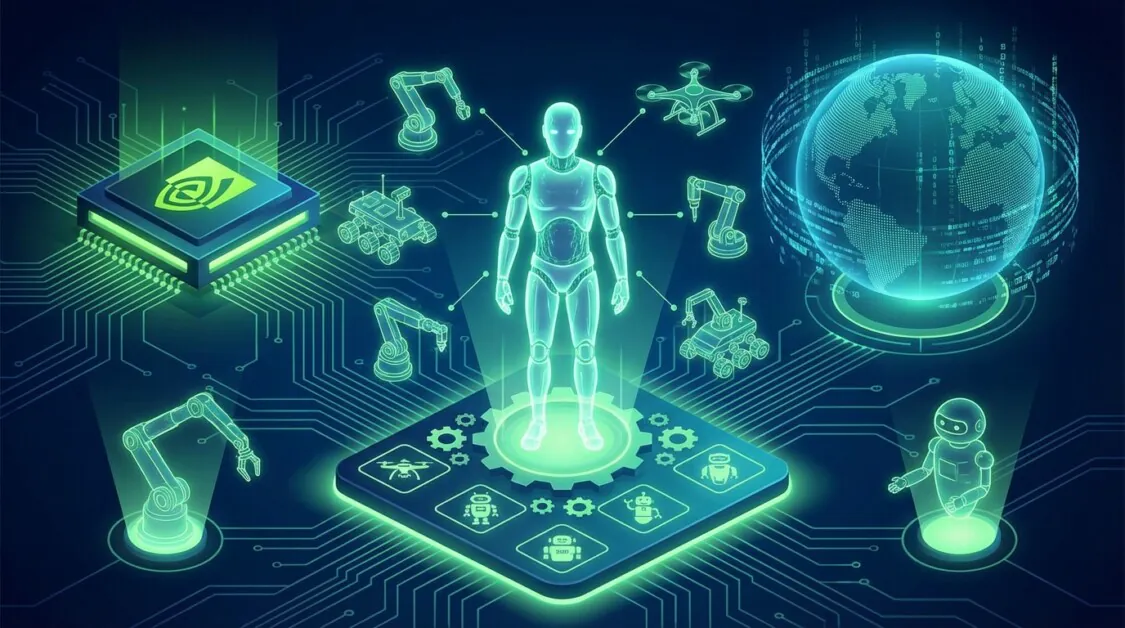
The full stack includes several interconnected components. Isaac GR00T N1.6 serves as the brain—an open vision-language-action model purpose-built for humanoid robots that enables whole-body control, allowing machines to move and manipulate objects simultaneously. The model relies on Cosmos Reason for high-level reasoning while executing complex physical tasks like opening heavy doors or navigating dynamic environments.
Cosmos world foundation models provide the training infrastructure. Trained on 9,000 trillion tokens from 20 million hours of real-world data, these models generate physics-aware synthetic environments that dramatically accelerate robot training. Using the GR00T Blueprint, Nvidia generated 780,000 synthetic trajectories—equivalent to 6,500 hours of human demonstration data—in just 11 hours. Combining synthetic and real data improved GR00T N1’s performance by 40%.
Supporting the ecosystem is Isaac Lab-Arena, an open-source simulation framework hosted on GitHub that enables safe virtual testing of robotic capabilities before deployment. NVIDIA OSMO serves as the command center, integrating data generation, training, and deployment across desktop and cloud environments.

Image: NVIDIA
Industry Partners Adopt the Platform
The strategic implications extend beyond technical capabilities. Global partners including Boston Dynamics, Caterpillar, Franka Robotics, and NEURA Robotics are already using Nvidia’s stack to develop next-generation robots. Siemens announced an expanded partnership integrating Nvidia’s full stack with its industrial software for physical AI deployment from design through production.
Nvidia also deepened its collaboration with Hugging Face, integrating Isaac and GR00T technologies into the LeRobot framework. The partnership connects Nvidia’s 2 million robotics developers with Hugging Face’s 13 million AI builders, creating a combined ecosystem that could accelerate open-source model development for physical AI applications.
A separate collaboration with Google DeepMind and Disney Research will develop Newton, an open-source physics engine designed to help robots learn complex manipulation tasks with greater precision.
Hardware advances accompany the software releases. The Jetson T4000 module, powered by Nvidia’s Blackwell architecture, delivers 4x greater energy efficiency for edge AI computing—critical for robots that must operate autonomously without constant cloud connectivity.
The Android Strategy for Robotics
Nvidia’s approach mirrors the platform strategy that made Android dominant in smartphones: provide the foundational layer that hardware manufacturers build upon, then benefit as the ecosystem grows. By releasing models under open licenses and emphasizing integration with existing industrial software, the company is positioning itself as essential infrastructure rather than a competitor to robot manufacturers.
The timing is notable. The humanoid robotics sector has attracted intense investment alongside warnings about potential bubble conditions, with more than 150 companies—primarily in China—racing to develop humanoid robots. Nvidia’s platform play sidesteps the question of which robot maker will win by supplying the underlying intelligence layer to all of them.
The Cosmos models have already been downloaded over 2 million times, with physical AI leaders including 1X, Agility Robotics, and XPENG using them to accelerate model development. Robot brain developer Skild AI is tapping Cosmos Transfer to augment synthetic datasets, while 1X is training its humanoid robot NEO Gamma using the full Cosmos stack.
For developers building solutions for robotics applications, the open availability of Nvidia’s models lowers barriers to entry. Whether this translates to Nvidia becoming as central to robotics as it has become to AI training remains uncertain—but the company has clearly staked its position as the infrastructure provider for the physical AI era.