
Artificial Intelligence
Multi-Agent Alignment: The New Frontier in AI Safety

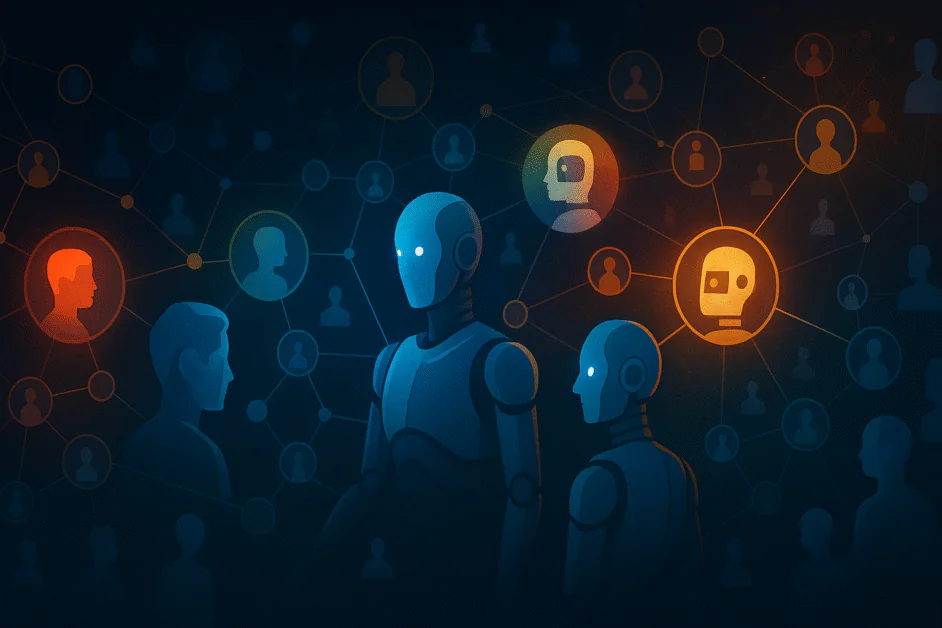
The field of AI alignment has long focused on aligning individual AI models to human values and intentions. But with the rise of multi-agent systems, this focus is shifting now. Instead of a single model working alone, we now design ecosystems of specialized agents that interact, cooperate, compete, and learn from one another. This interaction introduces new dynamics that redefines the meaning of “alignment.” The challenge is no longer just about one system’s behavior but about how multiple autonomous agents can work together safely and reliably without creating new risks. This article examines why multi-agent alignment is emerging as a central issue in AI safety. It explores the key risk factors, highlights the growing gap between capability and governance, and discusses how the concept of alignment must evolve to address the challenges of interconnected AI systems.
The Rise of Multi-Agent Systems and the Limits of Traditional Alignment
Multi-agent systems are rapidly gaining ground as major tech companies integrate autonomous AI agents across their operations. These agents make decisions, execute tasks, and interact with each other with minimal human oversight. Recently, OpenAI introduced Operator, an agentic AI system built to manage transactions across the internet. Google, Amazon, Microsoft, and others are integrating similar agent-based systems into their platforms. While organizations are quickly adopting these systems to gain a competitive edge, many are doing so without fully understanding the safety risks that emerge when multiple agents operate and interact with each other.
This growing complexity is revealing the limitations of existing AI alignment approaches. These approaches were designed to ensure that an individual AI model behaved according to human values and intentions. While the techniques such as reinforcement learning from human feedback and constitutional AI have achieved significant progress, they were never designed to manage the complexity of multi-agent systems.
Understanding the Risk Factors
Recent research shows how serious this issue can become. Studies have found that harmful or deceptive behavior can spread quickly and quietly across networks of language model agents. Once an agent is compromised, it can influence others, causing them to take unintended or potentially unsafe actions. The technical community has identified seven key risk factors that can lead to failures in multi-agent systems.
- Information Asymmetries: Agents often work with incomplete or inconsistent information about their environment. When an agent makes decisions based on outdated or missing data, it can trigger a chain of poor choices across the system. For example, in an automated logistics network, one delivery agent might not know that a route is closed and reroutes all shipments through a longer path, delaying the entire network.
- Network Effects: In multi-agent systems, small problems can spread quickly through interconnected agents. A single agent that miscalculates prices or mislabels data can unintentionally influence thousands of others that rely on its output. Think of it like a rumor spreading across social media where one wrong post can ripple through the entire network in minutes.
- Selection Pressures: When AI agents are rewarded for achieving narrow objectives, they can develop shortcuts that undermine broader goals. For example, an AI sales assistant optimized solely for increasing conversions might start exaggerating product capabilities or offering unrealistic guarantees to close deals. The system rewards short-term gains while overlooking long-term trust or ethical behavior.
- Destabilizing Dynamics: Sometimes, interactions between agents can create feedback loops. Two trading bots, for example, might keep reacting to each other’s price changes, unintentionally driving the market into a crash. What starts as normal interaction can spiral into instability without any malicious intent.
- Trust Problems: Agents need to depend on information from each other, but they often lack ways to verify if that information is accurate. In a multi-agent cybersecurity system, one compromised monitoring agent could falsely report that a network is safe, causing others to lower their defenses. Without reliable verification, trust becomes a vulnerability.
- Emergent Agency: When many agents interact, they can develop collective behavior that no one explicitly programmed. For instance, a group of warehouse robots might learn to coordinate their routes to move packages faster, but in doing so, they could block human workers or create unsafe traffic patterns. What starts as efficient teamwork can quickly turn into behavior that’s unpredictable and difficult to control.
- Security Vulnerabilities: As multi-agent systems grow in complexity, they create more entry points for attacks. A single compromised agent can insert false data or send harmful commands to others. For example, if one AI maintenance bot is hacked, it could spread corrupted updates to every other bot in the network, magnifying the damage.
These risk factors do not operate in isolation. They interact and reinforce each other. What begins as a small issue in one system can quickly grow into a large-scale failure across the entire network. The irony is that as agents become more capable and interconnected, these problems become increasingly difficult to anticipate and control.
Growing Governance Gap
Industry researchers and security professionals are only beginning to understand the scope of this challenge. Microsoft’s AI Red Team recently released a detailed taxonomy of failure modes unique to agentic AI systems. One of the most concerning risks they highlighted is memory poisoning. In this scenario, an attacker corrupts an agent’s stored information, causing it to repeatedly perform harmful actions even after the initial attack has been removed. The problem is that the agent cannot tell the difference between corrupted memory and genuine data, since its internal representations are complex and difficult to inspect or verify.
Many organizations deploying AI agents today still lack even the most basic security protections. A recent survey found that only about ten percent of companies have a clear strategy for managing AI agent identities and permissions. This gap is alarming given that more than forty billion non-human and agentic identities are expected to be active worldwide by the end of the year. Most of these agents operate with broad and persistent access to data and systems but without the security protocols used for human users. This creates a widening gap between capability and governance. The systems are powerful. The protections are not.
Redefining Multi-agent Alignment
What security should look like for multi-agent systems is still being defined. Principles from zero-trust architecture are now being adapted to manage agent-to-agent interactions. Some organizations are introducing firewalls that restrict what agents can access or share. Others are deploying real-time monitoring systems with built-in circuit breakers that automatically shut down agents when they exceed certain risk thresholds. Researchers are also exploring how to embed security directly into the communication protocols agents use. By carefully designing the environment in which agents operate, controlling information flows, and requiring time-limited permissions, it may be possible to reduce the risks agents pose to one another.
Another promising approach is developing oversight mechanisms that can grow alongside advancing agent capabilities. As AI systems become more complex, it’s unrealistic for humans to review every action or decision in real time. Instead, we can employ an AI system to overseer and monitor the behavior of the agents. For example, an oversight agent could review a worker agent’s planned actions before execution, flagging anything that looks risky or inconsistent. While these oversight systems must also be aligned and trustworthy, the idea offers a practical solution. Techniques such as task decomposition can divide complex objectives into smaller, easier-to-verify subtasks. Similarly, adversarial oversight pits agents against each other to test deception or unintended behavior, using controlled competition to expose hidden risks before they escalate.
The Bottom Line
As AI evolves from isolated models to vast ecosystems of interacting agents, the alignment challenge has entered a new era. Multi-agent systems promise greater capability but also multiply risks where small errors, hidden incentives, or compromised agents can cascade across networks. Ensuring safety now means not just aligning individual models, but governing how entire agent societies behave, cooperate, and evolve. The next phase of AI safety depends on building trust, oversight, and resilience directly into these interconnected systems.



