
AI Models & Platforms
Lumai Unveils Optical AI Server to Power the Next Era of Inference

 Add Unite.AI to your preferred sources on Google
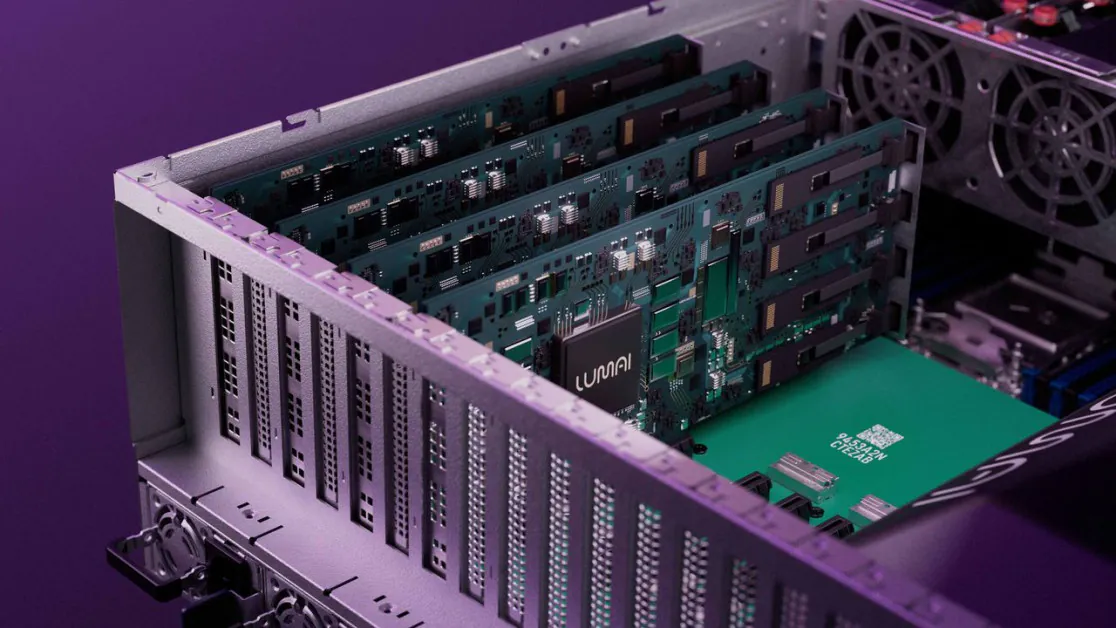
Lumai has announced what it describes as a major step forward in AI infrastructure: an optical computing system capable of running billion-parameter large language models in real time. The new system, called Iris Nova, signals a shift away from traditional silicon-based processing toward a fundamentally different approach built on light.
The announcement comes at a time when the AI industry is rapidly transitioning from model training to deployment at scale, placing unprecedented strain on existing compute infrastructure.
Moving Beyond Silicon Constraints
For years, AI progress has relied heavily on advances in silicon chips, particularly GPUs. But that model is beginning to show signs of strain. Power consumption is rising sharply, and performance gains are becoming harder to achieve without significantly increasing cost and energy requirements.
Lumai’s approach replaces electrons with photons. Instead of performing computations through electrical signals, its system uses light to process data. This enables massive parallelism, where millions of operations can occur simultaneously in three-dimensional space rather than across flat silicon surfaces.
According to the company, this architecture can deliver significantly higher throughput while reducing energy consumption by up to 90% compared to conventional systems .
The Growing Pressure on Data Centers
The timing of this launch reflects broader industry challenges. AI workloads are expanding rapidly, particularly in inference, which involves running trained models in real-world applications.
Data centers are increasingly constrained by power availability. Global demand for data center energy is expected to double by the end of the decade, forcing operators to explore unconventional solutions such as dedicated power generation and alternative energy sources .
At the same time, scaling traditional hardware is becoming less efficient. Each new generation of silicon offers incremental improvements but often requires disproportionately more energy and cooling.
Lumai is positioning optical computing as a way to bypass these limitations entirely rather than incrementally improving them.
How Iris Nova Works
The Iris Nova system uses a hybrid architecture that combines optical and digital components. The optical engine handles the core mathematical operations that power AI models, while conventional digital systems manage software and control functions.
This design allows the system to integrate into existing data center environments without requiring a complete overhaul of infrastructure.
One area where the system is particularly optimized is the “prefill” stage of inference, where models process large amounts of input data before generating responses. By accelerating this stage, the system aims to improve overall throughput and efficiency.
Lumai reports that Iris Nova can run models such as Llama 8B and 70B in real time, suggesting it is capable of handling production-scale workloads rather than just experimental use cases .
A Shift Toward the Inference Era
The launch reflects a broader shift in AI priorities. While training increasingly large models has dominated headlines, the real-world impact of AI is now being defined by inference—how efficiently those models can be deployed and scaled.
This shift is exposing bottlenecks that were less visible during the training phase. Inference workloads are continuous, latency-sensitive, and energy-intensive, making efficiency a critical factor.
Lumai’s system is designed specifically for this phase, focusing on throughput per watt rather than raw compute power alone.
Early Access and Industry Implications
The Iris Nova server is now available for evaluation by hyperscalers, enterprises, and research institutions. Additional systems in the Iris family, including Aura and Tetra, are expected to follow, expanding performance and deployment options.
If optical computing can deliver on its promises at scale, it could reshape the economics of AI infrastructure. Lower energy consumption and higher efficiency would not only reduce operational costs but also address growing concerns around the environmental impact of AI.
While it remains to be seen how quickly the technology will be adopted, Lumai’s announcement highlights a clear direction: the future of AI compute may not be built on silicon alone.



