
Announcements
OpenAI Unveils AgentKit to Simplify Building AI Agents

OpenAI has introduced AgentKit, a comprehensive platform designed to make it dramatically easier to build, deploy, and optimize AI agents. Announced during the company’s DevDay 2025 event, AgentKit represents a major shift toward production-ready “agentic” systems — AI that doesn’t just respond to prompts but takes meaningful actions across multiple steps.
During the presentation, CEO Sam Altman described AgentKit as a complete set of building blocks for developers to design, test, and refine autonomous agents with far less complexity. The announcement marks one of OpenAI’s most significant expansions beyond large language models, signaling the company’s intention to dominate the entire agent development pipeline.
A Unified Platform for Agent Development
For years, building an AI agent has required juggling fragmented tools — model APIs, orchestration scripts, third-party connectors, evaluation frameworks, and custom-built interfaces. AgentKit eliminates this friction by combining everything into one cohesive ecosystem.
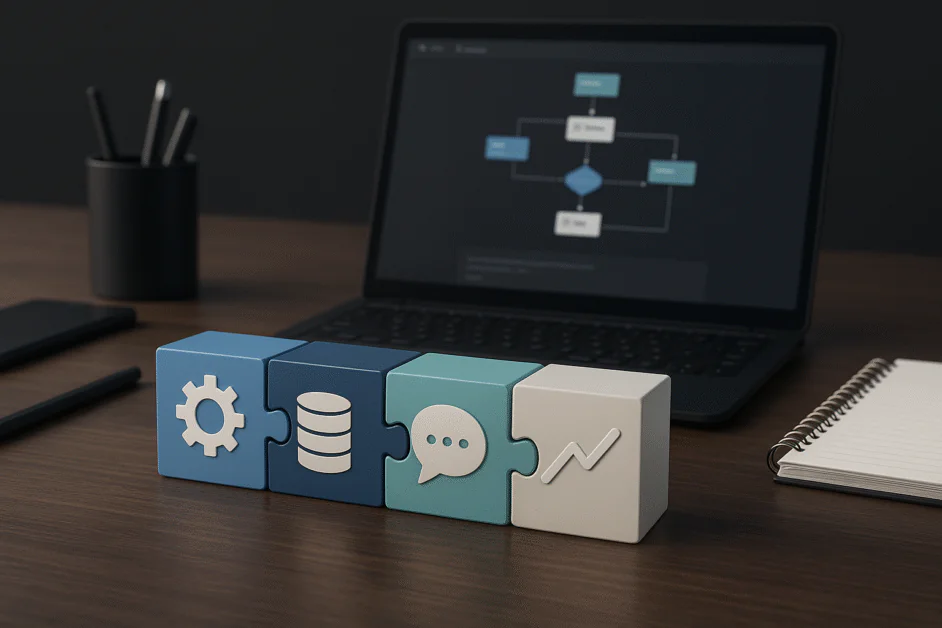
At its core, the platform introduces four foundational components that work together seamlessly:
Agent Builder provides a visual, drag-and-drop canvas for mapping an agent’s decision logic. Developers can create multi-step workflows, connect reasoning chains, and version their progress without writing extensive glue code.
Connector Registry acts as the central hub for linking external data and services. It offers pre-built integrations with popular tools such as Dropbox, Google Drive, and enterprise systems, while giving administrators full control over data access and permissions.
ChatKit enables instant deployment of an interactive interface, allowing agents to communicate naturally with users. This plug-and-play chat framework supports message streaming, branding customization, and multi-session context, making it easy to embed agents into existing applications.
Evals and Optimization Tools give developers a way to test agents in controlled environments, trace their decisions step by step, and refine performance through prompt optimization and reinforcement fine-tuning. This built-in feedback loop turns what was once trial-and-error development into a measurable engineering process.
Together, these tools form a full-stack environment that bridges the gap between experimental prototypes and reliable, scalable AI agents.
From Demos to Production-Ready Agents
AgentKit arrives at a time when many AI systems remain limited to basic interactions — generating text, summarizing data, or answering queries. OpenAI’s goal is to move beyond these reactive use cases toward autonomous, goal-driven systems that can analyze, plan, and act.
By reducing the need for complex code and integrations, AgentKit makes it possible for developers and enterprises to transition quickly from a working demo to a production-ready agent. Instead of stitching together multiple frameworks, teams can now use a single interface that handles everything from logic to deployment.
This shift also reflects a broader trend in AI: the move from “model-first” experimentation to workflow-first engineering. In this model, the agent is the central unit of value — a configurable entity that can reason, adapt, and integrate into daily operations.
Enterprise-Grade Reliability and Control
One of the biggest challenges in adopting AI agents has been trust. Enterprises need to ensure that autonomous systems behave safely, respect data governance, and produce consistent results. AgentKit directly addresses these needs through its built-in guardrails, role-based access control, and audit-friendly architecture.
Organizations can configure how and where an agent accesses sensitive data, ensuring that information stays within approved boundaries. The evaluation tools allow developers to benchmark performance, detect reasoning errors, and continuously refine results before wide-scale deployment.
This design reflects OpenAI’s understanding that AI adoption depends as much on governance and transparency as on intelligence and automation. In doing so, AgentKit helps transform experimental agents into dependable business tools.
How It Stacks Up Against Other Tools
The agent ecosystem has rapidly evolved, with numerous frameworks offering partial solutions for automation and orchestration. Platforms like n8n and Zapier popularized the no-code approach to connecting APIs and automating workflows. Meanwhile, developer libraries such as LangChain gave programmers low-level control over prompt chaining, reasoning, and external tool use. And experimental systems like AutoGPT and BabyAGI demonstrated the potential — and the limits — of fully autonomous reasoning loops.
AgentKit differentiates itself by unifying these ideas under a single, purpose-built platform. Where workflow tools excel in app integration, AgentKit adds deep reasoning capabilities. Where code libraries offer flexibility, AgentKit provides a managed, enterprise-ready foundation. And where autonomous agent experiments struggled with reliability, AgentKit enforces structure, versioning, and oversight.
In short, it’s a bridge between innovation and production — a way to make advanced agents both practical and predictable.
A Glimpse Into the Future of Agentic AI
The implications of AgentKit extend beyond OpenAI’s ecosystem. By standardizing how agents are designed and deployed, the company is laying the groundwork for a new generation of software that operates through intelligent automation rather than manual control.
In the coming years, this could reshape how people and organizations interact with technology:
- Customer support agents could independently resolve service requests and escalate complex cases only when necessary.
- Research assistants might continuously monitor news, trends, and academic data to deliver synthesized insights.
- Business operations agents could automate procurement, compliance reviews, and reporting tasks, freeing employees to focus on strategy.
- Personal assistants could coordinate daily schedules, manage communications, and even perform cross-application tasks seamlessly.
These examples illustrate a broader reality: AI agents are evolving from side tools into co-workers, capable of managing entire workflows and adapting to user intent.
OpenAI’s Strategic Position
With AgentKit, OpenAI is not only strengthening its developer ecosystem but also redefining its role in the AI infrastructure stack. The company already provides the models that power many of today’s AI products. Now, it’s offering the scaffolding that determines how those models are used, controlled, and scaled.
This vertical integration mirrors the early days of cloud computing, when companies began to rely on unified platforms for hosting, deployment, and monitoring. AgentKit could become the equivalent foundation for the AI agent era — a standardized layer where reasoning, safety, and automation converge.
While still in early stages, the launch highlights OpenAI’s ambition to lead not just in model innovation but in how those models shape the future of work. If successful, AgentKit could make agent development as commonplace as app development — marking a new phase in the evolution of artificial intelligence.



