
Thought Leaders
From Trial and Error to Predict and Verify: AI’s Impact on Manufacturing R&D

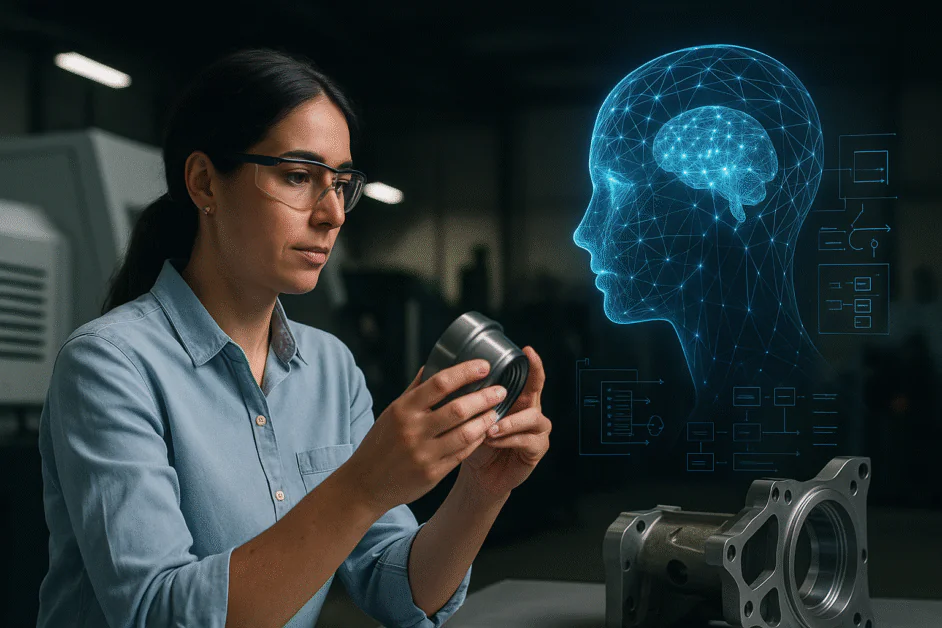
For decades, manufacturing research and development (R&D) has largely relied on a time-tested but costly model: trial and error. Scientists and engineers iterate through experiments, testing different material formulations, coatings, or composites, often guided by intuition, human expertise, and incremental tweaks. This process, while foundational for many breakthroughs, is slow, wasteful, and expensive.
Today, AI is fundamentally transforming that paradigm. Rather than relying on blind experimentation, companies can now use predict-and-verify workflows: AI models suggest promising candidates, guide which experiments to run, and help validate them which dramatically reduces the number of failed trials. This shift is not just theoretical but is already unlocking major gains in areas like energy storage, composites, and surface treatments.
Why traditional R&D Is inefficient
Traditional R&D typically depends on human-led experimentation. Researchers formulate a material, run tests, analyse results, adjust, and repeat. Each cycle takes time, resources, and often large volumes of materials, especially in sectors like coatings or advanced composites.
This approach has three big drawbacks:
- High cost: Physical experiments consume chemicals, energy, lab time, and manpower.
- Long timelines: Iterative cycles mean it may take months or years to converge on optimal formulations.
- Wasted resources: Many experiments fail, or only yield incremental improvements.
In many sectors, this method has barely changed in half a century.
Enter AI: predict before you try
AI changes this fundamentally. Rather than testing everything in the lab, AI-driven models can predict which material formulations are likely to work, filter out unpromising ones, and guide experiments more intelligently.
The predict-and-verify workflow uses AI to streamline R&D by guiding experimentation rather than relying on guesswork. First, models are trained on existing data, such as past lab results and material properties, to learn how different parameters influence performance. They then predict which formulations or process conditions are most likely to meet specific targets, from durability to conductivity. Researchers run a small, focused set of experiments to validate these predictions, and the results feed back into the model, sharpening its accuracy over time. This continuous loop significantly reduces the number of experiments required while accelerating discovery.
For example, in battery R&D, discovering new materials for electrodes or electrolytes traditionally meant synthesising and testing dozens (if not hundreds) of variants. AI models can predict which combinations of chemical components (e.g., salts, solvents, additives) are likely to deliver performance targets such as higher energy density or longer cycle life, reducing the number of expensive physical tests.
Why generic AI models (like ChatGPT) can’t do this
It’s tempting to imagine dropping a powerful LLM into lab R&D and having it “figure out” new materials. However in reality, general-purpose language models are not well-suited to physical science.
- LLMs are designed to work with text, not structured scientific data.
- They do not understand molecular properties, thermodynamics, or reaction kinetics in a mechanistic way.
- Without domain-specific training, they can generate plausible-sounding but scientifically incorrect combinations.
Speeding innovation to market
Because AI guides experimentation, the path from concept to viable material is dramatically shortened. Instead of running hundreds of experiments, companies can home in on a handful of high-potential candidates, test them, and scale up.
The most successful AI-driven R&D combines deep domain expertise with strong data science, creating a partnership that keeps predictions grounded in physical reality. Chemists ensure that AI-generated suggestions are actually synthesizable, safe, and scalable, while data scientists build and tune the models, uncover patterns, and generate hypotheses for experts to validate. As new experimental results come in, chemists refine their protocols and data scientists update the models, forming a continuous loop where AI proposes, humans verify, and both sides learn. This virtuous cycle steadily improves accuracy and accelerates meaningful discovery.
Challenges and Considerations
While the AI-enabled predict-and-verify approach is powerful, it is not a silver bullet. There are important challenges to navigate:
- Inaccessibility to data: One of the biggest barriers to accelerating R&D is simply finding and using the data required to train effective models. Much of the information scientists and engineers need is scattered across siloed systems, stored in inconsistent formats, or not digitised at all. Even when it is available, data can be difficult and time-consuming to clean, structure, and interpret. This slows down progress long before experimentation begins.
- Reproducibility: When AI predicts promising candidates, it’s critical that these predictions are verifiable. Researchers recently highlighted the importance of reproducible materials informatics work, especially in frameworks that claim to predict inorganic material properties.
- Interpretability: For AI to be trusted in R&D, models must be explainable. Otherwise, chemists may not trust or act on recommendations. Explainable AI research in manufacturing has shown how model outputs can be visualised to guide design decisions.
- Integration with existing workflows: AI should augment, not replace, human workflows. Labs must adapt: build systems for data capture, deploy feedback loops between modelling and experimentation, and invest in collaborative skills.
The bigger picture: AI’s role in the future of manufacturing
The transition from trial-and-error to predict-and-verify is more than a technical upgrade. It represents a cultural shift in R&D. AI will not only accelerate innovation, but also democratise it. Smaller companies with fewer resources can compete by leveraging predictive models to guide their experiments. The future of manufacturing R&D will be defined by intelligent experimentation, where machines and humans collaborate in a tight loop of prediction, verification, and refinement.
Crucially, AI is not here to replace scientists or engineers. By handling repetitive data processing and narrowing the field of promising candidates, AI allows scientists to spend more time doing science, and engineers to focus on engineering. Rather than automating people out of the process, AI amplifies human expertise and removes bottlenecks that prevent teams from working at their full creative and technical potential.
Manufacturing R&D has long been stuck in a cycle of slow, resource-intensive trial and error. With AI, that’s changing. By shifting to a predict-and-verify paradigm, companies can radically reduce waste, cost, and time-to-market and accelerate innovation in critical sectors.
The most powerful applications arise when domain experts and data scientists work together, using specialised models tailored to the physical, chemical, and structural properties of materials. The promise of AI in this context isn’t just about automation, it’s about smarter experimentation, more efficient discovery, and more sustainable manufacturing.
We are entering a new era where R&D is not measured in failed trials, but in validated predictions. The companies that embrace this approach will lead the next wave of industrial innovation.



