Thought Leaders
Commercial Real Estate in NYC Is on the Rocks: Can AI Be Its Savior?

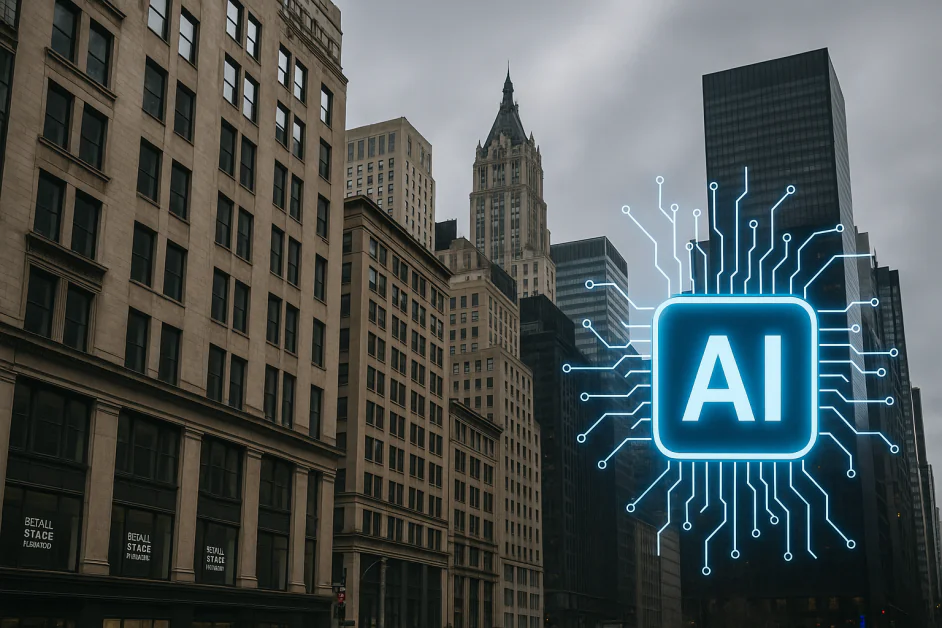
New York City has always been a prime location for real estate in high demand.
However, in 2025 the commercial real estate market (CRE) is grappling with challenges that place its very future in question.
While some Class A properties are holding strong, the middle and lower-end buildings are struggling with high vacancy rates and declining value. And according to the New York Fed, some banks are obscuring risk by quietly extending loans to delay refinancing under higher rates, essentially masking growing risks. Unsteady economic conditions have always affected how investors and developers approach commercial real estate.
But what makes this moment in history unusual is that AI is starting to reshape the sector itself.
Across the commercial real estate industry, property tech solutions are being used to cut costs and scale building operations to regain healthy profit margins. Meanwhile, the demand for AI has paved the way for a burgeoning tech scene in New York. In turn, this is creating demand for real estate from a new class of tenants, bringing fresh investment and giving vacant buildings a new lease of life.
Eyes Are on NYC as a Capital for AI
As New York carves a new role as the strategic home of AI, tech companies are making major investments in the physical infrastructure.
In Lower Manhattan, a full floor of the United Federation of Teachers headquarters is being turned into the National Center for AI. It’s part of a $23 million project backed by Microsoft, OpenAI, and Anthropic to train teachers in how to use AI tools in the classroom.
UFT President Michael Mulgrew said at a press conference that some of his union’s educators started training this month, adding that the initiative will expand nationally over the next year.
“This tool could truly be a great gift to the children of this country and to education overall,” Mulgrew said. “But we’re not going to get there unless it’s driven by the people doing the work in the most important place in education, which is the classroom.”
While some educators remain skeptical about this partnership, citing privacy concerns and impact on developing critical thinking skills, those building the software say these types of centers give direct access to teachers expected to use them. Creating a closer collaboration that will lead to tools that educators, teachers and students will see value in.
Charlie Sander, CEO of ManagedMethods, which provides cybersecurity tools to K-12 schools, sees a need to educate all stakeholders on cutting-edge tech use in education. “Bad actors use sophisticated, socially engineered emails to impersonate trusted sources like administrators, vendors, and even students and parents in order to steal credentials, deploy ransomware, or trick staff into wiring funds,” he told the AI Journal.
The UFT’s National Center for AI is one of many AI facilities fueling innovation in NYC. In June, IBM opened a new office at One Madison in Manhattan, which now houses its WatsonX AI Labs. The space is designed as a hands-on hub where engineers and researchers can work directly with startups, established companies, and local universities to build practical AI for business use.
“This initiative strengthens New York’s position as a global hub for responsible and cutting-edge AI development,” says Julie Samuels, President and CEO of Tech:NYC. “We’re thrilled to see IBM betting big on the extraordinary talent and entrepreneurial spirit that make this city so unique.”
Meanwhile, local developers are pitching new AI-focused co-working hubs in Brooklyn and Long Island City aimed at startups in machine learning and robotics.
More importantly, a new executive order clears the way for faster development of large data centers, critical infrastructure needed to power the computing demand for AI and machine learning. The government’s strategy is to remove barriers and offer tax breaks, grants, and loans in hopes of accelerating the growth of data centers across the country.
For New York CRE, this move could fuel the current wave of investment. Among them is DataBank’s Orangeburg Data Centre, outside of NYC proper, which is already seeking to develop a second facility. The addition will continue to correlate expansion to other sectors across the city, by attracting projects looking to leverage the nearby data center, representing new types of tenants, giving new life to older buildings.
Whether in the heart of Midtown or the outer edges of the city, AI-focused workspaces are quietly redrawing the map of commercial real estate, opening the door to new investment tied to an evolving industry that the world is taking a bet on.
AI Is Advancing Hybrid Work, but NYC Is Returning to the Office
While AI is experiencing growth as an industry itself, it’s important to consider its influence on wider workplace trends and how these tie back to the CRE market.
At the start of the pandemic, technology gave us the means to work from home. Although many companies have moved to champion a return to the office since then, the rise of AI could negate this. It enables employees to do more meaningful, high-quality work from anywhere, by automating routine tasks and allowing teams to complete complex projects without needing to be physically in the office.
This means hybrid work is more likely to settle as the new default moves forward. Even for those required to return to the office five days a week, AI means what’s happening is less a return and more of a reshaping of how we work and the spaces we are looking to work in.
This trend has hit New York’s commercial real estate market in a unique way. According to recent data from Placer.ai, NYC and Miami are leading when it comes to returning to the office, reporting Manhattan office traffic is now just 5.3% below June 2019 levels, outpacing cities like Los Angeles, Chicago, and San Francisco.
This could be a reflection of the major corporate return-to-office mandates and announcements in New York City over the past year, particularly in finance and law, doubling down on physical presence.
For instance, JPMorgan formally ordered nearly all staff back to the New York office five days a week, reinforcing expectations that being in-office supports mentoring and productivity. A move that ties directly into its major $3 billion Park Avenue headquarters, set to open later this year and designed to appeal to employees not keen on returning full-time.
While the broader CRE market may seem uncertain, institutional players in certain industries with money to spend are still placing big bets on New York’s office landscape. Many tenants aren’t renewing at the same scale, requesting more flexible lease terms and smarter layouts that value efficiency in space, energy consumption, health, and threat prevention.
AI is Trimming CRE Costs, but Not Without an Upgrade First
AI is rewriting how commercial properties are run. For a sector that’s long operated on legacy systems and manual processes, that shift is overdue.
With AI, its real value lies in energy and safety. AI tools are managing lighting, air conditioning, and access in real time, learning how people move through buildings and adjusting use to match. But most aren’t ready. A Deloitte study found that 60% of real estate firms lack the data and controls needed to meet compliance targets.
We’ve seen federal ESG mandates stalled in the U.S. under the current administration, but many states are stepping in. Investors, tenants, and regulators want ESG data that’s verifiable and standardized. Some buildings now command up to 31% higher rent if they meet green certifications, looked at as premium Grade A spaces. Those without modern systems face rising costs, potential fines, or an inability to attract capital.
According to Gaku Ueda, CEO of MODE, Inc., an AI platform for building management, a solid foundation already exists for AI integration; however, facility managers still face uncertainties around adoption.
“Part of that lies in a lack of understanding about how AI can be used to simplify and enhance building operations, with most facility managers struggling to develop adequate implementation strategies,” Ueda said.
The point isn’t just that AI can help save money. It’s that the systems behind many buildings, especially older ones, weren’t designed to show you where that money is being lost and how to best protect those inside.
Take the case of 45 Broadway in Manhattan. After installing AI-based HVAC controls, the building cut energy use by nearly 16 percent. That translated to annual savings of $42,000, plus a 37‑metric‑ton reduction in carbon output. According to Christian Struve, co-founder and CEO at asset management software firm Fracttal, “The correct maintenance not only ensures optimal environmental conditions, but also significantly improves energy efficiency, reducing electricity consumption and prolonging the life of the equipment. “ Many studies confirm that dated HVAC systems can be breeding grounds for harmful pathogens if not properly monitored and maintained. These same AI systems can now track indoor air quality, adjust airflow, and temperature based on sensor data. This gives management teams the ability to detect CO2 levels, and airborne particles early, helping them pinpoint high-risk areas before they pose a health threat.
Recently, a serious outbreak highlighted how real those risks can be. Dozens of people were reported sick and two died from Legionnaire’s disease, a condition often linked to water supply sources, including cooling towers used in HVAC systems. Health officials have since confirmed 11 cooling towers in Harlem that contained the type of bacteria that causes the disease.
Further, when it comes to safety in the workplace there is a clear shift in norms, according to Joshua Schwartz, co-founder of Viking Pure Solutions, which provides disinfection solutions to facilities in the U.S. “There is no question that employees, employers and visitors are now more aware of the potential for the spread of illness within their offices so it is necessary for companies to have forward facing programs which were atypical pre-pandemic,” he said.
In addition to protecting against illness, buildings are also turning to AI to prioritize physical security. Especially following last week’s mass shooting at a high-profile office building in Manhattan, igniting discussion between commercial property owners on how to best upgrade their security.
According to Mark Ein, Kastle Systems’ executive chairman, today’s systems can track movement, verify identity through biometrics, and flag unusual behaviour in real time using AI.
“These tools add valuable layers of protection. … The most effective way to make a building as safe as possible for its occupants is the marriage of the best technology and coordinated human preparation. … Nothing can solve every threat, but they are essential,” says Ein.
In a city as densely populated as New York, where energy costs rank among the highest in the country, investing in AI means investing in data storytelling technology, giving property owners the ability to unlock real-time data insights. In turn, this paves the way for highly efficient buildings that optimize energy usage, and prioritizes health and physical safety.
AI forging a new chapter for commercial real estate in NYC
As the commercial real estate market in New York faces an unprecedented drop in demand, carving out a new approach will be key in securing ongoing investments. If NYC is able to get traction as a capital for AI, the city and its commercial real estate will benefit.
With an AI-driven future, the city can counter the changing demands driven by hybrid work, attract high-value tenants and open up access to property tech solutions that boost efficiencies and profit margins.