Book Reviews
Book Review: The Worlds I See by Dr. Fei-Fei Li

Artificial intelligence is often explained through algorithms, hardware breakthroughs, and the rapid rise of powerful models. What is frequently missing from that narrative is the human story behind the scientists who laid the groundwork for today’s AI revolution.
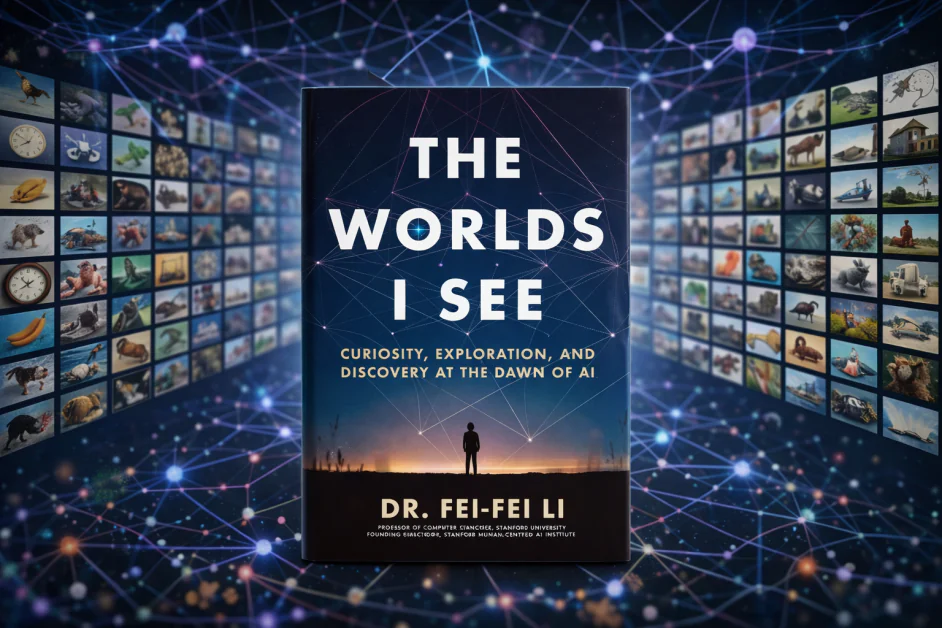
The Worlds I See: Curiosity, Exploration, and Discovery at the Dawn of AI by Dr. Fei-Fei Li fills that gap beautifully. The book operates simultaneously as a memoir, a history of modern artificial intelligence, and a reflection on the responsibility that comes with building transformative technologies.
What makes the book particularly compelling is how Li intertwines two parallel stories. One is the story of AI itself. The other is the story of a young immigrant arriving in the United States and eventually becoming one of the most influential figures in the field of computer vision.
An Immigrant Journey That Shapes a Scientific Mind
One of the strongest elements of the book is the deeply personal narrative that precedes Li’s scientific career.
Li grew up in China before immigrating to the United States as a teenager. The transition was difficult. Her family arrived with limited financial resources and faced the challenge of rebuilding their lives from scratch. During those early years in America, Li helped her parents run a dry-cleaning business while continuing her education.
These experiences form an important foundation for the book. They reveal the persistence and resilience that would later define her scientific work. The memoir does not romanticize the immigrant experience. Instead, it presents the reality of cultural adjustment, financial pressure, and the determination required to pursue academic ambitions in a completely new environment.
Eventually Li was admitted to Princeton University. Her first days on campus are described with a mixture of excitement and disbelief. For someone who had only recently arrived in the United States, Princeton represented an intellectual world that seemed almost unimaginable only a few years earlier.
Those early academic experiences helped shape the curiosity that drives the rest of the story.
Navigating a Male-Dominated Field
Another theme that runs throughout the book is Li’s experience as a woman in computer science.
Artificial intelligence research has historically been dominated by men, particularly during the early years of Li’s career. She frequently found herself in rooms where she was one of very few women. The book does not frame this as a dramatic conflict but rather as an underlying reality that influenced how she navigated the field.
These experiences ultimately contributed to Li’s later efforts to broaden participation in AI. She became an advocate for diversity in the field and helped create initiatives designed to bring more women and underrepresented groups into artificial intelligence research.
The broader message that emerges is that AI should not be built by a narrow segment of society. If the technology is going to shape the world, the people building it should reflect that world as well.
Discovering WordNet and the Importance of Knowledge Structures
The book begins to move deeply into the technical history of AI when Li encounters a linguistic database known as WordNet during her academic work.
WordNet organizes English words into groups of related concepts called synsets. These conceptual relationships map language in a way that resembles how humans categorize and understand the world.
For Li, WordNet represented more than a linguistic tool. It revealed a possible framework for teaching machines to understand visual information.
At the time, artificial intelligence research was heavily focused on improving algorithms. But Li began to see the field differently. She realized that the real bottleneck in machine learning was not only better models but better data.
If computers were going to learn how to recognize objects in the world, they would need access to an enormous number of labeled examples.
This realization would ultimately lead to one of the most influential datasets ever created.
The Creation of ImageNet
The most fascinating portion of the book centers on the creation of ImageNet.
ImageNet was designed as a massive visual database that could help machines learn how to recognize objects. Using WordNet as its conceptual backbone, the dataset organized millions of images into thousands of object categories.
The scale of the project was unprecedented. The dataset eventually contained more than fourteen million labeled images spanning over twenty thousand categories. Researchers and crowd workers carefully annotated the images so that algorithms could learn to identify objects such as animals, vehicles, tools, and everyday items.
At the time, many researchers questioned whether such a dataset was necessary. Artificial intelligence research was still heavily focused on designing smarter algorithms rather than collecting massive amounts of data.
Li took the opposite view. She believed that machine learning systems could only improve if they were trained on vast quantities of real-world examples.
The book describes in detail how difficult it was to build ImageNet. The project required years of persistence, technical experimentation, and large-scale coordination with thousands of contributors who helped label images.
It was a massive undertaking that initially attracted skepticism within the research community.
The Breakthrough That Changed Artificial Intelligence
The turning point came with the ImageNet Large Scale Visual Recognition Challenge.
This competition invited researchers to build systems capable of identifying objects within the massive dataset. For several years progress was gradual. Then in 2012 a deep neural network dramatically outperformed previous approaches.
That breakthrough demonstrated the power of combining large datasets with deep learning architectures. The results shocked the AI community and triggered a rapid shift toward neural network methods.
ImageNet became the training ground that enabled many of the advances in computer vision that followed. The dataset helped catalyze progress in areas ranging from image recognition to autonomous vehicles, medical imaging, and modern AI systems that rely heavily on visual understanding.
The book provides a rare behind-the-scenes perspective on how that moment unfolded and how researchers realized they were witnessing a major turning point in the history of artificial intelligence.
Human-Centered Artificial Intelligence
As the narrative progresses, Li begins to focus on the broader implications of the technology she helped accelerate.
She argues that artificial intelligence must remain fundamentally human centered. The goal of AI should not simply be to build powerful systems but to ensure those systems benefit society.
This perspective reflects Li’s later work in academia and policy. She became a leading voice advocating responsible AI development and helped promote initiatives designed to ensure that AI is built with ethical considerations in mind.
The book emphasizes that the future of AI will not be defined solely by technological breakthroughs. It will also be shaped by the choices researchers, engineers, and policymakers make about how those systems are deployed.
Final Thoughts
The Worlds I See is much more than a memoir about artificial intelligence.
It is the story of a young immigrant pursuing curiosity in a new country. It is a detailed account of how one of the most important datasets in machine learning was created. It is also a reflection on the responsibilities that come with building technologies capable of reshaping society.
What makes the book particularly powerful is that these stories are inseparable. Li’s personal journey and the evolution of modern AI unfold together.
For readers interested in the history of artificial intelligence, this book offers a rare perspective from someone who helped build the foundations of the field. For anyone interested in the human side of scientific discovery, it is equally compelling.
In many ways, The Worlds I See reminds us that revolutions in technology rarely begin with machines. They begin with curiosity, persistence, and the courage to pursue ideas that others might initially overlook.