AI Models & Platforms
Argonne National Laboratory Launches Large-Scale AI Inference Service for Open Science

 Add Unite.AI to your preferred sources on Google

The race to build larger AI models has dominated headlines for years, but one of the biggest challenges in scientific computing has remained largely unresolved: how researchers can actually use advanced AI systems at scale without building their own costly infrastructure.
That is the problem Argonne National Laboratory is now aiming to solve with the launch of what it describes as the first large-scale AI inference service designed specifically for open science.
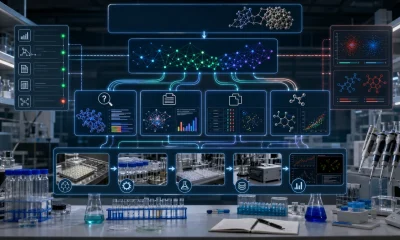
The new service, developed through the Argonne Leadership Computing Facility (ALCF), gives researchers cloud-style access to large language models, scientific foundation models, and computer vision systems running directly on Argonne’s high-performance computing infrastructure. Instead of training their own models or managing specialized hardware clusters, scientists can tap into a shared inference platform optimized for large-scale research workflows.
Why AI Inference Matters for Science
Much of the AI conversation has centered around model training, but inference is where AI systems become practically useful. AI Inference is the stage where trained models analyze data, generate predictions, interpret results, or assist with decision-making in real time.
For scientific research, inference can dramatically accelerate the pace of experimentation. Massive datasets from particle accelerators, telescopes, fusion experiments, genomics projects, and molecular simulations often overwhelm traditional analysis pipelines. AI inference systems can rapidly interpret these datasets, helping researchers identify patterns or anomalies that would otherwise take weeks or months to uncover.
Argonne’s new service is intended to eliminate a major bottleneck by making advanced inference capabilities accessible as a centralized resource rather than requiring every institution to deploy its own AI stack.
Michael Papka, director of the ALCF, described the initiative as a shift away from simply offering raw compute power toward providing integrated AI-enabled scientific services.
A National AI Infrastructure for Research
The inference service is tied closely to the U.S. Department of Energy’s broader Genesis Mission, a national initiative focused on accelerating scientific discovery through AI-driven infrastructure. The mission aims to connect supercomputers, scientific instruments, and large-scale datasets into a unified AI ecosystem capable of supporting next-generation research.
Argonne’s system already supports researchers from multiple DOE laboratories, including Brookhaven National Laboratory, Lawrence Berkeley National Laboratory, Oak Ridge National Laboratory, and Los Alamos National Laboratory. The broader vision is to create an interconnected national research platform where AI tools, experimental data, and supercomputing resources can operate together seamlessly.
This is particularly important as scientific AI workloads increasingly involve agentic workflows, where models repeatedly interact with simulation systems, databases, and analytical tools. These workflows can generate enormous token consumption and computational costs when run on commercial AI platforms. Argonne’s infrastructure is designed to support these workloads internally for scientific applications.
The Technology Behind the Platform
The service provides access to multiple model families, including Google’s Gemma models, Meta’s LLaMA family, and OpenAI’s GPT-OSS systems, alongside domain-specific scientific foundation models and internally developed systems such as AuroraGPT.
AuroraGPT is especially notable because it represents Argonne’s broader ambition to build AI systems trained specifically on scientific literature, datasets, and multimodal research inputs. The project has explored extremely large-scale architectures optimized for scientific reasoning and high-performance computing environments.
The infrastructure itself runs on dedicated ALCF systems including Sophia and Metis, with future expansion planned onto NVIDIA-powered systems named Tara and Minerva.
Beyond Chatbots: Real Scientific Applications
While public AI discussion often revolves around conversational assistants, Argonne’s focus is firmly on research acceleration.
In fusion energy research, inference models can monitor plasma behavior in real time and potentially predict disruptions before they occur. In astronomy and particle physics, AI systems can analyze enormous streams of telescope or collider data to identify rare events more efficiently. In chemistry and materials science, inference systems can coordinate complex molecular simulations and automate large-scale computational workflows.
One example highlighted by Argonne is ChemGraph, an AI-driven framework designed to simplify molecular simulation workflows. The system uses repeated AI tool-calling interactions to coordinate simulations, data analysis, and iterative experimentation in a more connected workflow.
The broader implication is that scientific computing is evolving from isolated supercomputing jobs into continuously interactive AI-assisted research environments.
Argonne’s Growing Role in AI Infrastructure
Founded in 1946, Argonne National Laboratory has long been one of the United States’ most important scientific research institutions, particularly in high-performance computing, energy systems, materials science, and nuclear research. The laboratory operates under the U.S. Department of Energy and has played a central role in several generations of American supercomputing initiatives.
In recent years, Argonne has become increasingly influential in AI-for-science development through projects tied to exascale computing and large scientific foundation models. The ALCF itself houses some of the nation’s most advanced computing systems, including Aurora, one of the world’s fastest supercomputers.
The launch of the inference service reflects a larger transition happening across both academia and enterprise computing: moving from standalone AI models toward integrated AI infrastructure platforms capable of supporting continuous, large-scale reasoning workloads.
For scientific research, that transition could significantly compress the timeline between raw data generation and meaningful discovery.