AR, XR & Brain Interfaces
AI Breakthrough Improves Brain–Computer Interfaces by Decoding Complex Brain Signals

 Add Unite.AI to your preferred sources on Google
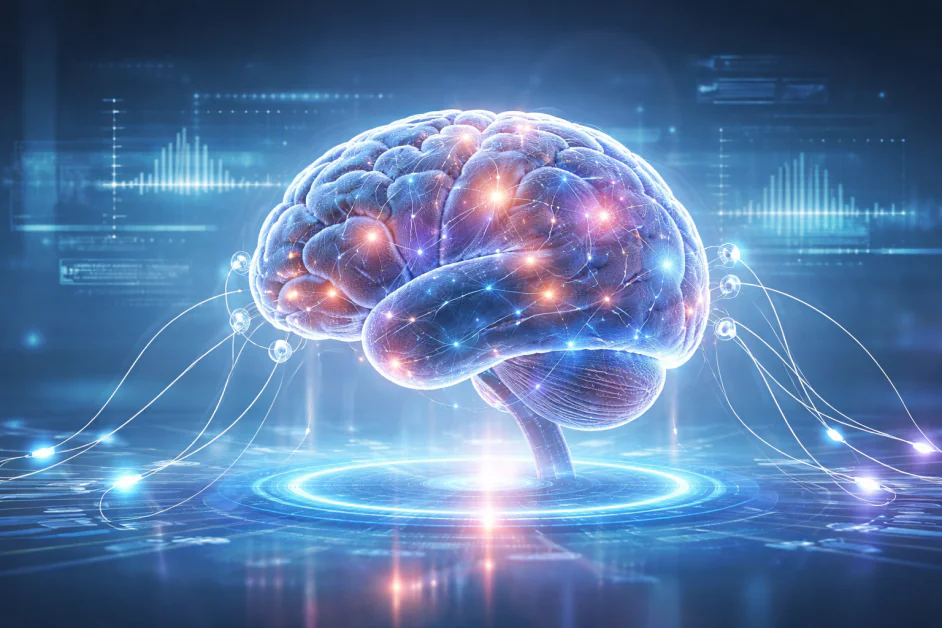
Researchers at Chiba University in Japan have developed a new artificial intelligence framework capable of decoding complex brain activity with significantly improved accuracy, marking an important step toward more reliable brain–computer interfaces (BCIs). The breakthrough could help accelerate the development of assistive technologies that allow people with neurological conditions to control devices such as prosthetic limbs, wheelchairs, and rehabilitation robots using their thoughts.
The research, led by Ph.D. student Chaowen Shen and Professor Akio Namiki at the Graduate School of Engineering at Chiba University, introduces a novel deep learning architecture known as an Embedding-Driven Graph Convolutional Network (EDGCN). The system is designed to interpret the complex electrical signals generated in the brain when a person imagines moving their limbs—a process known as motor imagery.
Brain–Computer Interfaces and Motor Imagery
Brain–computer interfaces aim to create aect communication channel between the human brain and external machines. Instead of relying on muscle movement, BCIs interpret neural signals and convert them into commands for digital systems or physical devices.
One of the most widely studied approaches in BCI research involves motor imagery electroencephalography (MI-EEG). In these systems, users imagine performing movements—such as raising a hand, grasping an object, or walking. Even though no physical movement occurs, the brain generates distinctive patterns of electrical activity associated with the imagined motion.
These signals can be captured using electroencephalography (EEG), a non-invasive technique that records brain activity through electrodes placed on the scalp. EEG provides multi-channel time-series data representing neural activity across different regions of the brain.
Decoding these signals accurately allows computers to translate neural activity into actionable commands. In practice, this could allow individuals with paralysis or severe motor impairment to control assistive technologies simply by imagining movements.
However, achieving reliable decoding of MI-EEG signals remains one of the most difficult challenges in neurotechnology.
Why Brain Signals Are Difficult to Decode
The primary obstacle in brain–computer interface development lies in the inherent complexity of EEG signals.
Motor imagery signals display high spatiotemporal variability, meaning they vary both across different brain regions and across time. They also differ widely between individuals and even within the same person from one session to another.
Traditional machine learning models often struggle with these variations. Many existing systems rely on predefined graph structures or fixed parameters that assume brain signals behave in consistent patterns. In reality, neural signals are far more dynamic and heterogeneous.
Earlier methods often used techniques such as common spatial pattern analysis or conventional convolutional neural networks to extract features from EEG signals. While these approaches can identify some patterns in neural activity, they frequently fail to capture deeper interactions between brain regions or evolving patterns in time.
As a result, many BCI systems require extensive calibration and training before they can function effectively for individual users.
A New Approach: Embedding-Driven Graph Convolutional Networks
The research team at Chiba University addressed these challenges by developing a new deep learning framework designed to better capture the complexity of brain activity.
Their solution—Embedding-Driven Graph Convolutional Network (EDGCN)—combines several advanced techniques to model the spatial and temporal structure of EEG signals simultaneously.
At the core of the framework is an embedding-driven fusion mechanism that allows the system to dynamically generate parameters used for decoding brain signals. Instead of relying on fixed architectures, EDGCN adapts its internal representation to better capture variations between subjects and across time.
The architecture integrates multiple specialized components:
Multi-Resolution Temporal Embedding (MRTE)
This module analyzes EEG signals at different time scales. Because neural signals evolve rapidly, important information may occur at different temporal resolutions. MRTE extracts features from multi-resolution power spectral patterns, allowing the system to identify meaningful neural activity that might otherwise be missed.
Structure-Aware Spatial Embedding (SASE)
Brain signals are not isolated; different brain regions interact continuously. The SASE mechanism models these interactions by incorporating both local and global connectivity structures among EEG electrodes. This allows the AI to represent the brain as a network rather than as independent signal channels.
Heterogeneity-Aware Parameter Generation
One of the most innovative aspects of the EDGCN framework is its ability to dynamically generate graph convolution parameters from an embedding-driven parameter bank. This allows the model to adapt to the unique characteristics of each subject’s brain signals.
To support this process, the researchers used Chebyshev graph convolution, a technique that efficiently models relationships within complex networks.
Orthogonality-Constrained Kernels
To further improve robustness, the model introduces orthogonality constraints within its convolution kernels. This encourages diversity in the learned features and reduces redundancy, helping the system extract richer representations from EEG signals.
Together, these components allow EDGCN to capture both local neural activity patterns and large-scale interactions between brain regions, resulting in more accurate decoding of motor imagery signals.

Performance Results
The researchers tested EDGCN using widely used benchmark datasets from the BCI Competition IV, which are standard evaluation datasets in the field of brain–computer interface research.
The model achieved:
- 90.14% classification accuracy on the BCIC-IV-2b dataset
- 86.50% classification accuracy on the BCIC-IV-2a dataset
These results surpass several existing state-of-the-art decoding methods and demonstrate strong generalization across different subjects.
Importantly, the system also showed improved adaptability when applied to cross-subject scenarios, a key requirement for practical BCI deployment. Many existing models perform well for a single trained user but fail when applied to new individuals. EDGCN’s embedding-driven architecture helps overcome this limitation by better modeling individual variability.
Implications for Rehabilitation and Assistive Technology
The ability to decode brain signals more accurately could have profound implications for assistive technologies.
Motor imagery-based BCIs are already being explored for applications such as:
- Thought-controlled wheelchairs
- Neural prosthetics
- Robotic rehabilitation devices
- Communication systems for patients with paralysis
Improved decoding accuracy could make these technologies significantly more reliable and easier to use.
Researchers believe systems like EDGCN may help patients with conditions including:
- Stroke
- Spinal cord injuries
- Amyotrophic lateral sclerosis (ALS)
- Other neuromusculoskeletal disorders
With more reliable signal interpretation, patients could potentially control neurorehabilitation devices through simple imagined movements, enabling more natural interaction with assistive systems.
According to Professor Namiki, decoding motor imagery signals is not just a technological challenge but also an opportunity to better understand how the brain organizes movement and neural connectivity.
Toward Consumer-Grade Brain–Computer Interfaces
Despite decades of research, most brain–computer interface systems remain confined to laboratories or specialized clinical settings. Reliability, adaptability, and ease of use remain significant barriers to broader adoption.
Advances like EDGCN could help move BCIs closer to consumer-grade neurotechnology.
By improving the system’s ability to handle heterogeneous brain signals, the model reduces the need for extensive calibration and expert tuning. This is a critical step toward making BCI systems usable outside research environments.
Future research will likely focus on integrating such AI models into portable EEG systems and wearable devices. Combined with improvements in sensor technology and computing power, these systems could enable more accessible and scalable brain–machine interfaces.
A Step Toward Deeper Human–Machine Integration
The development of EDGCN reflects a broader trend in artificial intelligence and neuroscience: the increasing use of graph-based neural networks to model biological systems.
Because the brain itself operates as a complex network of interconnected regions, graph neural networks provide a natural way to represent its structure and dynamics. As these AI models become more sophisticated, they may unlock deeper insights into neural activity and cognition.
Ultimately, improved decoding of brain signals could pave the way for a new generation of technologies that allow humans to interact with machines more seamlessly than ever before.
If progress continues at its current pace, brain–computer interfaces may soon transition from experimental research tools to everyday assistive technologies capable of restoring independence and mobility to millions of people worldwide.