
Thought Leaders
A New Enterprise Playbook to Lead in the Agentic AI Era

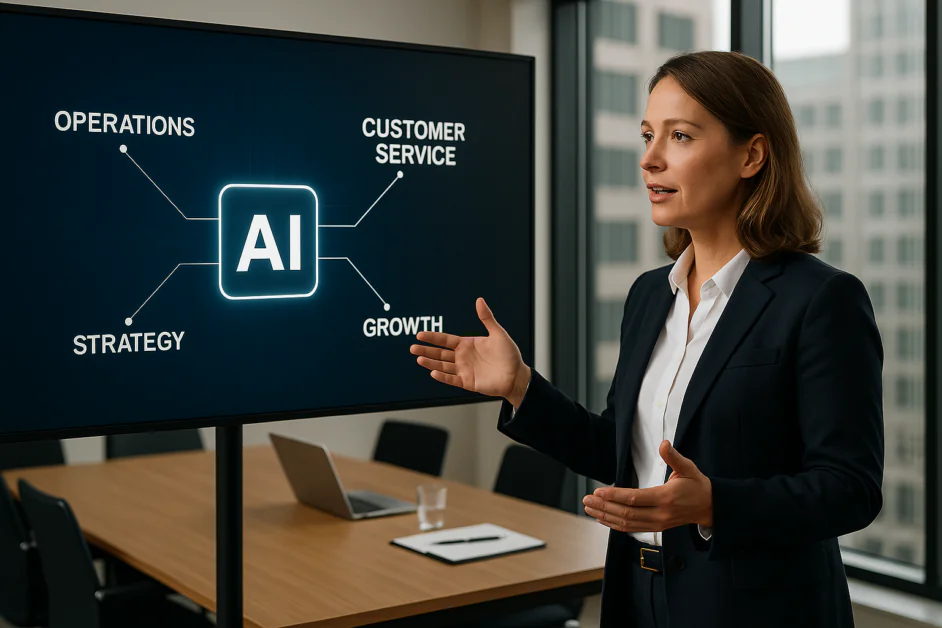
Artificial intelligence (AI) has rewritten the rules of the enterprise. From streamlining daily operations to delivering hyper-personalized customer experiences at scale, AI has moved from experimentation to the center of business strategy. It is no longer a question of if AI will impact your organization, but how deeply it impact your business. Beneath the momentum, however, most businesses remain unprepared for what’s next: the agentic AI era.
According to EY research, 73% of senior business leaders believe that one day, entire business units will be managed by agentic AI. However, this vision is tempered by practical concerns, with nearly nine in ten leaders reporting key barriers to agentic AI adoption in their organizations. The challenges are wide-ranging, from cybersecurity risks to data privacy concerns, but at the very core, successful AI adoption comes down to meeting business needs while expanding the realm of outcomes with this technology.
Closing the gap between AI aspiration and execution requires more than investment in technology. It demands a new kind of playbook – one that equips teams to collaborate confidently and effectively with AI agents and treats AI not just as a technology rollout but as an evolution of the workforce itself.
1. Build AI Fluency Across Your Organization
AI is drastically transforming how work gets done. PwC research shows that three quarters (75%) of business leaders agree or strongly agree that AI agents will reshape the workplace more than the internet did. Even in roles like customer service agents, where human interaction and empathy remains essential, AI’s touch is unmistakable. Five9’s Business Leaders CX Report revealed that only 7% of leaders believe customer service agents’ roles have remained unchanged by AI.
Despite this, many enterprises still treat AI literacy as a technical requirement rather than a strategic imperative. For agentic AI adoption to be successful, every employee must understand what it can do, how to interact with it, when to trust outputs, and when to intervene.
Building this AI fluency starts with education and exposure. Leaders should provide accessible training to employees that demystifies AI, showcases practical use cases, and emphasizes the shared responsibility of human-AI collaboration. When workers understand AI’s purpose and its limits, companies can build confidence and accelerate adoption.
Just as importantly, it’s critical that leaders set the tone by positioning AI as an enabler of human potential, not a replacement. As agentic AI takes on routine tasks, like summarizing customer interactions or routing IT tickets with simple actions, employees gain the space to focus on higher-value activities like strategic planning, creative problem-solving, and relationship building that drives differentiation and trust for the business.
Research shows that workers already believe in an autonomous future and are beginning to offload tasks to AI. While only 10% of global workers surveyed said they trust AI to operate autonomously today, that number is expected to rise to 26% within three years, and 41% beyond that. For enterprise leaders, this signals the need to invest in building AI fluency and trust. When done right, human enablement will pave the way for an agentic future tomorrow.
2. Reimagine Processes, Not Just Tools
Plugging agentic AI into legacy workflows rarely delivers transformative impact. Agentic AI adoption requires a complete redesign of processes. The organizations pulling ahead aren’t merely experimenting with new tools, they are fundamentally changing their operating models around AI. According to IBM research, 78% of C-suite executives say achieving maximum benefit from agentic AI requires a new operating model.
The question then isn’t “Where can we insert AI?” Instead, leaders need to be examining their processes end-to-end and asking questions like, “If AI could take on low-value execution, how should the rest of the work change?” and “How can humans and AI work together to achieve better outcomes?” The key is to identify where AI can operate autonomously and where human touch adds irreplaceable value.
In customer experience (CX), for example, this might mean reimagining escalation paths. AI can autonomously resolve routine issues, freeing human agents to focus on more complex tasks and relationship building. In operations, AI can forecast demand while people design the strategy to meet it.
It’s all about humans and AI working in harmony. This kind of intentional redesign is key to adapting in the age of agentic AI. It allows organizations to become more agile and resilient to change without losing the human touch that drives trust, loyalty, and long-term business success.
3. Set Clear Guardrails that Build Confidence and Scale
As enterprises deploy agentic AI across their operations, structure becomes as important as innovation. Clear guardrails are essential – agentic AI can only flourish in an environment of clarity and safety. Therefore, product and business leaders need to ensure there are frameworks in place to design, implement and govern AI responsibly.
This starts with alignment. Every organization needs clear principles and guidelines around data use, human oversight, and accountability. Those principles must be built into the design and deployment process from the start, not added as afterthoughts.
It’s also important for leaders to connect AI governance to measurable outcomes. Goals tied to real business metrics, like resolution time, customer satisfaction or operational output, help teams evaluate performance, identify risks, and determine if additional safeguards are needed. When teams know how AI is governed, how data is protected, and when human oversight is required, they can move faster with greater confidence.
Equally important is how these AI guardrails are communicated to customers. Trust is built on transparency, and transparency starts by explaining when and how AI is involved in an interaction. Clearer communication about what AI can do, how data is handled and how humans remain in the loop can help customers feel empowered by AI, not shorthanded.
Leading Through the Next Revolution
Agentic AI is redefining the modern enterprise, but technology alone won’t determine who wins in this next era of transformation. People will. For today’s leaders, that means pairing every investment in data, models, and infrastructure with equal focus on AI education, design, and governance.
Competitive advantage won’t come from building the smartest systems. It will come from empowering the smartest, most agile, teams to lead confidently alongside them.



