AI Fundamentals
What Is Conversational Speech Recognition (CSR)?

 Add Unite.AI to your preferred sources on Google

Conversational speech recognition (CSR) extends automatic speech recognition beyond isolated transcription by using dialogue context, turn-taking signals, speaker information, and low-latency processing. The goal is to support a live interaction in which words, timing, interruptions, and prior turns all matter.
CSR is an emerging product and research label, not a single standardized model class. A strong system combines streaming ASR with endpointing, speaker handling, contextual language modeling, dialogue state, and a response policy, then evaluates the experience end to end.
Key takeaways
- Streaming recognition emits provisional hypotheses and revises them as more audio arrives.
- Endpointing and turn prediction are separate from transcription accuracy.
- Conversation history and hotwords can improve recognition but also propagate earlier errors.
- Evaluate latency, interruptions, speakers, accents, noise, privacy, and task completion—not word error rate alone.
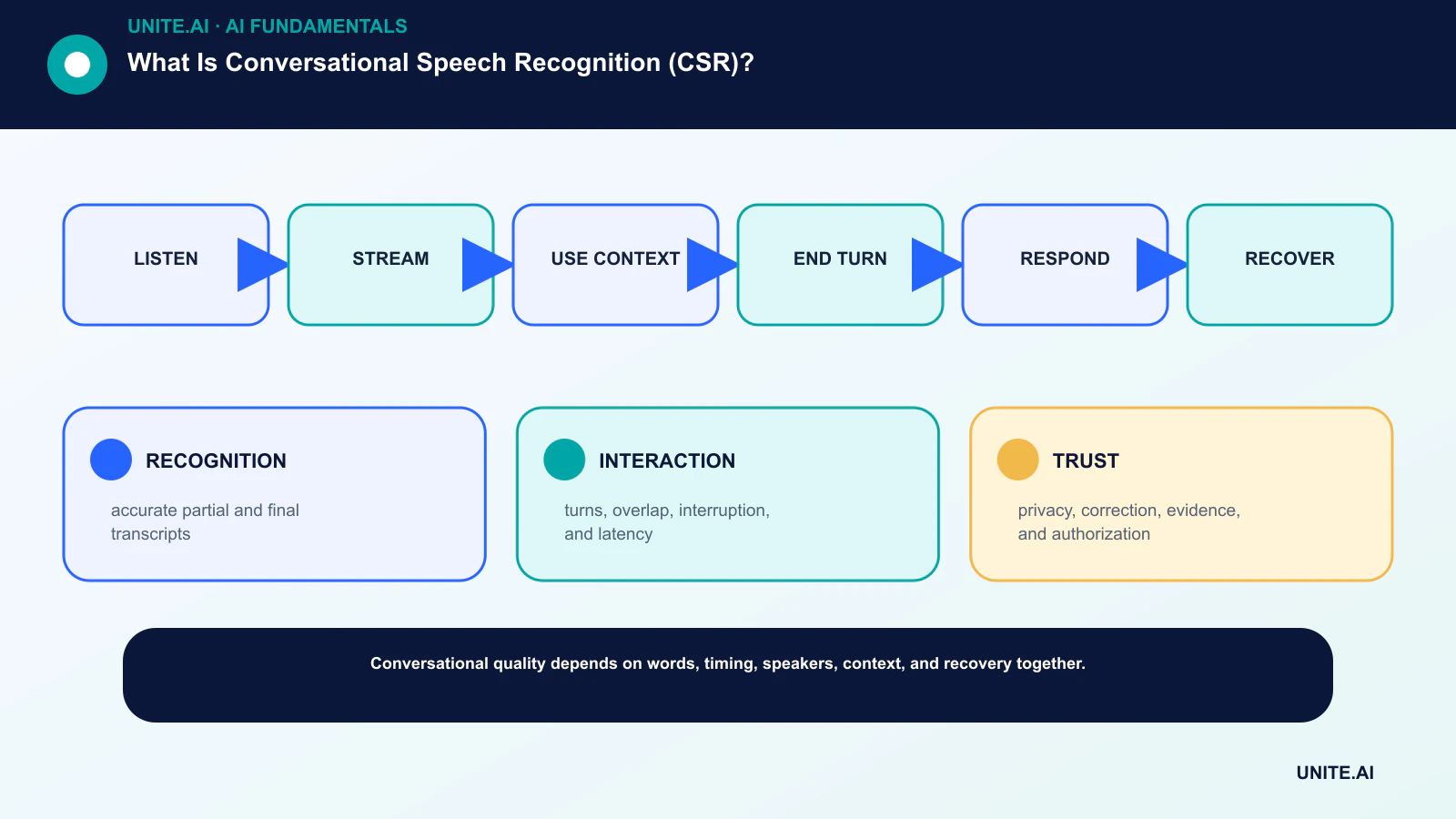
From ASR to live dialogue
Traditional ASR maps audio to text. A conversational system must decide when to listen, when a turn is complete, whether speech is directed at the system, and how to recover when its transcript or response is wrong.
Streaming models process frames incrementally and produce partial transcripts. Low latency improves responsiveness, but premature commitment can increase revisions or errors. The application needs a policy for stable versus provisional text.
Turn-taking, overlap, and speakers
Silence duration alone is a weak endpoint signal. Lexical completion, prosody, timing, gaze, and dialogue state can help predict whether a person is holding or yielding the floor. Barge-in lets a user interrupt synthesized speech without losing context.
Overlapping voices and diarization remain difficult. Systems should preserve speaker uncertainty, avoid attributing a statement to the wrong person, and provide a correction path—especially for records used in healthcare, finance, or legal work.
Contextual recognition
Previous turns can disambiguate names and references; hotword lists can bias recognition toward domain terms. Speech-language models may encode audio and text context in a shared prompting or attention framework.
Context can also reinforce a mistaken earlier transcript or leak information between sessions. Limit history to the current purpose, separate trusted metadata from user speech, and use transformer context with explicit retention and access rules.
Evaluation and responsible deployment
Report streaming word error rate, first-token and finalization latency, revision rate, endpoint errors, barge-in success, speaker attribution, and task completion. Test real microphones, noise, accents, code-switching, disability, and emotionally charged speech.
Voice data can identify or reveal sensitive information. Apply consent, minimization, encryption, retention limits, and human review. Connect generated replies to chatbot safety controls, because accurate transcription does not make a response correct or authorized.
From acoustic input to conversational state
A conversational speech system captures audio, applies signal conditioning, detects speech, recognizes words or semantic units, identifies speakers when needed, and updates dialogue state. Streaming systems produce partial hypotheses before an utterance ends. Those hypotheses can change, so downstream components must distinguish tentative from final results.
Voice activity detection and endpointing decide when speech starts and when the user has finished. Fixed silence thresholds fail with slow speakers, background noise, and thinking pauses. Turn-taking models can use words, prosody, gaze, and dialogue context, but they must balance fast response against cutting the speaker off.
Diarization answers who spoke when; speaker recognition estimates identity; source separation isolates overlapping voices. These are different tasks with different risks. In meetings, healthcare, and customer service, attributing the right words to the right person can matter as much as the transcript’s word error rate.
Context, overlap, emotion, and interaction recovery
Conversational context resolves pronouns, ellipsis, corrections, domain terms, and references to earlier turns. A system can combine acoustic evidence with dialogue history and retrieved knowledge, but prior context can also bias recognition toward an incorrect expectation. Preserve audio evidence and confidence so context does not silently overwrite uncertainty.
Natural dialogue includes backchannels, interruptions, false starts, laughter, code-switching, and simultaneous speech. A responsive agent needs barge-in handling: stop or lower its output, capture the user’s new speech, decide whether the interruption changes intent, and recover without duplicating or losing an action.
Prosody and paralinguistic signals can indicate emphasis or uncertainty, but inferring emotion, health, or intent from voice is error-prone and culturally dependent. Use such estimates conservatively, disclose them where appropriate, and do not make consequential decisions from an unvalidated emotion label.
Evaluation, privacy, and production design
Word error rate remains useful, but conversational evaluation should also measure speaker attribution, entity accuracy, semantic task success, partial-hypothesis stability, endpoint latency, interruption success, recovery, and user correction rate. Segment by accent, language, device, noise, overlap, speaking style, and network conditions.
Streaming architecture needs bounded buffers, backpressure, reconnection, sequence numbers, and explicit finalization. Keep model and dialogue latency budgets separate, trace every stage, and test degraded networks. When a system triggers actions, confirm high-impact intent and make retries idempotent so repeated audio or reconnects do not duplicate transactions.
Speech contains identity, content, environment, and bystander information. Minimize retention, encrypt transport and storage, control access, define deletion, and distinguish audio from derived transcripts and embeddings. Provide visible recording indicators and alternatives when consent is absent. A local model can reduce transfer but still requires permission and lifecycle controls.
Worked example: a voice agent handling interruption and correction
A caller says, ‘Book Tuesday—no, Wednesday afternoon,’ while the agent begins responding after ‘Tuesday.’ Streaming recognition emits changing partial transcripts, endpointing detects continued speech, and barge-in stops output. Dialogue state marks the earlier date as superseded rather than creating two requests. Entity confirmation focuses on the corrected date and time, while the system retains confidence and evidence for the final interpretation.
The architecture separates audio capture, speech detection, streaming recognition, speaker handling, dialogue policy, tool execution, and synthesis. Sequence numbers and finalization prevent late partial results from overwriting the final transcript. The booking tool accepts a structured request, checks authorization and availability, and uses an idempotency key. A consequential booking is read back and confirmed before execution; a reconnect cannot silently repeat it.
Testing combines word and entity accuracy with endpoint latency, interruption success, correction handling, speaker attribution, task completion, and duplicate-action rate. Scenarios cover noise, overlap, accents, code-switching, slow speech, assistive devices, weak networks, and synthetic attacks. Audio retention is minimized and disclosed, bystander data is handled explicitly, and users can switch to text or a human. Conversational intelligence is measured by safe recovery and outcome, not transcript accuracy alone.
Practical implementation checklist
Turn the concept into a bounded, testable workflow: listen → stream → use context → end turn → respond → recover. Name an accountable owner, document the data and dependencies, establish a simple baseline, set acceptance and stop criteria, test representative failures, and define monitoring, rollback, and review before expanding scope. Record versions and assumptions so another team can reproduce the result and understand what changed.
Before launch, run a documented readiness review with the people who build, operate, secure, and are affected by the system. Test normal cases, boundary conditions, dependency failures, and misuse; preserve the evidence and unresolved risks. Define who can approve release, change a threshold, override an output, or stop operation. Revisit the decision after real-world data arrives, because a technically successful pilot does not guarantee reliable performance at broader scale.
- RECOGNITION: accurate partial and final transcripts.
- INTERACTION: turns, overlap, interruption, and latency.
- TRUST: privacy, correction, evidence, and authorization.
Frequently asked questions
Is CSR different from ASR?
ASR is the speech-to-text component. CSR uses ASR plus dialogue context, timing, speaker and endpoint handling, and interaction policies for live conversation.
Does lower word error rate guarantee a better voice agent?
No. A system can transcribe accurately yet interrupt users, respond slowly, misattribute speakers, or take the wrong action. End-to-end interaction metrics are required.
Primary references