AI Fundamentals
What Is K-Means Clustering?

 Add Unite.AI to your preferred sources on Google
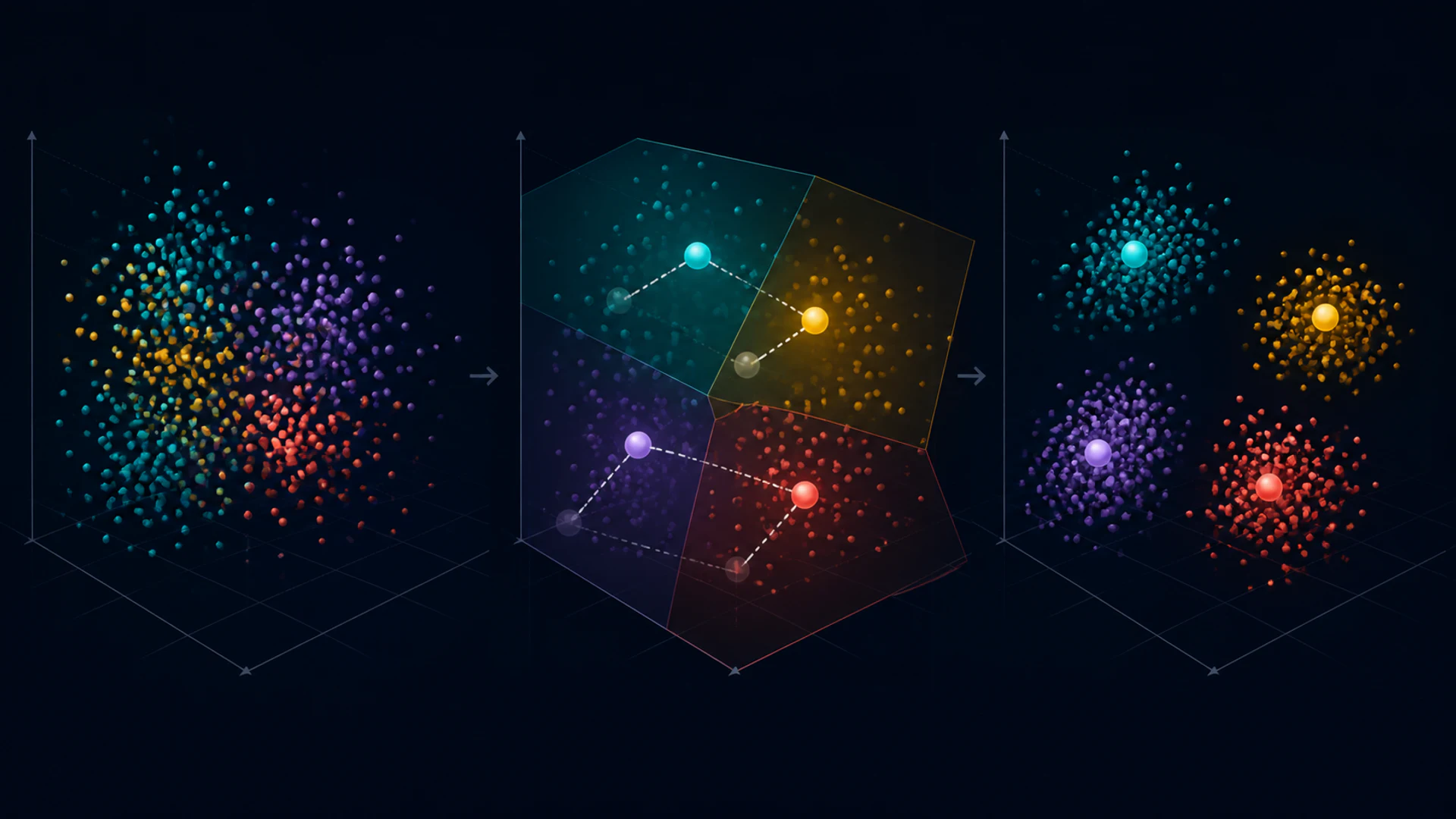
K-means is an unsupervised algorithm that partitions numeric observations into k clusters. It alternates between assigning each point to its nearest centroid and recomputing every centroid as the mean of its assigned points.
The algorithm is fast and useful, but its result is shaped by scaling, distance, initialization and the chosen k. A cluster is a mathematical partition, not automatically a real-world category.
Key takeaways
- K-means minimizes within-cluster squared Euclidean distance to centroids.
- Initialization matters; k-means++ spreads starting centroids and usually improves results.
- Standardize features when their units or scales should contribute comparably.
- K-means struggles with outliers, non-spherical clusters, unequal densities and categorical data.
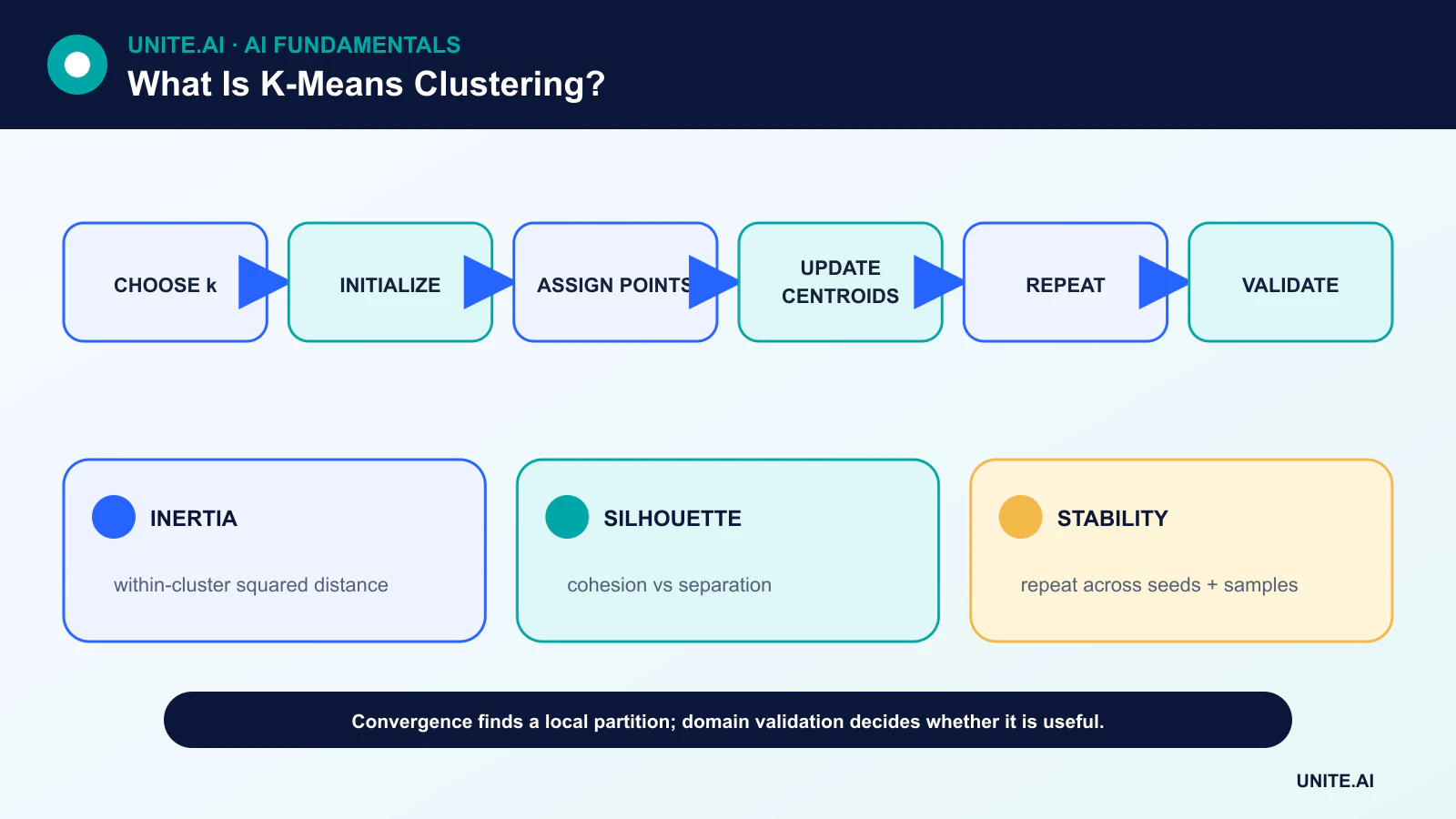
The objective and update loop
Given k centroids, the assignment step sends each observation to the nearest one. The update step replaces each centroid with the mean of its assigned observations. The within-cluster sum of squares cannot increase under these steps, so the process converges to a local optimum.
Convergence does not guarantee the global optimum. Different initial centroids can lead to different partitions, which is why implementations run several initializations and keep the solution with the lowest inertia.
Initialization and k-means++
Randomly choosing all starting centroids from one dense region can produce a poor solution or slow convergence. K-means++ chooses seeds with probability related to distance from existing seeds, encouraging coverage of the dataset.
Multiple runs remain useful. Record the random seed and number of initializations so results can be reproduced.
Scaling and distance
Squared Euclidean distance makes K-means sensitive to units. A feature measured in thousands can dominate another measured between zero and one. Standardization is common, but domain knowledge should decide whether equal standardized variance reflects equal importance.
Outliers can pull a mean far from typical points. Robust scaling, trimming or methods based on medoids may be better. One-hot categorical features create a distance geometry that may not match category similarity.
Choosing k and validating clusters
Inertia decreases whenever k increases, so it cannot select k alone. The elbow heuristic looks for diminishing improvement. Silhouette analysis compares cohesion and separation. Stability across samples and seeds adds another check.
The strongest validation is usefulness for the intended domain. Compare clusters with known outcomes, expert review or a downstream task without pretending that post-hoc labels were discovered objectively.
Limits and alternatives
K-means favors compact, roughly spherical groups of similar scale. Gaussian mixture models represent probabilistic ellipsoidal components; DBSCAN-style methods identify dense regions and noise; hierarchical clustering produces a tree of merges.
Dimensionality reduction can improve speed or denoise inputs, but fitting it on the full dataset may change the validation question. Mini-batch K-means reduces computation for large datasets at the cost of an approximate update.
Objective, initialization, and convergence
K-means partitions numeric observations into k clusters by minimizing within-cluster squared Euclidean distance to centroids. Lloyd’s algorithm alternates assigning each point to its nearest centroid and recomputing centroids until assignments or objective stabilize. It converges to a local optimum, not necessarily the global best. K-means++ initialization spreads initial centers and usually improves results, but multiple seeds remain important. Standardize features when units should contribute comparably because squared distance magnifies high-scale variables and outliers.
The method assumes roughly compact, spherical, similarly scaled clusters under Euclidean geometry. It struggles with elongated manifolds, unequal density, categorical data, heavy outliers, and nested structure. Empty clusters and duplicate points need defined handling. Mini-batch k-means scales to large data with an approximation tradeoff. For sparse text, cosine-oriented spherical k-means may better match direction, while mixtures, density methods, hierarchical clustering, or k-medoids encode other assumptions.
Choosing k and validating meaning
Elbow curves, silhouette scores, information criteria in related models, and stability can inform k, but none discovers a uniquely correct number. Business usefulness and domain interpretation matter. Refit across samples and seeds, compare centroid movement and assignment consistency, and validate clusters on independent outcomes not used to form them. A two-dimensional projection can distort separation, so examine distances and examples in original or validated representation space.
Clusters are descriptive groups created by the selected features and metric; they are not natural kinds or causal segments. Profiles based on the same variables used for clustering can be circular. Use held-out attributes and qualitative review, and inspect whether clusters primarily reproduce geography, data source, or sensitive traits. Small clusters may be anomalies or artifacts. Naming a cluster does not make every member fit the label.
Deployment and maintenance
Store scaling, feature order, centroids, distance definition, and cluster labels together. For new points, monitor distance to assigned centroid and the fraction far beyond training support; provide an unknown state instead of forcing every case into a cluster. Track cluster sizes, centroids, and outcome relevance over time. Retraining changes cluster identities, so map or version downstream rules rather than silently reusing old names. K-means is a useful compression and segmentation baseline when its geometry matches the question, not a universal discovery engine.
Worked example: customer segmentation with k-means
A subscription company standardizes usage features over a fixed window, removes account identifiers, and tests k across seeds. Stability, silhouette, and held-out business outcomes are reviewed, but product teams also inspect representative and boundary accounts. They discover one cluster is simply new customers with shorter observation, so tenure is handled explicitly. K-means is compared with hierarchical and density-based alternatives rather than assumed appropriate. The exercise is treated as unsupervised learning, not label discovery.
Segments guide research and messaging experiments, not eligibility or price. New accounts far from every centroid receive an unknown assignment. Scaling, features, centroids, and names are versioned, and retraining maps new clusters to old only with evidence. Monitoring tracks cluster size, distance, and outcome relevance. Sensitive attributes and proxies are audited, and the team avoids describing clusters as natural personality types when they are mathematical partitions of selected behavior.
Implementation evidence and operational readiness
A production decision needs more than a successful demonstration. Define the intended users, operating environment, inputs, outputs, dependencies, owner, and the consequence of each important failure. Establish a reproducible baseline and a versioned evaluation set before tuning. Test ordinary cases, boundary conditions, malformed or missing input, distribution shift, dependency outage, misuse, and the groups or environments most likely to be underserved. Measure task quality together with calibration or uncertainty, latency, throughput, resource cost, accessibility, privacy, and security. Record every transformation and threshold so an independent reviewer can reproduce the result and distinguish evidence from an attractive prototype.
Before launch, assign authority for release, exceptions, changes, rollback, and retirement. Use a staged rollout, preserve a safe fallback, and verify monitoring with deliberately injected failures. Operational telemetry should reveal input quality, output behavior, model or rule version, dependency health, human overrides, and confirmed outcomes without collecting unnecessary sensitive data. Define alert thresholds and a response owner, then review real-world evidence after deployment rather than assuming offline performance will persist. Reevaluate whenever data sources, users, models, vendors, policies, hardware, or objectives change. A maintained system also needs documented recovery, incident learning, deletion and retention procedures, and a clear point at which it should be disabled or replaced.
Frequently asked questions
Is K-means supervised or unsupervised?
It is unsupervised because it receives features and a chosen number of clusters, not target labels.
Does K-means classify new data?
After fitting, a new point can be assigned to its nearest centroid. That is cluster assignment, not necessarily supervised class prediction.
Primary references