AI Fundamentals
What is Explainable AI?

 Add Unite.AI to your preferred sources on Google

Explainable AI (XAI) comprises methods and practices that help people understand an AI system’s behavior or output. An explanation might describe influential inputs, show a similar example, present a counterfactual change, summarize a global rule or communicate when the system does not know.
No explanation is universally best. A developer debugging a model, an auditor testing policy compliance and a person affected by a decision need different evidence. Explanations must therefore be evaluated for accuracy, meaning and intended use—not only visual appeal.
Key takeaways
- Transparency describes available information; interpretability concerns meaning; explanation communicates evidence or reasons.
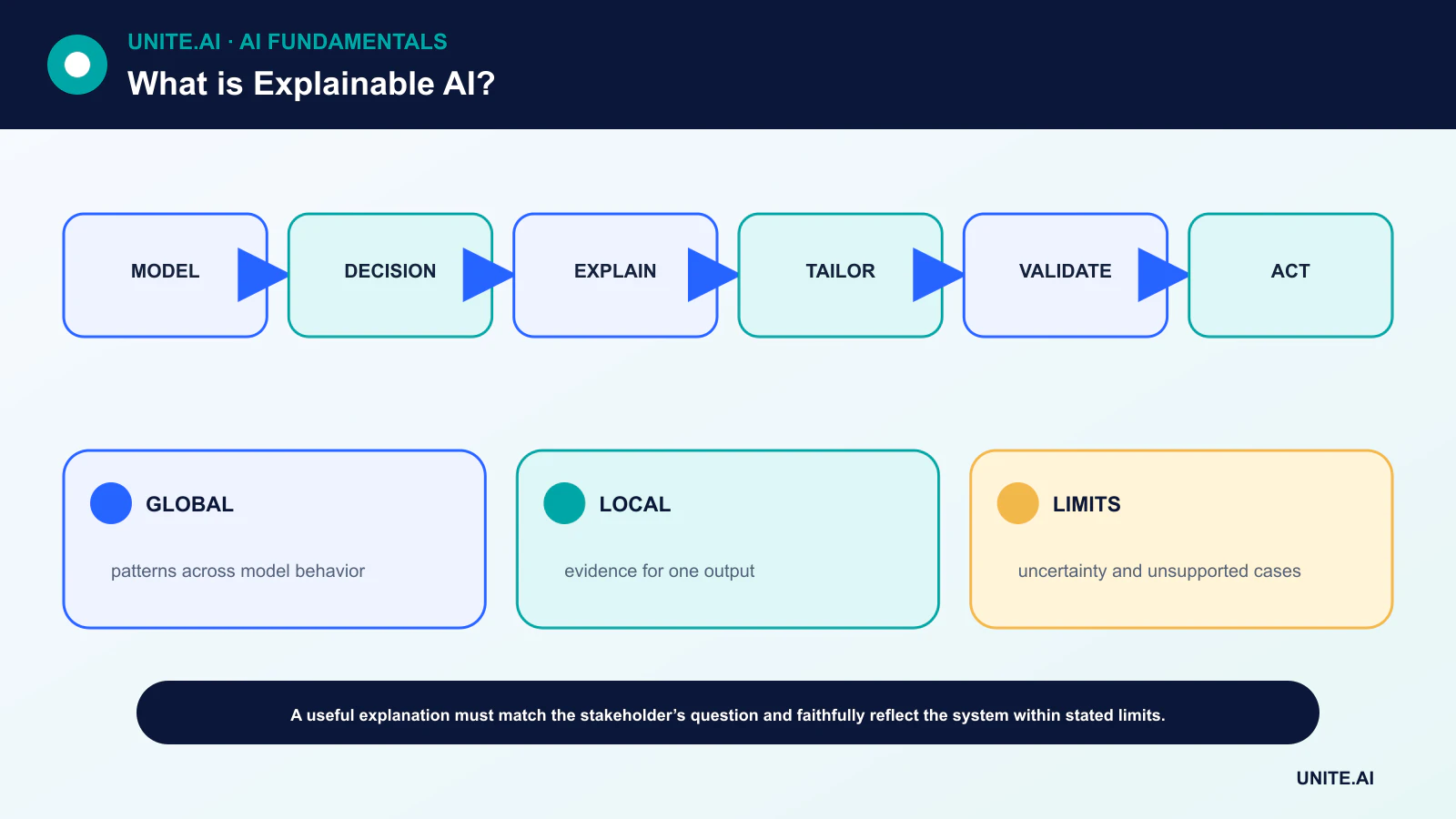
- Global methods summarize a model, while local methods address one prediction or small region.
- Post-hoc explanations can be useful but may be unstable or unfaithful to the underlying model.
- An explanation does not prove fairness, causality, robustness or correctness.
Four principles for useful explanations
NIST proposes that a system provide an explanation, make it meaningful to its intended user, ensure it accurately reflects the system’s process, and communicate its knowledge limits. These principles separate the existence of an explanation from its quality.
Meaning is audience-specific. A concise reason code may help an applicant, while a model developer may need distributions, feature behavior and failure clusters. Both should be connected to the same documented system and decision context.
Intrinsic and post-hoc methods
A sparse linear model or constrained decision tree can be directly interpretable within its valid scope. A complex model may instead use post-hoc feature attribution, a local surrogate, examples, saliency maps or counterfactuals.
Intrinsic simplicity is not automatically faithful when features are poorly defined or the pipeline is hidden. Post-hoc complexity is not automatically misleading. The method must be tested against the question it is intended to answer.
Feature attribution and correlated inputs
Attribution methods assign portions of an output to input features under explicit assumptions. LIME fits a simple local surrogate around a prediction; SHAP-related methods connect additive attributions to Shapley-value concepts.
Correlated features can share or exchange attribution, and a high attribution is not a causal effect. Changing a feature in isolation may create an impossible person, image or transaction. Explanations should state their baseline, sampling and dependence assumptions.
Counterfactuals, examples and global behavior
A counterfactual asks what feasible change would alter an outcome. Constraints are essential: an actionable explanation should not recommend immutable, illegal or unrealistic changes. Example-based methods show prototypes or influential training cases but can expose private data.
Global analysis examines performance, partial dependence, monotonicity, interactions and subgroup behavior. For ensembles such as gradient boosting, combine summaries with local evidence and direct tests of expected constraints.
Validate the explanation and the system
Test fidelity, stability under small perturbations, consistency across equivalent inputs, user comprehension and whether the explanation supports an appropriate decision. Adversarial tests should check whether a persuasive explanation can accompany a wrong or manipulated output.
XAI belongs inside broader evaluation: held-out quality, calibration, fairness, privacy, security, monitoring and appeal mechanisms. An explanation can support accountability, but it cannot substitute for accountable governance.
Explanation targets and method families
Explainable AI should begin with a question and audience: why one decision occurred, how the model generally behaves, what evidence influenced it, what would change the result, or whether a policy was followed. Local explanations address one prediction; global explanations summarize broader behavior. Intrinsically interpretable models expose coefficients, rules, or structures, while post-hoc methods approximate complex models. An explanation of model behavior is not automatically a causal explanation of the world or a justification that a decision is fair.
Feature attribution methods include gradients, integrated gradients, SHAP-style values, permutation, and local surrogate models. Example-based explanations retrieve influential or similar cases; counterfactuals propose changes associated with a different output; concept methods relate internal representations to human categories. Each has assumptions about baselines, feature independence, local linearity, or model access. Correlated variables, interactions, and preprocessing can make attributions unstable or misleading. Compare methods and perturb inputs to test whether an explanation predicts behavior.
Evaluation and human factors
Evaluate fidelity—whether the explanation matches the model—separately from plausibility to a person. Test stability, sensitivity, completeness, sparsity, and usefulness for a defined task such as debugging or appeal. Human studies need representative participants and should measure decision quality, error detection, reliance, and time, not whether users say a chart looks clear. A persuasive explanation can increase trust in a wrong model, so interfaces must show uncertainty, alternatives, and limitations.
Counterfactuals should be feasible, actionable, and not recommend changing protected or immutable traits. Explanations can leak model or personal information and help attackers reverse engineer decisions. Apply access controls and output minimization. For regulated or high-impact uses, retain data provenance, model version, threshold, and actual decision logic; a generic feature-importance graphic cannot replace a legally meaningful reason or human review.
Using explanations responsibly
Select the simplest model that meets performance and operational needs, but do not sacrifice validity for superficial interpretability. Combine explanations with subgroup testing, robustness checks, causal analysis where relevant, and outcome monitoring. Document intended audience and invalid inferences. If an explanation changes after a harmless perturbation, investigate before deployment. Explainability is evidence about a system under a method; it is valuable for debugging, oversight, and communication, but it does not certify truth, fairness, safety, or understanding.
Worked example: explaining a credit-risk model
A lender first defines the audience and required reason: applicants need accurate decision factors and a correction path, while developers need diagnostics. A calibrated interpretable baseline is compared with a boosted model. Local attributions, counterfactuals, and global error analysis are tested for fidelity, stability, correlated-feature behavior, and usefulness. Explanations cannot recommend changing age, disability, or another immutable trait, and they are not presented as causal effects.
The production decision record preserves source data, feature transformation, model, threshold, policy, and human action. Applicants can challenge incorrect data and receive a meaningful review. Monitoring checks outcome and explanation stability across groups and model updates. If a plausible explanation changes under harmless feature perturbation or omits a decisive policy rule, deployment stops. Explainability supplements validation and procedural rights; it does not excuse an invalid target, discriminatory outcomes, or lack of accountable human authority.
Implementation evidence and operational readiness
A production decision needs more than a successful demonstration. Define the intended users, operating environment, inputs, outputs, dependencies, owner, and the consequence of each important failure. Establish a reproducible baseline and a versioned evaluation set before tuning. Test ordinary cases, boundary conditions, malformed or missing input, distribution shift, dependency outage, misuse, and the groups or environments most likely to be underserved. Measure task quality together with calibration or uncertainty, latency, throughput, resource cost, accessibility, privacy, and security. Record every transformation and threshold so an independent reviewer can reproduce the result and distinguish evidence from an attractive prototype.
Before launch, assign authority for release, exceptions, changes, rollback, and retirement. Use a staged rollout, preserve a safe fallback, and verify monitoring with deliberately injected failures. Operational telemetry should reveal input quality, output behavior, model or rule version, dependency health, human overrides, and confirmed outcomes without collecting unnecessary sensitive data. Define alert thresholds and a response owner, then review real-world evidence after deployment rather than assuming offline performance will persist. Reevaluate whenever data sources, users, models, vendors, policies, hardware, or objectives change. A maintained system also needs documented recovery, incident learning, deletion and retention procedures, and a clear point at which it should be disabled or replaced.
Frequently asked questions
Are attention maps explanations?
They can be diagnostic signals, but attention weights alone are not guaranteed to faithfully represent the reasons for a model’s output.
Does explainable AI require a simple model?
Not always. Complex models can be analyzed with post-hoc methods, but those explanations need independent validation and clearly stated limits.
Primary references