AI Fundamentals
What Is Mechanistic Interpretability? How Researchers Analyze AI Models

 Add Unite.AI to your preferred sources on Google

Mechanistic interpretability studies how learned components inside a neural network causally produce behavior. Instead of only correlating inputs with outputs, researchers form hypotheses about features, attention heads, neurons, and circuits, then intervene to test those hypotheses.
The field has produced detailed explanations for selected behaviors in small and medium models, but a complete, faithful account of a frontier model remains out of reach. Automated explanations and attractive visualizations can be useful starting points, not proof.
Key takeaways
- Features are represented patterns; circuits are interacting components proposed to implement a computation.
- Activation patching, ablation, and causal tracing test whether a component changes a behavior.
- Superposition means one neuron can participate in many features; sparse autoencoders attempt a different feature basis.
- Interpretability methods need ground truth, falsifiable tests, coverage, and evaluation against alternative explanations.
From representation to mechanism
Probing asks whether information can be decoded from an activation. Attribution estimates which inputs or components matter. Mechanistic work goes further by proposing an internal computation and checking whether interventions change the expected intermediate and final behavior.
This makes it related to but narrower than explainable AI. A post-hoc explanation for one decision is not necessarily a reverse-engineered algorithm inside the model.
Circuits and causal interventions
Researchers may identify an attention head or feature associated with a task, ablate it, patch activations from another run, or trace how information moves across layers. A good hypothesis predicts behavior on new examples and survives controls.
Interventions can create off-distribution states, so a behavioral change does not automatically reveal the natural computation. Use multiple methods, matched controls, and quantitative effects rather than one illustrative prompt.
Superposition and sparse features
Neural networks can represent more features than individual dimensions by superimposing them. A neuron may therefore activate for several unrelated patterns, making neuron-level labels misleading.
Sparse autoencoders learn a larger dictionary of features from model activations. They can make patterns more separable, but the chosen sparsity, training data, reconstruction error, and automated labels affect what is recovered. Neural-network features still require causal validation.
Safety, debugging, and limitations
Mechanistic tools may help find memorized facts, bias, deceptive strategies, or failure circuits and may support editing or monitoring. The same tools can miss distributed, rare, or context-dependent computations.
Treat findings as scoped evidence: model version, task, dataset, layer, intervention, effect, and uncertainty. Connect interpretation to behavioral evaluations, red-teaming, and responsible-AI governance rather than using it as a blanket safety certificate.
Representations, circuits, and causal evidence
Mechanistic interpretability studies how internal computations produce model behavior. Researchers inspect activations, weights, attention, and intermediate features, then form hypotheses about representations and circuits. A representation is not necessarily stored in one neuron; it may be distributed across directions, layers, tokens, and context-dependent combinations.
Sparse autoencoders attempt to decompose dense activations into a larger set of features that activate selectively. Feature labels are human interpretations of observed examples, not ground truth. Reconstruction error, sparsity, feature splitting, absorption, and dead features affect what the decomposition reveals and what it misses.
Correlation is insufficient for a mechanistic claim. Activation patching, ablation, causal tracing, steering, and targeted weight interventions test whether a component changes behavior as predicted. Interventions can also create off-distribution states, so results need controls, dose-response analysis, alternative explanations, and replication across prompts and models.
A rigorous interpretability workflow
Start with a precisely measured behavior and a dataset that separates competing hypotheses. Localize relevant layers, positions, components, or features; inspect candidate mechanisms; intervene; and test whether the proposed circuit predicts new cases. Keep exploratory examples separate from confirmatory evaluation to reduce selection bias.
Automated tools can rank neurons, features, heads, or paths, while language models can propose descriptions. Automation increases coverage but can manufacture plausible stories. Score explanations on held-out activation examples and causal predictions, record uncertainty, and make artifacts reproducible with model version, tokenizer, prompts, and code.
Mechanisms may be polysemantic, redundant, nonlinear, and distributed. Removing one component can be compensated by others, while a feature can participate in several behaviors. Negative findings are informative: an apparent circuit that fails outside curated examples should be narrowed or rejected rather than rescued with an increasingly vague explanation.
Applications, limitations, and safety claims
Interpretability may help debug hallucination, bias, memorization, jailbreak behavior, or unexpected generalization; compare models; and generate scientific hypotheses. It can also identify features for monitoring or intervention. These uses require task-specific validation because a useful research visualization is not automatically a reliable production control.
Absence of a detected feature does not prove absence of a capability or intention, and a readable feature does not prove the model uses it in a given answer. Tools observe a projection of computation with limited coverage. Safety claims must specify detection sensitivity, false positives, distribution, adversary, and known blind spots.
Use interpretability alongside behavioral evaluations, red teaming, data governance, access controls, monitoring, and incident response. Publish methods and counterexamples when possible. The field is progressing quickly, but current techniques do not provide a complete, faithful explanation of frontier-model reasoning or a general guarantee of alignment.
Worked example: testing a proposed model circuit
Suppose a model appears to use a set of attention heads and features to resolve an indirect object in a sentence. Researchers define a controlled dataset with varied names, positions, distractors, and counterexamples, then measure the behavior. Activation inspection identifies candidate components, but the hypothesis is written before intervention: which information each component carries, where it moves, and how changing it should alter the output.
Activation patching and ablation test necessity and sufficiency across held-out examples. A targeted edit that changes the predicted token in the expected direction supports the mechanism; broad performance damage does not. Controls patch unrelated positions and components, vary intervention magnitude, and compare alternate circuits. The team publishes negative cases where the explanation fails and avoids assigning a human-readable purpose from correlation alone.
To claim a safety application, the method must detect the relevant behavior with known sensitivity under realistic prompts and adversarial adaptation. Feature monitors are evaluated for false positives, evasion, model updates, and causal relevance. Interpretability evidence can guide debugging and further tests, but enforcement remains in external controls and behavioral monitoring. A compelling circuit diagram is a scientific hypothesis with evidence—not a complete explanation of a model or a guarantee about unseen behavior.
Practical implementation checklist
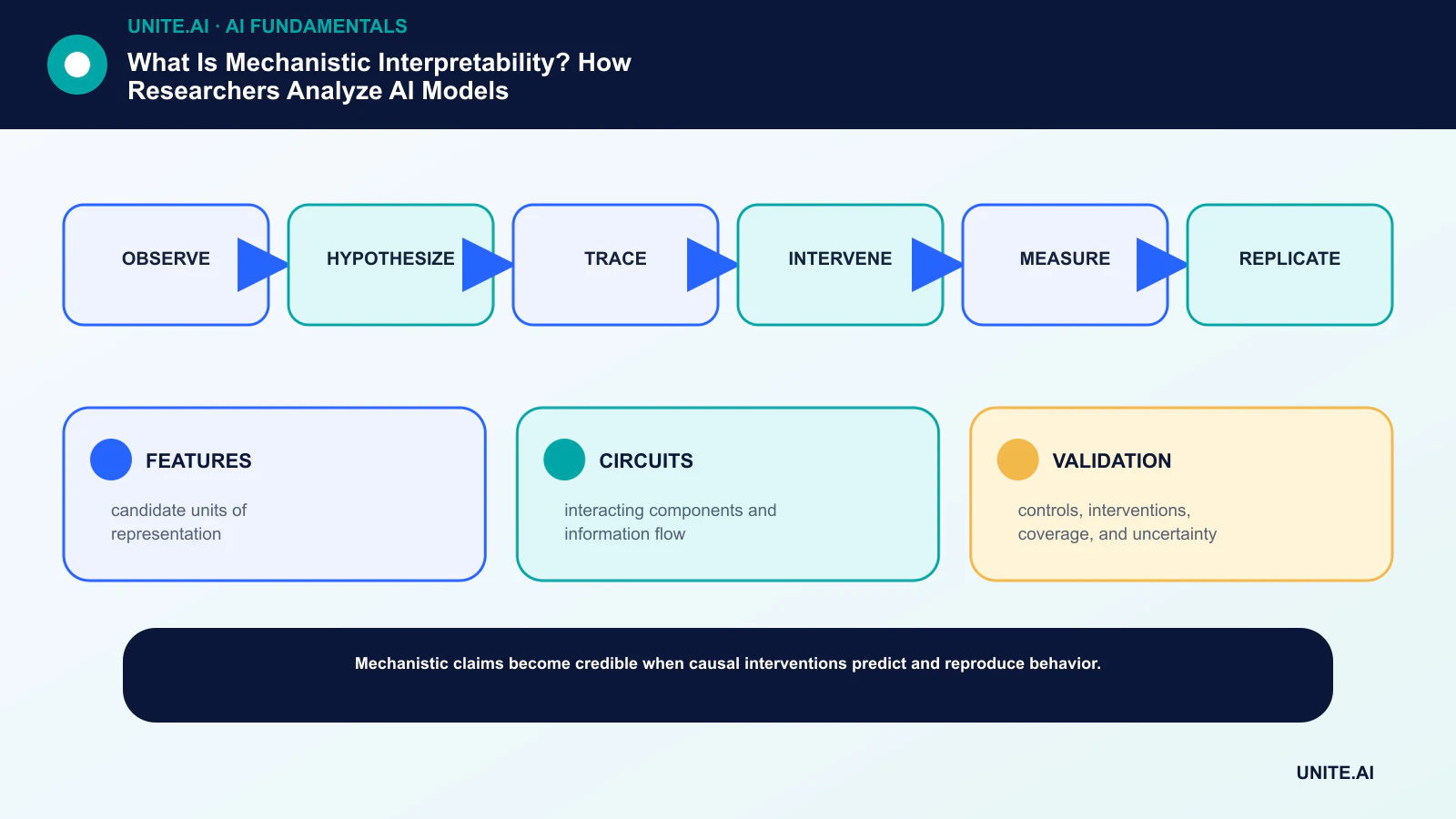
Turn the concept into a bounded, testable workflow: observe → hypothesize → trace → intervene → measure → replicate. Name an accountable owner, document the data and dependencies, establish a simple baseline, set acceptance and stop criteria, test representative failures, and define monitoring, rollback, and review before expanding scope. Record versions and assumptions so another team can reproduce the result and understand what changed.
Before launch, run a documented readiness review with the people who build, operate, secure, and are affected by the system. Test normal cases, boundary conditions, dependency failures, and misuse; preserve the evidence and unresolved risks. Define who can approve release, change a threshold, override an output, or stop operation. Revisit the decision after real-world data arrives, because a technically successful pilot does not guarantee reliable performance at broader scale.
- FEATURES: candidate units of representation.
- CIRCUITS: interacting components and information flow.
- VALIDATION: controls, interventions, coverage, and uncertainty.
Frequently asked questions
Is mechanistic interpretability the same as reading model weights?
No. Raw weights are not self-explanatory. Researchers analyze activations, features, components, and interventions to build and test causal hypotheses.
Can sparse autoencoders fully explain an LLM?
No. They offer a candidate feature basis and can support circuit analysis, but coverage, faithfulness, reconstruction, labeling, and scalability remain open problems.
Primary references