AI Fundamentals
What is AIOps? Artificial Intelligence for IT Operations

 Add Unite.AI to your preferred sources on Google
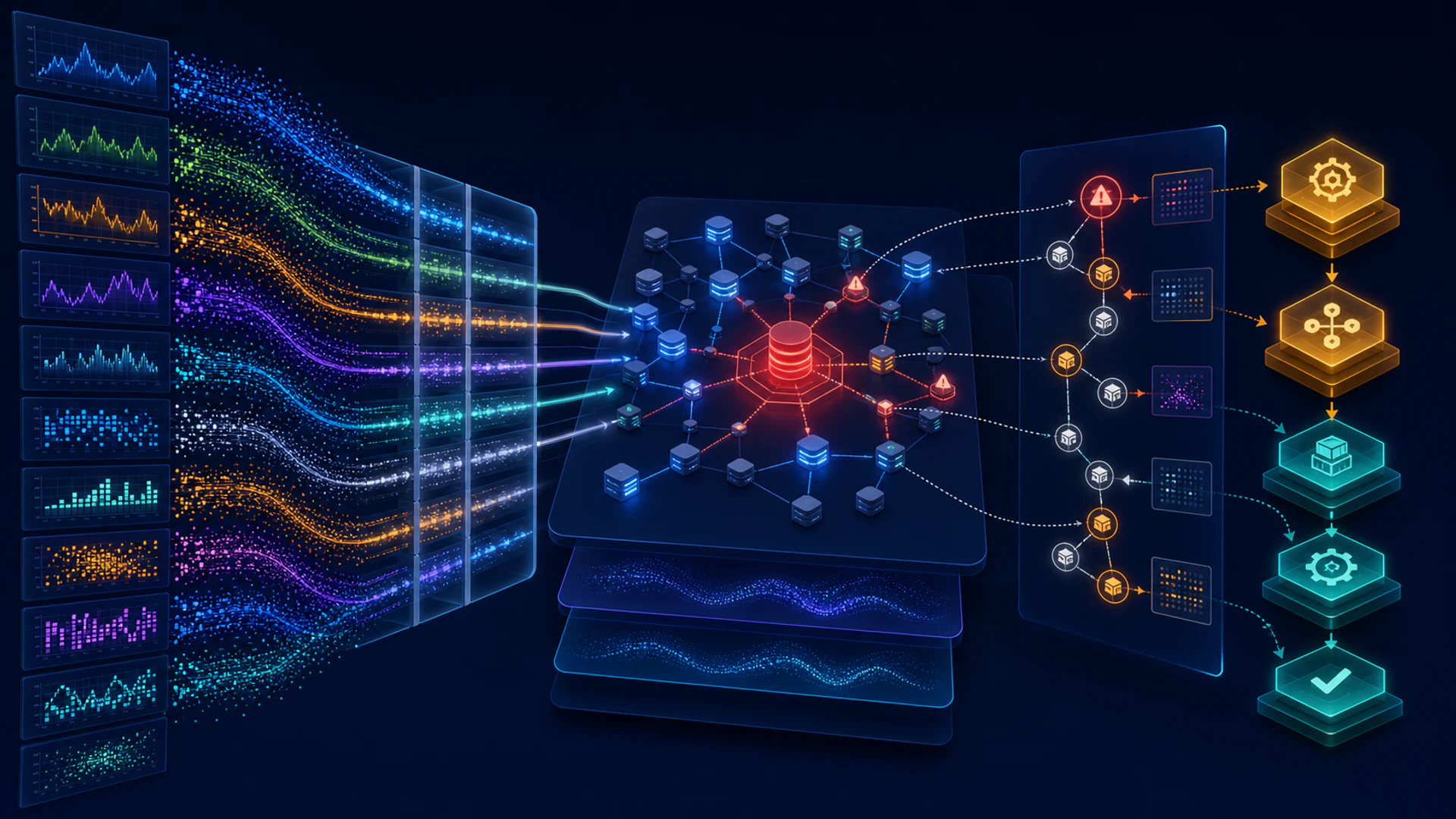
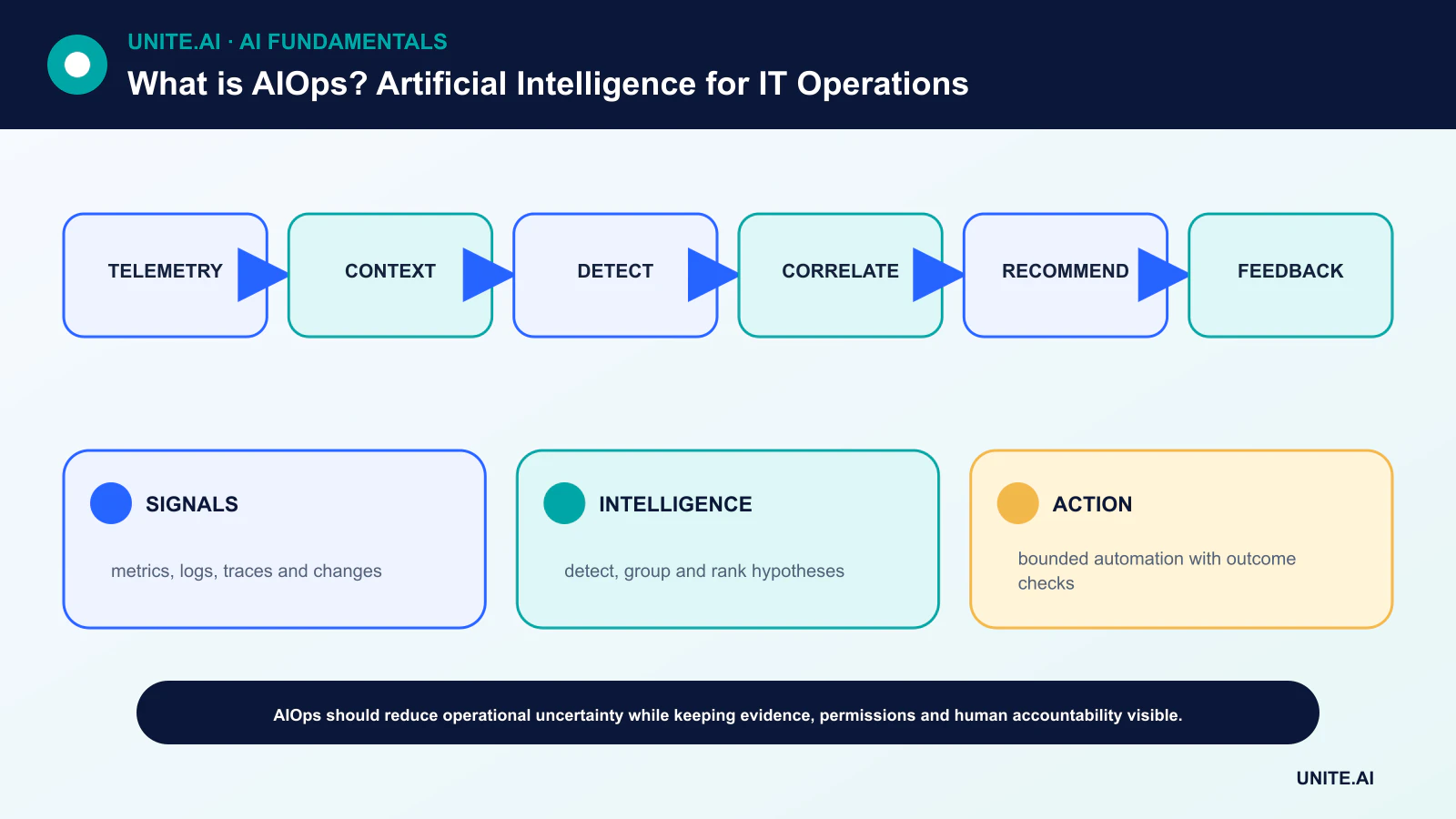
AIOps applies machine learning and automation to IT operations data so teams can detect unusual behavior, reduce duplicate alerts, connect related events, rank likely causes and recommend or execute response actions.
AIOps is not an autonomous replacement for operations. It is a layer inside an ITOps system, and its value depends on telemetry quality, service topology, change history, human feedback and safe automation boundaries.
Key takeaways
- Normalize events and add service context before applying sophisticated models.
- Anomaly detection identifies deviations, not necessarily failures or root causes.
- Correlation and probable-cause ranking should expose evidence and uncertainty.
- Automated remediation needs least privilege, approvals, canaries, rollback and outcome monitoring.
Build an operational data layer
AIOps platforms ingest metrics, logs, traces, alerts, tickets, topology, deployments and configuration changes. Timestamps, identifiers and service ownership must be reconciled so the system can connect signals that refer to the same incident.
Missing or inconsistent context causes false correlations. Data retention, access and privacy also matter because logs can contain credentials or personal information. Apply the same governance expected of other production data systems.
Detection and noise reduction
Static thresholds work for known limits; statistical and machine-learning methods can model seasonality or multivariate patterns. Deduplication groups repeated notifications, while suppression removes alerts that are not actionable under defined rules.
An anomaly is only a deviation from expected behavior. Planned releases, traffic campaigns and business cycles may be unusual but healthy. Evaluate precision, recall, detection delay and operator workload instead of celebrating the number of alerts removed.
Correlation and probable cause
Event correlation links symptoms across a dependency graph and time window. A probable-cause model can rank components or recent changes that might explain the incident. This prioritizes investigation; it does not establish causality.
Show contributing evidence, alternative hypotheses and confidence. Explainable AI is especially important when an operator must decide whether to isolate a service or roll back a deployment.
From recommendation to automation
A runbook can collect diagnostics, restart a stateless worker or scale capacity. Copilots can summarize incidents and retrieve procedures. Agents may plan tool calls, but production permissions should be narrow and actions should be validated against current state.
Begin with read-only recommendations. Promote mature actions through simulation, human approval, canaries and automatic rollback. Record the inputs, model version, authorization and result for every action.
Evaluation and operational feedback
Replay historical incidents without leaking their final labels into features. Test on new services and changes, measure false suppression, time to detect, time to mitigate, operator acceptance and recurrence. Compare against existing rules and simple baselines.
Drift occurs when architecture, traffic or response practices change. Close the loop by letting operators correct correlations and outcomes, then review whether the system reduces toil without hiding risk or creating automation complacency.
AIOps data and analytical pipeline
AIOps applies statistical and machine-learning methods to operations data such as metrics, logs, traces, events, topology, tickets, and changes. The pipeline collects and normalizes signals, enriches them with service and ownership context, detects anomalies, correlates related events, estimates likely causes, and recommends or triggers action. Quality depends on timestamps, identifiers, topology, and change records. A sophisticated model cannot reliably correlate alerts that refer to the same service under inconsistent names.
Anomaly detection learns baselines by service, season, and operating state; static thresholds may be better for known safety limits. Event correlation groups symptoms into an incident using time, topology, text, and historical patterns. Root-cause ranking proposes hypotheses but can confuse the first observed failure with the true cause or miss a shared dependency absent from topology. Natural-language summaries can assist responders but must link to raw evidence and state uncertainty.
Automation, evaluation, and feedback
Start with decision support and low-risk reversible remediation. Every automated action needs authorization, preconditions, bounded scope, timeout, postcondition verification, rollback, and an audit trail. The model must not grant itself credentials or treat log text as trusted instructions. Human responders should accept, reject, or correct recommendations, and those outcomes should update rules or training data through review rather than uncontrolled self-learning.
Evaluate alert reduction without missing incidents, detection lead time, correlation precision, root-cause ranking, remediation success, recovery time, recurrence, and responder workload. Use historical replay and injected faults, but account for incomplete incident labels. Measure by service and incident type; an average can hide dangerous failures in rare critical systems. Compare with deterministic rules and improved observability before adding AI complexity.
Governance and failure modes
AIOps can amplify telemetry gaps, automate a wrong diagnosis, or create correlated fleet-wide actions. Isolate environments, limit concurrency, maintain a kill switch outside the model, and rehearse failure of the AIOps platform itself. Protect logs and tickets that contain secrets or personal data. Monitor model drift, topology freshness, false actions, and overrides. AIOps supports reliable operations when it makes evidence and bounded action faster; it is not an autonomous replacement for service ownership, incident command, or engineering judgment.
Worked example: AIOps for a payment incident
AIOps groups a surge of API errors, database saturation, and regional alerts into one incident and enriches it with a recent deployment, topology, and owner. It ranks the deployment as a likely contributor but exposes raw telemetry and alternatives. A deterministic policy pauses further rollout; a human incident commander approves traffic shift after checking that capacity and data consistency are safe.
The system measures grouping precision, detection lead time, ranking accuracy, responder acceptance, recovery, and false remediation in historical replay and game days. All automated actions have limits, idempotency, postcondition checks, and rollback. Logs are sanitized and malicious text cannot become a command. After the incident, confirmed cause and action outcomes update reviewed rules and evaluation data. The AIOps platform assists evidence and coordination; it never replaces incident command or external authorization.
Implementation evidence and operational readiness
A production decision needs more than a successful demonstration. Define the intended users, operating environment, inputs, outputs, dependencies, owner, and the consequence of each important failure. Establish a reproducible baseline and a versioned evaluation set before tuning. Test ordinary cases, boundary conditions, malformed or missing input, distribution shift, dependency outage, misuse, and the groups or environments most likely to be underserved. Measure task quality together with calibration or uncertainty, latency, throughput, resource cost, accessibility, privacy, and security. Record every transformation and threshold so an independent reviewer can reproduce the result and distinguish evidence from an attractive prototype.
Before launch, assign authority for release, exceptions, changes, rollback, and retirement. Use a staged rollout, preserve a safe fallback, and verify monitoring with deliberately injected failures. Operational telemetry should reveal input quality, output behavior, model or rule version, dependency health, human overrides, and confirmed outcomes without collecting unnecessary sensitive data. Define alert thresholds and a response owner, then review real-world evidence after deployment rather than assuming offline performance will persist. Reevaluate whenever data sources, users, models, vendors, policies, hardware, or objectives change. A maintained system also needs documented recovery, incident learning, deletion and retention procedures, and a clear point at which it should be disabled or replaced.
Frequently asked questions
Is AIOps the same as observability?
No. Observability supplies and explores system signals; AIOps uses analytics and automation over those signals. Each can exist without the other.
Can AIOps determine root cause automatically?
It can rank hypotheses and collect evidence, but causal claims require topology, change context and validation. Many incidents have interacting causes.
Primary references