AI Fundamentals
What Is Platform Engineering? Platforms, Developer Experience, and Guardrails

 Add Unite.AI to your preferred sources on Google

Platform engineering is the practice of building and operating shared internal capabilities that help software teams deliver and run applications through supported self-service workflows. The platform is treated as a product whose users are developers and other technical teams.
A platform is not automatically a portal, Kubernetes cluster, or collection of scripts. It becomes useful when it reduces cognitive load and lead time while improving reliability, security, observability, and organizational consistency.
Key takeaways
- Start with developer research and recurring friction, not a predetermined tool stack.
- Offer optional, supported golden paths with clear escape routes for legitimate exceptions.
- Expose capabilities through APIs, templates, automation, and documentation; a portal is only one interface.
- Measure user outcomes and product adoption together with delivery, reliability, security, and cost.
Platform as an internal product
A platform team identifies internal users, journeys, pain points, and desired outcomes. It maintains a roadmap, service levels, documentation, support, and feedback loops like any product team. Adoption is earned by usefulness, not mandated by naming a central team.
This extends DevOps cooperation. Application teams retain ownership of their services while the platform provides reusable capabilities and policy.
Capabilities, portals, and golden paths
Capabilities may cover repositories, environments, CI/CD, secrets, identity, infrastructure, observability, service catalogs, cost, and incident integration. A developer portal can expose them, but orchestration and operating services make the platform real.
A golden path is a well-supported way to accomplish a common task. It should encode secure defaults and remain transparent. Teams need a governed exception path when requirements differ.
Architecture and guardrails
Use stable interfaces and declarative APIs so the platform can evolve behind them. Separate control plane from workloads, scope credentials, preserve ownership metadata, and make generated changes reviewable and reversible.
Integrate DevSecOps checks, policy, and artifact provenance into workflows. Guardrails should provide fast feedback and actionable remediation rather than unexplained denials.
Measure and evolve
Measure time to first deployment, lead time, failed-change recovery, platform availability, support burden, adoption, satisfaction, security posture, and cost. Avoid counting portal logins as a proxy for improved delivery.
Instrument the platform through IT operations practices and interview users regularly. Retire unused paths, standardize where repetition is costly, and allow diversity where it creates product value.
Internal developer platforms and golden paths
An internal developer platform is a product that exposes approved infrastructure and operational capabilities through self-service interfaces. It may combine a portal, service catalog, templates, APIs, command-line tools, deployment workflows, secrets, environments, and observability. The platform does not replace cloud or Kubernetes; it organizes them into usable capabilities.
A golden path is an opinionated, supported way to complete a common task, such as creating a service with a repository, CI pipeline, runtime, dashboards, alerts, and ownership metadata. It should be the easiest safe option while permitting justified exceptions. A mandatory path that cannot support real workloads becomes a bottleneck or is bypassed.
Platform teams should treat developers as customers and capabilities as products. Discovery interviews, usage analytics, support data, roadmaps, documentation, and service-level objectives matter as much as automation. Adoption is evidence of usefulness, but adoption alone does not prove that delivery, reliability, security, or developer experience improved.
Control planes, interfaces, and operating model
The platform control plane reconciles a developer’s declared intent with underlying resources. A service definition might request a runtime, database, region, and reliability tier; controllers translate that into cloud, network, policy, and observability configuration. Stable abstractions should hide incidental complexity without concealing operational state needed for debugging.
Interfaces can include web portals, APIs, Git-based configuration, CLIs, and reusable pipeline components. The best interface depends on task frequency and user workflow. Every interface needs authentication, authorization, validation, audit history, error explanations, and versioning. Self-service without lifecycle management produces abandoned resources and configuration sprawl.
A platform team owns shared capabilities and paved roads, while application teams retain responsibility for software behavior and business outcomes. Security, reliability, finance, and infrastructure teams contribute policies and services. Explicit responsibility boundaries prevent the platform from becoming either an unaccountable ticket queue or an attempt to centralize every engineering decision.
Measuring value and avoiding platform failure
Measure lead time to a first production deployment, environment provisioning time, deployment frequency, change failure rate, recovery time, cognitive load, support volume, reliability, and security control adoption. Segment results by team and workload. A faster template launch has limited value if day-two changes remain slow or incidents become harder to diagnose.
Common failures include building before understanding users, copying a large company’s stack, exposing raw infrastructure behind a portal, forcing premature standardization, and optimizing for the platform team’s output. Start with one painful recurring journey, map its steps and waits, deliver a thin end-to-end path, and iterate using observed outcomes.
Platforms must evolve without destabilizing every service. Use versioned contracts, deprecation windows, automated migrations, compatibility tests, and clear ownership. Track platform dependencies so a control-plane outage does not block all deployments or damage running workloads. Document break-glass procedures and regularly test recovery from platform failure.
Worked example: a self-service path for a new API
A developer selects an approved API template and supplies service name, owner, data classification, language, and reliability tier. The platform creates a repository, dependency policy, CI pipeline, test environment, deployment configuration, service catalog entry, dashboards, alerts, and an initial runbook. Policy validates names, regions, permissions, and network exposure before provisioning, while the generated artifacts remain inspectable and owned by the team.
The platform exposes lifecycle operations—create environment, deploy, scale, rotate a secret, view logs, roll back, and retire—through stable APIs and a portal. Running workloads continue if the portal is unavailable. Exceptions use a documented extension point and expiry rather than an untracked manual change. Versioned templates and automated migrations prevent platform improvements from silently breaking existing services.
Measure time from repository creation to a healthy production deployment, developer effort, support demand, change failure, recovery, policy compliance, and adoption by workload type. Interview users who abandon the path and inspect where they wait or escape the abstraction. The platform team should prioritize the largest recurring friction, publish reliability and roadmap, and retire unused capabilities. A polished catalog is not a platform if teams still need tickets for every meaningful operation.
Adoption should be staged. Start with volunteer teams and one workload class, prove day-two operations, then migrate with tooling and support. Publish the platform’s service objectives and dependency status, and design a break-glass route that is controlled but usable during outages. Chargeback or showback can expose resource cost, but product teams also need sensible defaults so financial governance does not become another manual approval queue.
Practical implementation checklist
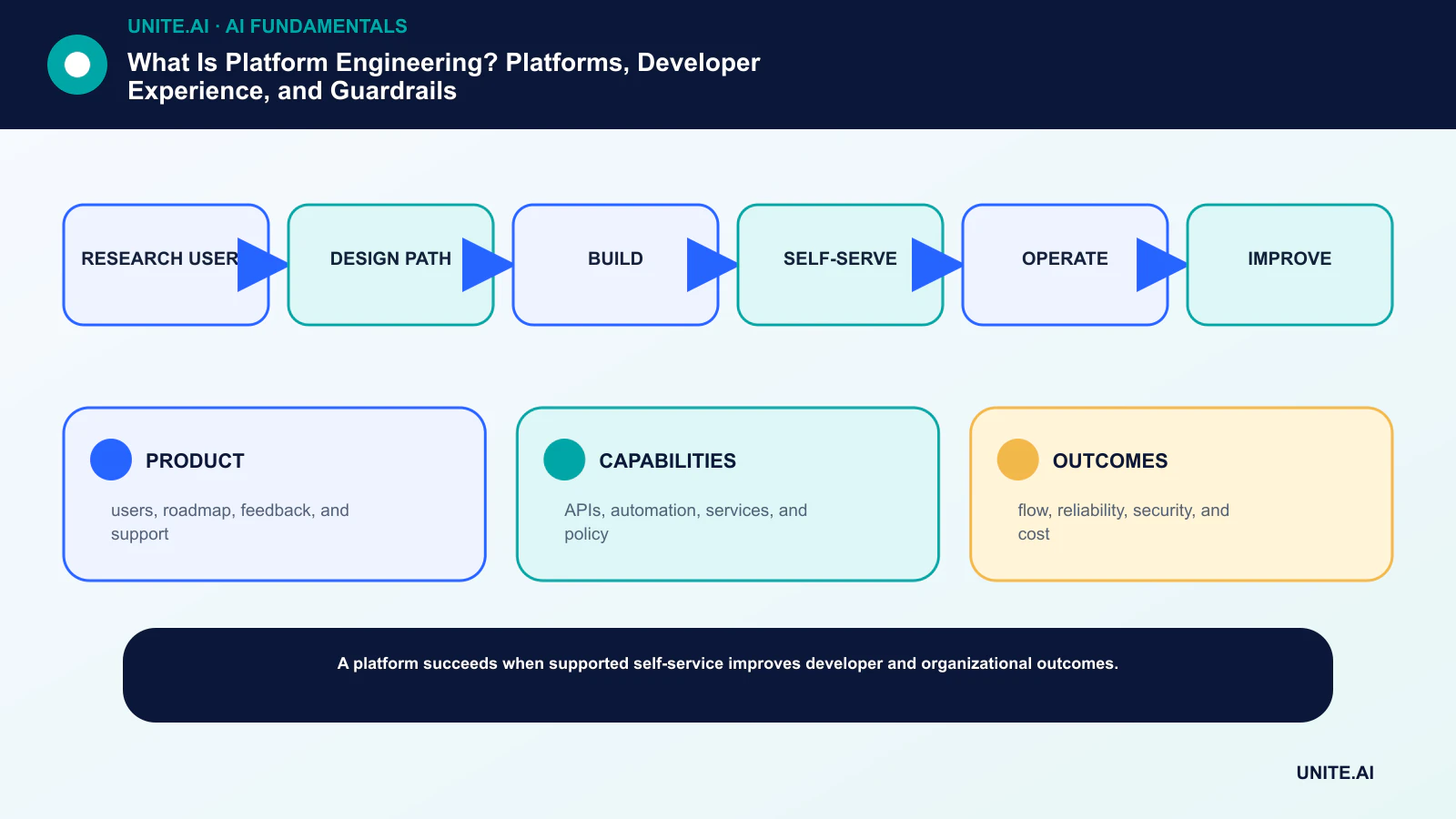
Turn the concept into a bounded, testable workflow: research users → design path → build → self-serve → operate → improve. Name an accountable owner, document the data and dependencies, establish a simple baseline, set acceptance and stop criteria, test representative failures, and define monitoring, rollback, and review before expanding scope. Record versions and assumptions so another team can reproduce the result and understand what changed.
Before launch, run a documented readiness review with the people who build, operate, secure, and are affected by the system. Test normal cases, boundary conditions, dependency failures, and misuse; preserve the evidence and unresolved risks. Define who can approve release, change a threshold, override an output, or stop operation. Revisit the decision after real-world data arrives, because a technically successful pilot does not guarantee reliable performance at broader scale.
- PRODUCT: users, roadmap, feedback, and support.
- CAPABILITIES: APIs, automation, services, and policy.
- OUTCOMES: flow, reliability, security, and cost.
Frequently asked questions
Is platform engineering replacing DevOps?
No. Platform engineering is one way to scale DevOps principles by providing shared products and self-service capabilities. Collaboration and service ownership remain essential.
Is an internal developer portal the platform?
Usually not. A portal is an interface. The platform also includes APIs, automation, infrastructure, policies, services, documentation, support, and operating ownership.
Primary references