AGI & Future AI
What is the Turing Test and Why Does it Matter?

 Add Unite.AI to your preferred sources on Google

The Turing test grew from Alan Turing’s 1950 paper “Computing Machinery and Intelligence.” Instead of trying to define thought, Turing proposed an imitation game: a human interrogator exchanges written messages with unseen participants and judges which is human and which is a machine.
The test remains influential because it turns an abstract philosophical question into an observable interaction. It is also limited: appearing human in a conversation is not the same as being truthful, knowledgeable, safe, conscious or generally intelligent.
Key takeaways
- Turing’s original imitation game is a text-based behavioral test, not a checklist of internal cognitive properties.
- Results depend on the evaluator, prompt, duration, participant instructions and scoring rule.
- A model can imitate human conversation while hallucinating facts or failing on simple robustness tests.
- Modern evaluation needs task metrics, adversarial testing, human review and risk-specific evidence in addition to conversation.
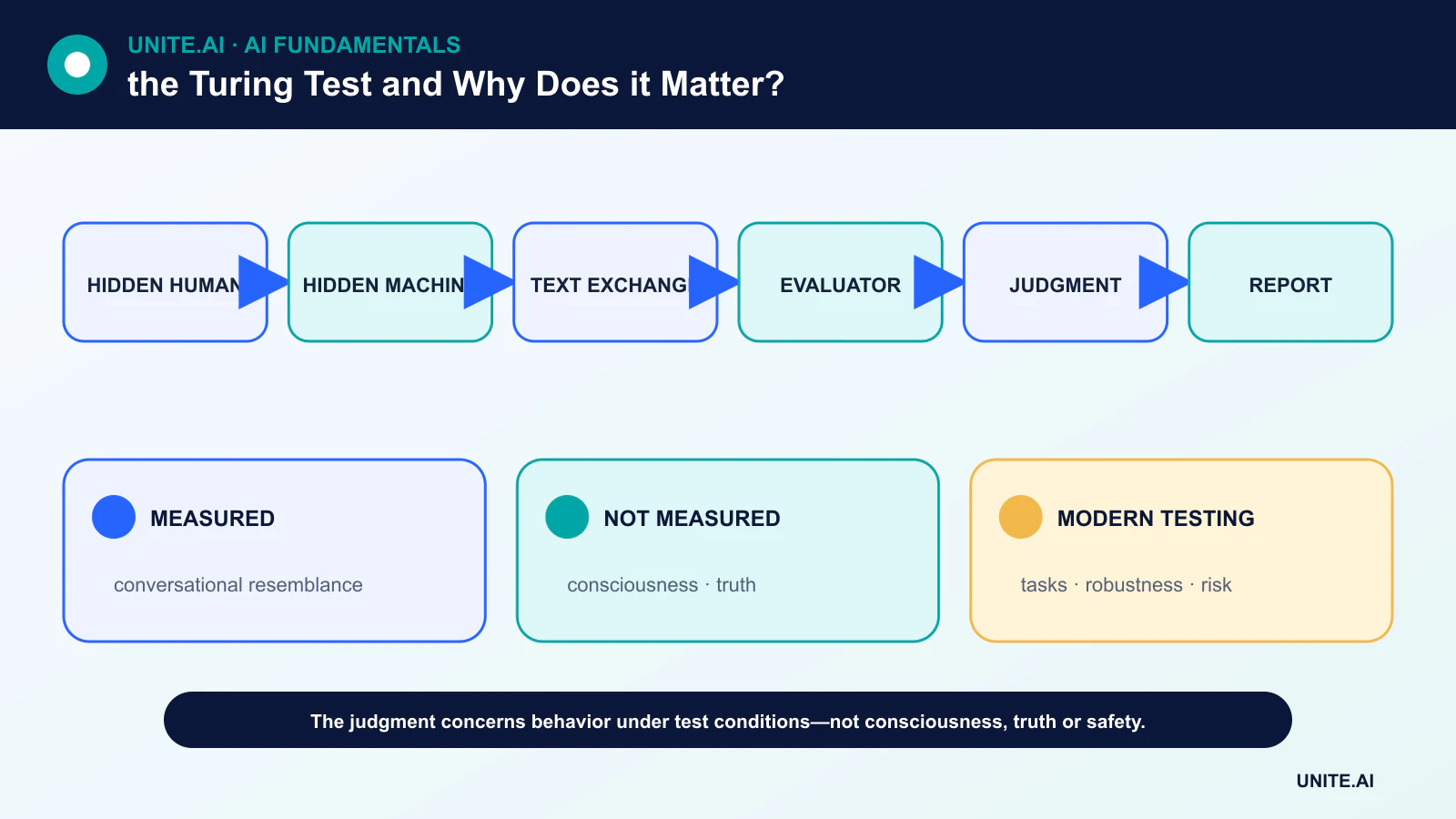
Turing’s imitation game
In the original setup, an interrogator communicated at a distance so voice and appearance would not reveal identity. Turing asked whether a machine could perform well enough in the game that an evaluator could not reliably distinguish it from a person.
This operational framing avoided the need to settle one definition of thinking. It did not claim that every convincing exchange proves intelligence, nor did it specify a universal pass threshold that applies to any later chatbot demonstration.
What a result actually measures
A trial measures behavioral indistinguishability under defined conditions. Short conversations, inexperienced judges or prompts chosen by the system builder can make the task easier. A rigorous report should disclose the transcript selection, number and background of judges, comparison humans, time limit and statistical method.
A system may also exploit expectations: evasiveness, humor, typographical errors and role-play can appear human without demonstrating reliable reasoning. Conversely, an unusually formal human response can be misclassified as machine-generated.
What the Turing test does not establish
The test does not directly measure consciousness, subjective experience, factual accuracy, causal understanding or moral agency. It does not reveal the training data, model architecture or failure modes outside the conversation. It also says little about non-linguistic intelligence such as physical manipulation.
Modern language systems are built with transformer neural networks and deep learning, but their fluent outputs can still be generated from learned statistical structure rather than a verified world model.
How modern AI evaluation expands the question
Contemporary evaluation uses held-out task sets, calibrated uncertainty, robustness tests, red teaming, factuality checks and human preference studies. A text-classification metric can test a defined behavior, while scenario-based evaluation can test whether a system follows policy under pressure.
No single benchmark captures every deployment. Test contamination can inflate scores, and static benchmarks encourage overfitting. Evaluation should be repeated as models, data, prompts, tools and user populations change.
Why the test still matters
The Turing test anticipated a core lesson of AI evaluation: assess observable capability rather than relying on claims about an internal essence. It also forces us to ask which human behaviors count as evidence and how an experimental setup shapes a conclusion.
Its best modern use is as a historical and conceptual baseline. Passing an imitation game can be interesting, but deployment decisions require evidence tied to the actual task, affected users and foreseeable harms.
What the Turing Test measures
Alan Turing’s imitation game asked whether an interrogator communicating through text could reliably distinguish a machine from a person. It reframed an abstract debate about whether machines think into an observable conversational experiment. The test depends on participants, duration, protocol, topics, and judging rule; there is no single universal score. Passing means producing human-like responses under that setup. It does not directly measure factual accuracy, reasoning, consciousness, autonomy, perception, embodiment, reliability, or beneficial real-world behavior.
Human imitation can reward evasion, persona, mistakes, humor, or manipulation. A judge may mistake a human for a machine or be influenced by expectations, language, and cultural context. Short conversations enable tricks that fail over sustained interaction. Conversely, a highly useful system for mathematics, translation, or protein modeling might fail because it does not pretend to be human. The test therefore measures a social and linguistic capability shaped by the evaluator, not a complete ordering of intelligence.
Modern language models and stronger evaluation
Large language models can sustain fluent dialogue by predicting sequences from broad training data and later tuning, but fluency is weak evidence of truth or understanding. Memorized patterns, tool access, hidden prompting, latency, and sampling settings affect results. Controlled evaluations should disclose model and protocol, prevent information leakage, include adversarial and domain questions, and score uncertainty and citation. A demonstration selected from successful conversations cannot estimate reliability across the distribution of use.
Modern evaluation is multidimensional: task accuracy, calibration, robustness, long-horizon consistency, safety, bias, privacy, security, efficiency, and human outcomes. Behavioral tests should be complemented by process evidence, red teaming, reproducible benchmarks, and real-world monitoring. Benchmarks can saturate or enter training data, so private and refreshed test sets are needed. For systems that act, evaluate tool permissions, recovery, and consequences separately from conversation quality.
Why the test still matters
The Turing Test remains historically important because it centers behavior and the difficulty of defining intelligence. It also raises continuing questions about anthropomorphism and deception. Interfaces should identify synthetic agents rather than treat mistaken identity as success, especially in consequential settings. Use the test as a philosophical lens and one conversational evaluation, not a certification of general intelligence or personhood. The important deployment question is what the system can reliably do, under what evidence and limits, and who is accountable when it fails.
Worked example: a controlled conversational evaluation
Evaluators compare humans and several AI systems in text conversations with fixed duration, topics, language, and blinded identities. Judges record whether they believe each participant is human and also score factuality, consistency, helpfulness, uncertainty, and manipulation. Multiple judges and conversations estimate variation, and the protocol prevents model developers from selecting favorable transcripts. Human misclassification provides a necessary baseline for interpreting the result.
A system that fools judges but invents facts is not declared generally intelligent, while a clearly disclosed specialist model may be highly useful despite failing imitation. Results include prompt, model, sampler, tool access, and judge characteristics. The experiment is framed as one test of human-like conversation. Deployment decisions use separate evidence for task correctness, safety, privacy, and recovery, and the interface identifies the agent rather than turning deception into the product objective.
Implementation evidence and operational readiness
A production decision needs more than a successful demonstration. Define the intended users, operating environment, inputs, outputs, dependencies, owner, and the consequence of each important failure. Establish a reproducible baseline and a versioned evaluation set before tuning. Test ordinary cases, boundary conditions, malformed or missing input, distribution shift, dependency outage, misuse, and the groups or environments most likely to be underserved. Measure task quality together with calibration or uncertainty, latency, throughput, resource cost, accessibility, privacy, and security. Record every transformation and threshold so an independent reviewer can reproduce the result and distinguish evidence from an attractive prototype.
Before launch, assign authority for release, exceptions, changes, rollback, and retirement. Use a staged rollout, preserve a safe fallback, and verify monitoring with deliberately injected failures. Operational telemetry should reveal input quality, output behavior, model or rule version, dependency health, human overrides, and confirmed outcomes without collecting unnecessary sensitive data. Define alert thresholds and a response owner, then review real-world evidence after deployment rather than assuming offline performance will persist. Reevaluate whenever data sources, users, models, vendors, policies, hardware, or objectives change. A maintained system also needs documented recovery, incident learning, deletion and retention procedures, and a clear point at which it should be disabled or replaced.
Frequently asked questions
Has any AI definitively passed the Turing test?
There is no single official test authority or universally accepted protocol. Public demonstrations use different rules, so “passed” claims are not directly comparable.
Does failing the test prove a system is unintelligent?
No. A specialized system can be highly capable without imitating a human conversational style.
Primary references