AI Fundamentals
What is IT Operations (ITOps)?

 Add Unite.AI to your preferred sources on Google

IT operations (ITOps) is the work of running the technology services an organization depends on. It covers compute, networks, identity, endpoints, cloud platforms, databases, storage, backups and the operational processes that keep those components available, secure and supportable.
Modern ITOps is not limited to a network operations center watching dashboards. Teams increasingly manage software-defined infrastructure, platform services, automation and distributed ownership while retaining accountability for incidents, capacity, continuity and service levels.
Key takeaways
- ITOps manages services and their dependencies across on-premises, cloud and edge environments.
- Observability, configuration and inventory provide the context needed to interpret failures.
- Incident management restores service; problem management addresses recurring or systemic causes.
- ITOps overlaps with ITSM, SRE, DevOps, SecOps and AIOps but is not identical to any one of them.
Services, assets and configuration
Operations begins with knowing which services exist, who owns them, what users depend on them and which infrastructure supports them. Asset inventory records components; configuration management records relevant relationships and controlled state.
An inventory that is never reconciled becomes misleading. Automate discovery where useful, identify authoritative sources and record confidence or freshness instead of pretending every dependency map is complete.
Observability and service objectives
Metrics quantify behavior, logs record events and traces follow work across services. Synthetic checks can test a user journey. Useful observability starts with questions and service objectives, then collects the signals needed to answer them.
Alerting should identify conditions that require timely action. Thresholds without user impact create noise, while missing dependency context slows diagnosis. AIOps can assist correlation, but it needs trustworthy telemetry and operational feedback.
Incident, problem and change management
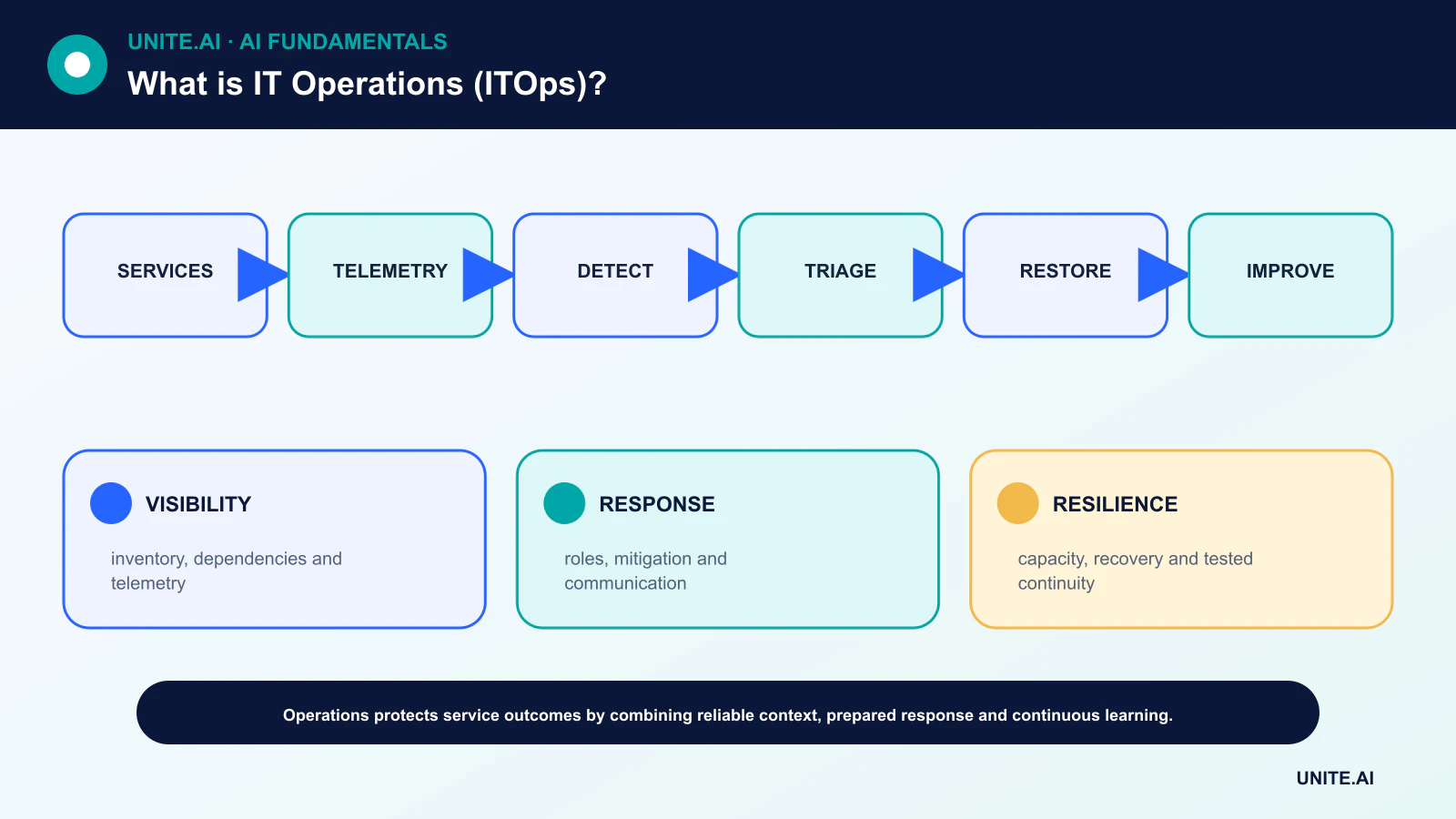
Incident management coordinates detection, triage, mitigation, communication and recovery. Clear roles reduce confusion under pressure. A temporary workaround can restore service while a later problem investigation addresses deeper causes.
Change management evaluates and records risk without turning every change into a queue. Standard, automated and low-risk changes can follow preapproved paths; high-impact changes require stronger evidence, scheduling and rollback preparation.
Capacity, resilience and continuity
Teams forecast resource demand, remove bottlenecks and test behavior under load. Backups are useful only when restoration is tested. Redundancy helps only when failure modes are independent and failover actually works.
Business continuity defines priorities, recovery time and acceptable data loss. Dependencies on identity, DNS, cloud control planes and vendors should be included in exercises rather than assumed available.
ITOps, ITSM, SRE and DevOps
IT service management supplies processes for aligning services with organizational needs. Site reliability engineering applies software engineering to operations and uses service-level objectives and error budgets. DevOps joins development and operations feedback.
SecOps focuses on threats and response, while ITOps maintains broader service health. Organizational charts differ; the important requirement is explicit ownership and shared evidence across these disciplines.
The ITOps operating model
IT operations keeps the organization’s technology services available, performant, secure, and recoverable. Scope commonly includes endpoints, identity, networks, servers, cloud, storage, collaboration, databases, monitoring, service desk, backup, and vendor services. Modern ITOps spans owned infrastructure and managed platforms, so responsibility must be explicit even when operation is outsourced. A configuration or service inventory connects technical components to owners, users, dependencies, data classification, and business criticality.
Service management organizes incidents, requests, problems, changes, assets, knowledge, and service levels. Incident management restores service; problem management investigates recurring causes; change enablement assesses and coordinates risk. Treating every change as a slow approval creates bypasses, while ungoverned automation creates uncontrolled failure. Standard low-risk changes can be preauthorized and automated; high-risk changes need evidence, communication, rollback, and scheduling based on impact.
Reliability, capacity, and continuity
Monitoring should follow user-facing services and dependencies, not device count alone. Define availability, latency, capacity, freshness, and support objectives with business owners. Alert on actionable symptoms and error-budget consumption; enrich events with ownership and recent changes. Capacity planning models demand, saturation, licenses, and lead time. Cloud elasticity reduces provisioning delay but does not eliminate quotas, regional limits, or cost control.
Business continuity requires tested backups, restoration, identity recovery, network alternatives, vendor contacts, and manual procedures. Define recovery-time and recovery-point objectives per service. A backup is not evidence of recovery until it is restored and validated. Rehearse ransomware, region loss, expired certificates, identity outage, and supplier failure. Track configuration and infrastructure as code where possible so recovery is reproducible.
Security, automation, and metrics
Use least privilege, patch and vulnerability management, endpoint controls, network segmentation, logging, and incident response. Automate repetitive work with idempotency, limits, approvals, and audit. Measure service availability, incident recurrence, request fulfillment, change failure, recovery, patch exposure, capacity, cost, and user satisfaction—not ticket closure alone. ITOps is successful when technology supports work predictably and can recover from failure, not when infrastructure appears busy or dashboards contain more green indicators.
Worked example: recovering a collaboration service
A company defines a four-hour recovery-time objective and one-hour recovery-point objective for a collaboration platform. It inventories identity, DNS, network, data, keys, configuration, integrations, and vendor dependencies. A recovery exercise assumes the primary region and admin account are unavailable. Operators activate an independently protected emergency identity, restore service configuration and data into an isolated region, and validate permissions, messages, integrations, and client access. Business owners verify the restored service with realistic user journeys rather than relying only on infrastructure health checks.
The exercise records actual data loss, elapsed time, manual steps, failed contacts, and hidden dependencies. A backup that restores files but not encryption keys or identity policy is marked incomplete. Corrective actions receive owners and dates, and the runbook is updated and retested. Monitoring and communication templates are included. The organization measures recovery evidence rather than backup job success, recognizing that dependable ITOps must restore the service users need under realistic failure conditions.
Implementation evidence and operational readiness
A production decision needs more than a successful demonstration. Define the intended users, operating environment, inputs, outputs, dependencies, owner, and the consequence of each important failure. Establish a reproducible baseline and a versioned evaluation set before tuning. Test ordinary cases, boundary conditions, malformed or missing input, distribution shift, dependency outage, misuse, and the groups or environments most likely to be underserved. Measure task quality together with calibration or uncertainty, latency, throughput, resource cost, accessibility, privacy, and security. Record every transformation and threshold so an independent reviewer can reproduce the result and distinguish evidence from an attractive prototype.
Before launch, assign authority for release, exceptions, changes, rollback, and retirement. Use a staged rollout, preserve a safe fallback, and verify monitoring with deliberately injected failures. Operational telemetry should reveal input quality, output behavior, model or rule version, dependency health, human overrides, and confirmed outcomes without collecting unnecessary sensitive data. Define alert thresholds and a response owner, then review real-world evidence after deployment rather than assuming offline performance will persist. Reevaluate whenever data sources, users, models, vendors, policies, hardware, or objectives change. A maintained system also needs documented recovery, incident learning, deletion and retention procedures, and a clear point at which it should be disabled or replaced.
Frequently asked questions
What is the primary goal of ITOps?
To deliver and restore dependable technology services within agreed security, performance, continuity and cost constraints.
Is cloud infrastructure operated entirely by the cloud provider?
No. Providers operate parts of the underlying platform, while customers remain responsible for configuration, identity, data, workloads, monitoring and many service-level decisions.
Primary references